Can You Learn a Language Through Conversation Before You Know Much?

Short answer: yes, with one condition. You can learn through real conversation before you know much, as long as each exchange is limited to a scope you can actually manage. A beginner with thirty words cannot debate politics, but that same beginner may attempt one question and, if a useful response arrives, save a phrase or two that came from a real person reacting to their exact sentence.
The trap is the opposite belief, the idea that conversation is a reward you unlock after finishing enough lessons. Treat conversation as a resource you use from the start, in tiny doses, and it can begin producing useful, personalized material early. That principle sits inside a wider set of language learning strategies that actually work, but this article stays focused on conversation as a resource.
Why access to real people is itself a learning resource
Access to people is a resource in the same sense a textbook is one, and this section explains why that framing matters. Courses, word lists, graded readers, and practice apps all share one property: they were prepared in advance, for an average learner, before you ever showed up. They are excellent at what they were built for, and this article does not argue against any of them.
What none of them can do is react to the sentence you just produced. A network of people who can respond to your exact attempt is a learning resource in its own right, because prepared materials cannot generate follow-up questions, clarifications, or natural rewordings around something you only said ten seconds ago. When Sarah writes a clumsy sentence and a native speaker replies with the natural version, that reply was personalized in a way no publisher could have prepared. The language-specific value of those reactions is illustrated in why beginner Italian needs real responses.
Scale matters here only as potential reach. The HelloTalk platform hosts 70M+ registered users across 200+ countries, and that number describes the size of the pool of possible partners, not a promise that any particular person is online, will reply, or will correct you. What it does mean is that the responsive layer of your resource mix exists and is reachable without scheduling a class.
The loop that turns talking into learning
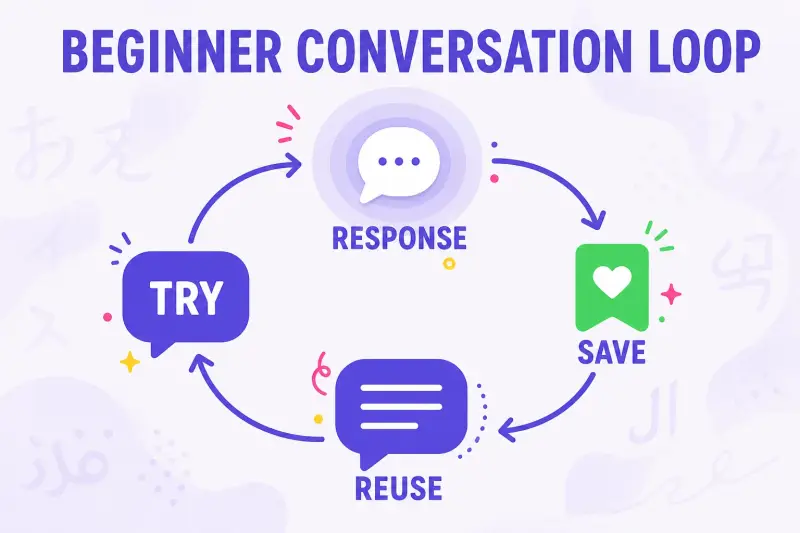
Talking only becomes learning when a specific loop runs, so before choosing tools it helps to see the loop itself. It has five steps: you attempt a sentence, you notice a gap, you receive a response, you save the useful piece, and you reuse it soon after.
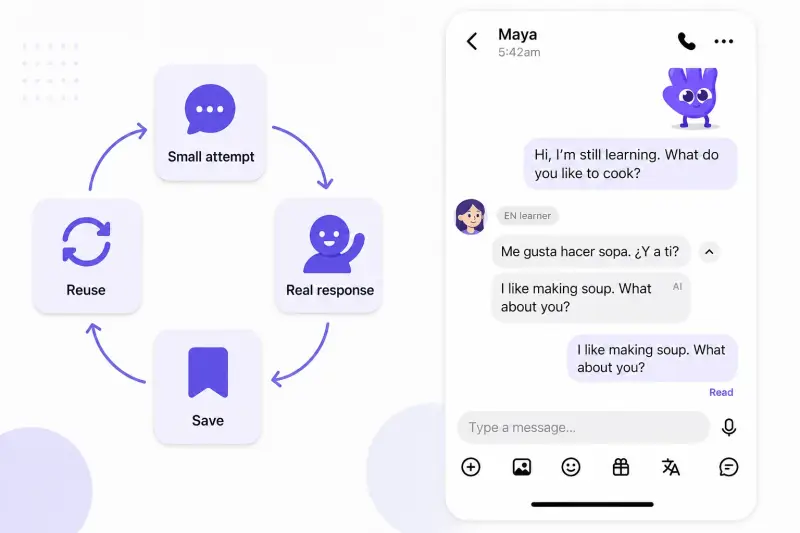
The learning value of a conversation lives in that loop, not in the length of the chat: attempt, notice the gap, get a response, save it, reuse it. Each step earns its place. The attempt forces you to reach for language you half-know.
The gap is the moment you feel the missing word or the doubtful ending. The response gives you material calibrated to that exact gap. Saving keeps it from evaporating. Reusing it in the next exchange creates another retrieval opportunity and may support retention.
The response step also raises a practical timing question. The evidence and tradeoffs behind whether faster feedback makes Spanish practice more efficient show why speed is only one part of the loop.
This is not a private theory. Since the early 1980s, interaction researchers such as Michael Long have argued that negotiating meaning through clarification requests and confirmation checks is one of the main ways conversation feeds language learning, and Merrill Swain's output work adds that trying to speak is what makes learners notice their gaps in the first place. These remain hypotheses about mechanisms rather than guarantees of results, but they describe exactly the loop above.
What prepared resources do well, and what only a person can do
Because the loop needs both preparation and response, the practical question is task division, not competition. The table below draws the boundary between prepared resources and responsive human resources. Read it by task: neither column replaces the other, and the point is to notice which tasks in the right column your current mix leaves uncovered.
| Task | Prepared resources (courses, lists, readers, drill apps) | Responsive human resources (partners, native speakers) |
|---|---|---|
| Introduce grammar in a sensible order | Strong, built for this | Weak, explanations vary in quality |
| Provide vocabulary with spaced review | Strong, systematic | Weak, exposure is unplanned |
| React to the sentence you just said | Not possible, content is fixed in advance | The core strength |
| Show how people naturally reword an idea | Limited to scripted examples | A natural byproduct of ordinary exchanges |
| Ask you an unplanned follow-up question | Not possible | Common in ordinary chats |
| Give you a reason to reuse a phrase today | Weak, exercises feel artificial | Strong, the conversation itself calls for it |
The table is a diagnosis tool, and the rest of this article walks the right-hand column. A Spanish-specific application appears in what a fast-start Spanish resource mix should include, where the responsive layer is placed beside lessons, review, input, and output practice.
The same division of labor changes when a new writing system is involved. How the full Japanese beginner resource stack fits together shows where responsive people sit alongside courses, flashcards, input, and output practice.
How to keep early conversations small enough to work
Scope control is the skill that makes all of this possible for a beginner, so it deserves its own rules. Keep three limits in place. First, one topic per exchange, chosen from things you can already half-say: greetings, your city, food, one hobby. Second, a fixed exit line you can use at any time, something like "Thank you, I am still learning, talk soon." Third, permission to be slow.
Text-based exchanges reduce time pressure, which is why they are a natural starting format. Japanese learners can see this principle adapted to a new script in micro-conversations before mastering the writing systems.
If a conversation stalls or breaks, that is material, not failure. Why repairing a misunderstanding is a learning event explains the mechanism, while what to do when you run out of Spanish mid-conversation provides language-specific recovery lines.
Once several exchanges have exposed different gaps, the next challenge is deciding which one deserves attention first. The method for letting real conversations decide what you study next turns those gaps into a manageable queue.
Where HelloTalk fits into the loop
A tool only matters here if it serves a step of the loop, so it is worth being concrete. HelloTalk's chat-based learning tools carry the attempt and response steps: translation, transliteration, and read-aloud sit inside the conversation, and the correction tool lets a partner mark up your sentence right where you wrote it, so the gap and the fix stay visible in one thread.
HelloTalk's Moments feed covers low-pressure attempts: you post a sentence publicly, and native speakers who pass by can respond or correct it on their own time, with no live turn-taking pressure. HelloTalk's Voicerooms and Livestreams handle the listening side of the loop, since you can enter a group audio room as a listener first and only speak when a small, manageable opening appears. The reason that voice variety matters is explored in why English fluency needs more than one familiar voice.
And HelloTalk's AI learning tools protect the save-and-reuse steps: AI grammar correction offers a suggested correction and explanation for an attempt before or after you send it, and AI pronunciation scoring returns a score and flags sounds to review before you try the phrase on a person. Most of HelloTalk's core features are available for free, and HelloTalk reports more than 1 billion messages exchanged daily across the platform, a figure that describes the scale of exchange activity on the HelloTalk platform, not anything about any individual learner's loop.
FAQ
How many words do I need before my first real exchange?
There is no fixed threshold, but a working minimum is one greeting, one self-introduction sentence, one question, and one exit line. With those four pieces a beginner can run a complete, polite micro-exchange and invite real responses from the first attempt.
Is text chat or voice better for a first conversation?
Text is an easier starting format for many beginners because it reduces time pressure, keeps a written record of every response, and lets you look things up mid-exchange. Voice becomes valuable once your text exchanges stop feeling stressful.
Does conversation replace courses and vocabulary study?
No. Conversation is a responsive layer that reacts to what you produce, while courses and vocabulary tools supply structure and coverage that random chats do not. The two do different jobs, and a sensible plan includes both.
What if nobody replies to me?
Treat replies as opportunities, not entitlements. No platform can guarantee that a specific person answers, so post in public spaces where many people can see your attempt, keep messages short and easy to respond to, and send several openers rather than one.
Isn't it rude to practice on native speakers?
A language exchange platform such as HelloTalk is designed around reciprocal exchange: helping others with your language while they help you with theirs is the platform's stated purpose, even though individual members join with their own motivations. Being upfront that you are a beginner, keeping early exchanges short, and offering help in your own native language keeps the trade fair.
How do I know the responses I get are correct?
Cross-check anything you plan to reuse. Compare a partner's phrasing against a dictionary or an AI grammar check, and watch whether multiple people phrase the idea the same way over time. Single responses are data points, not verdicts.
Real conversation is not the finish line of language learning. It is one of the resources you start with, and HelloTalk offers several ways to begin small, low-pressure exchanges.