
Language Learning Strategies That Actually Work
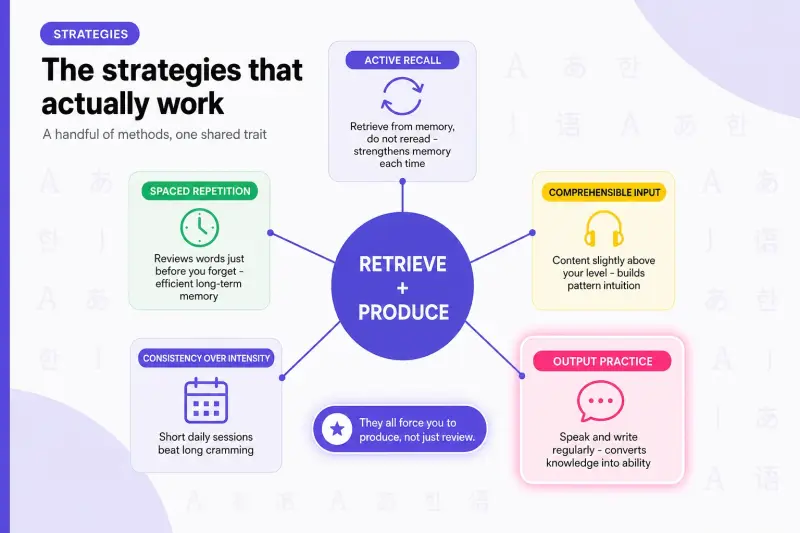
Search for language learning strategies and you drown in lists of thirty tips, most of which contradict each other. The useful truth is smaller. A handful of strategies produce most of the results in language learning, and they all share one trait: they force you to retrieve and produce the language, not just review it. Everything else is a variation on those few.

This guide covers the strategies that reliably work, what they have in common, and how to combine them into a routine. For deeper dives, we break down the two biggest debates in our input vs output guide and our immersion vs spaced repetition comparison.
The Principle Behind Every Working Strategy
The strategies that work all move you from recognizing the language to producing it, because production is where memory and fluency are actually built. Rereading notes feels productive and changes little. Recalling a word from memory, saying a sentence out loud, or writing without looking at the answer is what makes it stick. Keep that lens and the noise clears. Here are the strategies that pass it.
| Strategy | What it does | Why it works |
|---|---|---|
| Spaced repetition | Reviews words just before you forget | Efficient long-term memory |
| Active recall | Retrieve from memory, do not reread | Strengthens the memory each time |
| Comprehensible input | Consume content slightly above your level | Builds intuition for patterns |
| Output practice | Speak and write regularly | Converts knowledge into ability |
| Consistency over intensity | Short daily sessions | Beats occasional long cramming |
The Four Strategies Worth Your Time
Spaced repetition handles vocabulary efficiently, reviewing words right before you would forget them. Active recall means testing yourself instead of rereading, which is uncomfortable and exactly why it works. Comprehensible input means consuming content just above your level so you absorb patterns naturally. Output practice means speaking and writing early, because that is the strategy that turns a passive vocabulary into a spoken one. The first three are well served by apps and content. The fourth, output, is the one learners skip, and it is the one that determines whether you ever actually speak.
Turning Output Into a Daily Habit
Output needs a real person on the other end, or it quietly slides down your to-do list. This is where a language exchange platform makes the strategy practical. HelloTalk connects you with native speakers directly across a community of 70M+ registered users in 200+ countries and 260+ languages, so the output strategy has somewhere to happen every day. Its features line up with the working strategies: Chat-based learning builds in translation, transcription, and real-time grammar correction, so writing to a native speaker doubles as active recall with instant feedback. Moments lets you post short pieces of the language and get corrections from several native speakers, which is output plus crowd-sourced review. Voicerooms and Livestreams give you live audio rooms for comprehensible input you can join as a listener, then step into speaking when ready. AI learning tools score pronunciation and explain grammar corrections, adding recall practice when no partner is free. With 90% of core features free and over 1 billion messages daily, the output strategy costs nothing and always has a partner available.
How to Combine Them Into a Routine
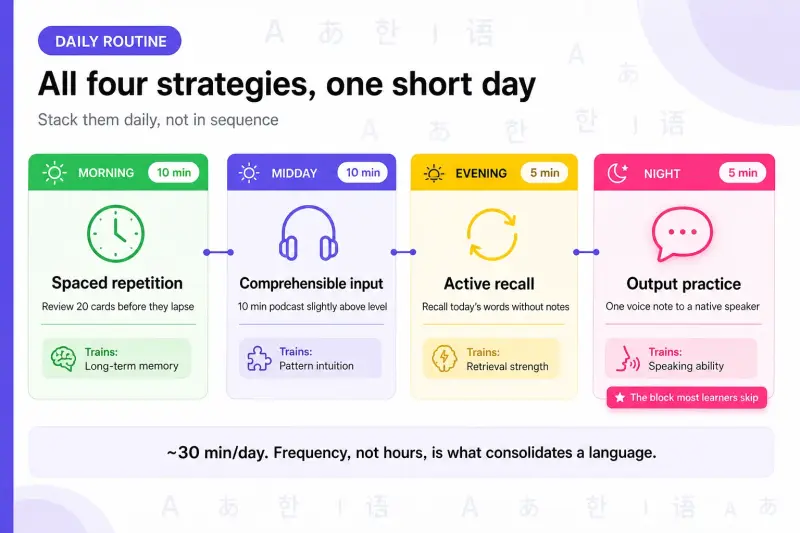
Do a little of each, daily. Ten minutes of spaced repetition for vocabulary, a short piece of input slightly above your level, and one real output session, a message, a voice note, or a short chat. Short daily sessions beat long weekly ones, because languages are consolidated by frequency, not by marathon study. Our strategy by goal guide shows how to weight these strategies depending on whether your goal is travel, work, or exams.
Common Mistakes
Rereading instead of recalling. It feels like studying and builds little memory. Consuming input far above your level. If you understand nothing, you absorb nothing. Skipping output. Recognition without production leaves you unable to speak. Cramming. One long session a week loses to short daily practice every time.
Frequently Asked Questions
What is the most effective language learning strategy?
The most effective single strategy is regular output, speaking and writing, paired with spaced repetition for vocabulary. Output converts what you know into what you can use, which is where most learners fall short.
Does spaced repetition really work?
Yes. Reviewing material just before you forget it is one of the most efficient ways to build long-term memory, which is why most vocabulary apps are built on it.
Is input or output more important?
Both matter, but they do different jobs. Input builds understanding, output builds the ability to speak. Learners usually get plenty of input and far too little output.
How long should I study a language each day?
Consistency beats length. Twenty to forty focused minutes daily, split across recall, input, and output, outperforms occasional multi-hour sessions.
Can I learn a language with apps alone?
Apps handle vocabulary, grammar, and input well, but they are weak at output. Add real speaking practice to cover the strategy apps miss.
What strategy helps most with speaking confidence?
Frequent, low-pressure output with native speakers. Short daily conversations build confidence faster than waiting until you feel ready, which never quite arrives.
Put the Strategies to Work
The strategies that work all share one trait: they make you produce the language, not just review it. Build a short daily routine around recall, input, and output, and results follow. The strategy to start today is output, so begin a short conversation with a native speaker on HelloTalk.