
Language Learning Strategy by Goal: Travel, Work, Exams, and Fluency
Most language advice assumes everyone wants the same thing, then wonders why the same plan fails different people. The real issue is simpler. The best language learning strategy depends entirely on your goal, because a traveler, an exam candidate, and someone chasing fluency need to spend their time on completely different things. Copy a plan built for a different goal and you work hard on the wrong skills.

This guide matches a strategy to each common goal. For the underlying principles behind all of them, see our language learning strategies that actually work.
Match the Strategy to the Goal
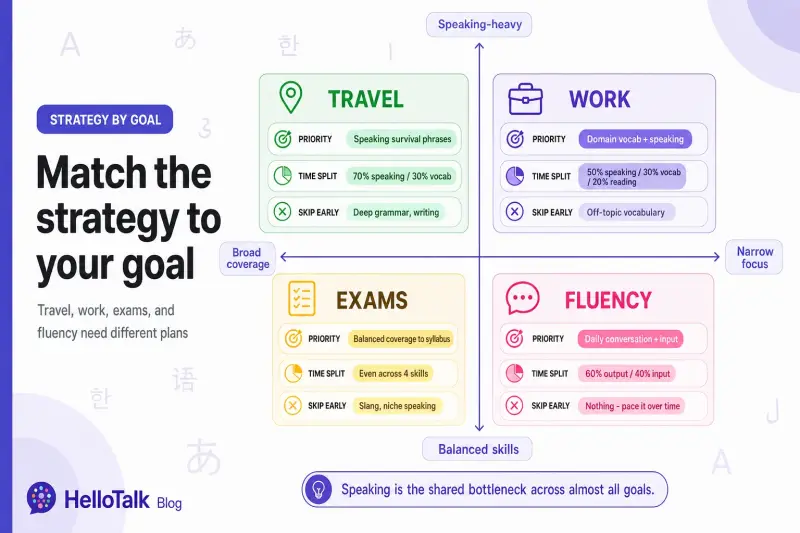
Study what your goal will actually test you on: travel rewards speaking survival phrases, exams reward structured coverage, and fluency rewards daily conversation, so the smartest move is to stop doing what your goal does not need. Here is how the priorities shift.
| Goal | Priority skill | Best time split | What to skip early |
|---|---|---|---|
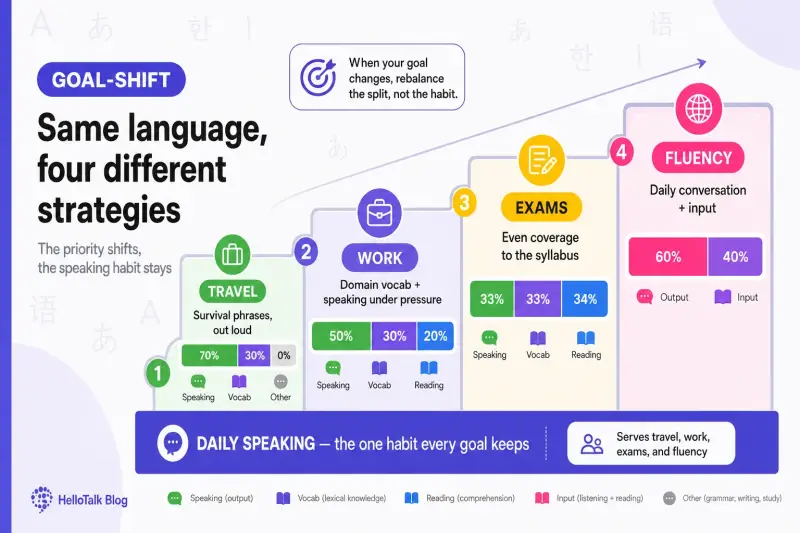
| Travel | Speaking survival phrases | 70% speaking, 30% vocabulary | Deep grammar, writing |
| Work | Domain vocabulary and speaking | 50% speaking, 30% vocab, 20% reading | Off-topic vocabulary |
| Exams | Balanced coverage to the syllabus | Even split across all four skills | Slang, niche speaking |
| Fluency | Daily conversation and input | 60% output, 40% input | Nothing, but pace it over time |
The Strategy for Each Goal
-
Travel: You have weeks, not years, so front-load the phrases you will actually say: greetings, ordering, directions, numbers, and asking for help. Drill them out loud until they are automatic. Grammar can wait.
-
Work: You need the vocabulary of your field plus the ability to speak it under mild pressure. General courses waste your time on topics you will never use. Learn your domain's words and rehearse them in realistic conversations. When you record those field terms, the decision of whether to store a word, a collocation or a whole sentence frame depends on which part of your phrasing keeps getting corrected at work.
-
Exams: You need even coverage matched to the syllabus, because the test decides the weighting, not you. Practice all four skills, including the ones you dislike, and use past papers to find gaps.
-
Fluency: This is the long game, and it rewards daily conversation above everything. For fluency, the single highest-value habit is talking with native speakers every day, because fluency is built by frequent real use, not by any amount of solo study.
The Skill Every Goal Undervalues: Speaking
Travel, work, and fluency all depend heavily on speaking, and even exam takers usually have a speaking section. Yet it is the skill learners practice least because it needs a partner. A language exchange platform solves that. HelloTalk connects you with native speakers across 70M+ registered users in 200+ countries and 260+ languages, so the speaking-heavy goals have a daily home:
-
Chat-based learning offers translation, transcription, and real-time grammar correction, so you can rehearse travel phrases or work vocabulary with a real person and get corrected instantly.
-
Moments lets you post and get corrections from several native speakers, useful for exam writing practice or trying new vocabulary.
-
Voicerooms and Livestreams give you live audio rooms to practice listening and speaking, which suits fluency and exam speaking prep.
-
AI learning tools score pronunciation and explain grammar, helping travelers and exam takers polish specific weak points. With over 1 billion messages daily and 90% of core features free, the speaking practice every goal needs is available and costs nothing.
Fluency is not one skill, and different methods cover different parts of it. We mapped which component of fluency each method actually covers.
How to Set Your Plan
Name your goal, pick its priority skill from the table, and cut the activities that goal does not reward, at least early on. Then protect a daily speaking slot, because it is the one habit that serves nearly every goal. Our input vs output guide and immersion vs spaced repetition guide help you tune the input side once your goal is set.
If you are running two languages at once, the same goal-first logic applies twice, and the guide to allocating study and conversation across two languages covers giving each one a use task without fixing a ratio between them.
Common Mistakes
-
Using a fluency plan for a travel trip. You run out of time on grammar you will not use.
-
Ignoring the exam syllabus. The test sets the weighting; study to it, not around it.
-
Learning general vocabulary for a work goal. Prioritize your field's words first.
-
Skipping speaking for every goal. It is the shared bottleneck across almost all of them.
Frequently Asked Questions
How should my language study change based on my goal?
Match your time to what the goal tests. Travel rewards speaking phrases, work rewards domain vocabulary, exams reward balanced syllabus coverage, and fluency rewards daily conversation.
What is the fastest way to learn a language for travel?
Front-load spoken survival phrases: greetings, ordering, directions, and asking for help. Drill them out loud and postpone deep grammar until after your trip.
How do I study a language for work?
Prioritize your field's vocabulary and rehearse speaking it in realistic conversations. Skip general topics you will not use on the job, at least at first.
What is the best strategy for a language exam?
Study evenly to the syllabus, practice all four skills including the ones you find hard, and use past papers to locate and close gaps.
What builds fluency fastest?
Daily conversation with native speakers. Fluency comes from frequent real use, so a short daily speaking habit outperforms long solo study sessions.
Does speaking practice help every goal?
Nearly all of them. Travel, work, and fluency lean on speaking directly, and most exams include a speaking section, so a daily speaking habit is rarely wasted.
Pick Your Goal, Then Your Plan
The right language strategy is the one that matches your goal and cuts what that goal does not need, with a daily speaking habit underneath almost all of them. Name your goal and build the plan around it. Then start the shared habit today by practicing with a native speaker on HelloTalk.