Italian Learning Apps Compared: Which One Fits Your Goal
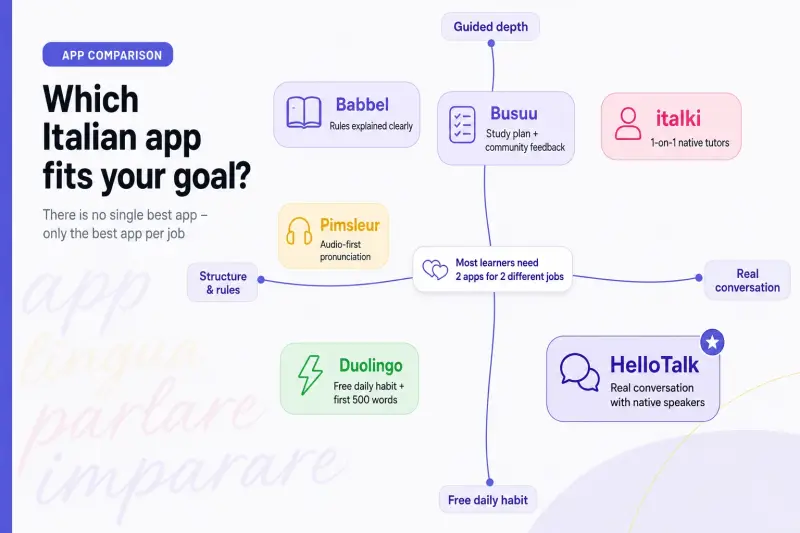
Ask ten people which app is best for learning Italian and you get ten answers, because they are quietly answering different questions. One wants a daily streak, one wants grammar explained, one wants to actually talk. There is no single best Italian app; there is only the best app for the specific job you need done, and most learners need two apps doing two different jobs.
This comparison sorts the main options by what they are genuinely good at, so you can stop app-hopping and build a routine that sticks. If you are brand new, our beginner roadmap for learning Italian online covers the order to tackle things first.
The Comparison at a Glance
The fastest way to choose is to match an app to one job, then add a second app for the job the first one is weak at. Here is how the common options line up.
| App | Core strength | Weak spot | Best for |
|---|---|---|---|
| Duolingo | Free daily habit, gentle onboarding | Thin grammar, little real speaking | Building a streak and first 500 words |
| Babbel | Clear grammar, structured lessons | Subscription, course-paced | Learners who want rules explained |
| Pimsleur | Audio-first pronunciation and recall | Slower vocabulary, less visual | Commuters and pronunciation focus |
| Busuu | Study plan plus community feedback | Best features behind paywall | Structured learners who want corrections |
| italki | One-on-one native tutors | Paid per lesson | Targeted help once you have basics |
| HelloTalk | Real conversation with native speakers | Pairs best with a study app, not a grammar course | Turning study into actual speaking |
Why App-Only Learning Stalls
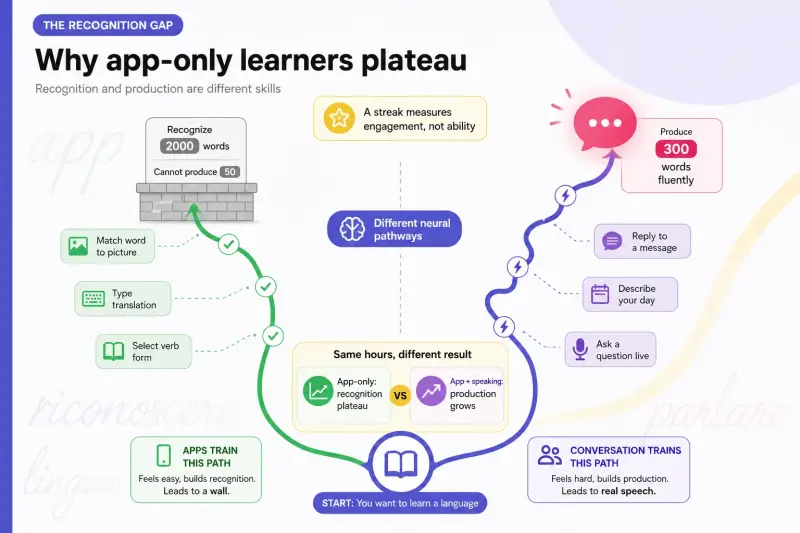
Vocabulary apps are good at input and recognition. The gap almost every Italian learner hits is output: recognizing a word in a quiz is not the same as recalling it mid-sentence with a real person waiting for your reply. That gap does not close by doing more quizzes. It closes by talking. This is where a language exchange platform earns its place next to your study app. HelloTalk connects you with native Italian speakers directly, and with 70M+ registered users across 200+ countries and 260+ languages, finding someone to practice with takes minutes rather than weeks. A few of its features map cleanly onto the weak spots of study apps:
- Chat-based learning puts built-in translation, transcription, and real-time grammar correction inside the conversation, so a beginner can message a native speaker without leaving the chat to look things up.
- Moments lets you post a short Italian sentence to the public feed and collect corrections from several native speakers at once.
- Voicerooms and Livestreams give you live Italian audio rooms you can join as a listener first, which trains your ear before you have to speak.
- AI learning tools score your pronunciation and point to the exact sound you missed, then explain grammar fixes in plain language. Because 90% of core features are free, the practice half of your routine costs nothing, which is why pairing a free chat platform with one study app is the setup we see work most often.
How to Choose in Under a Minute
Answer three questions. Do you want grammar explained, or just vocabulary drilled? Pick Babbel for the former, Duolingo for the latter. Do you learn better by ear? Add Pimsleur. Can you already build a simple sentence? Then your bottleneck is speaking, and a tutor on italki or free daily chats on HelloTalk will move you faster than any new flashcard deck. For a fuller look at going it alone, see our self-study Italian online roadmap. If you are weighing a structured course against conversation practice, our Italian courses versus language exchange breakdown covers the trade-off, and the broader guide to language exchange explains how real practice fits with self-study.
Common Mistakes When Choosing an App
- Downloading four apps and finishing none. One study app used daily beats three opened twice.
- Treating a streak as progress. A 200-day streak with no speaking still leaves you unable to talk.
- Waiting for the "right" app before starting to speak. The app matters less than starting real conversations early.
- Paying for premium before you know your bottleneck. Find where you are stuck first, then spend.
Frequently Asked Questions
What is the best app to learn Italian for free?
For free daily vocabulary, Duolingo is the common starting point. For free real conversation, a language exchange app like HelloTalk covers speaking practice, and most of its core features cost nothing. Pairing the two covers a beginner's needs without a subscription.
Is Duolingo enough to learn Italian?
Duolingo builds a vocabulary base and a daily habit, but it is light on real speaking and deeper grammar. Most learners who rely on it alone can read and recognize far more than they can say. Add speaking practice early to close that gap.
Which Italian app is best for grammar?
Babbel and Busuu give the clearest structured grammar explanations. For rules applied in real sentences, a tutor on italki can correct you in context, which tends to stick better than isolated exercises.
Do I need a paid app to learn Italian?
No. A free vocabulary app plus a free language exchange app covers the essentials. Paid courses and tutors speed things up and are worth it for targeted help, but they are optional to start.
How many Italian apps should I use at once?
Two is the sweet spot: one for daily vocabulary and grammar, one for real conversation. More than that usually means less consistency, not more progress.
When should I start speaking instead of just using apps?
Around week two, once you can introduce yourself and ask simple questions. Speaking early turns passive vocabulary into words you can actually use.
The Short Answer
Pick one study app for the job you need most, then add real conversation practice so your vocabulary turns into speech. The combination beats any single app. The easiest way to start the speaking half today is to find a native Italian speaker on HelloTalk and send one short message.
Apps are one category among several, and the rest of the field matters for a beginner. Our guide to the wider list of Italian resources beyond apps covers courses, YouTube channels, podcasts and graded television, each with what it stops doing for you.