Best Japanese Textbooks for Self-Study (2026)
A good textbook is still the clearest way to learn Japanese grammar in the right order, but most textbooks were written for a classroom with a teacher filling the gaps. When you self-study from a textbook, the book teaches you to read and understand Japanese, but it leaves the speaking half to you, and that gap is where self-learners get stuck. Choosing the right book and knowing what it will not do are equally important.

This guide compares the main self-study textbooks and shows how to cover what they miss. For the wider toolset, see our Japanese learning tools comparison, and for the specific app debate, our Genki vs WaniKani vs Duolingo guide.
No Japanese textbook teaches speaking; they teach the structure you then have to practice out loud with real people. Choose based on how you like structure explained, not on which promises the most.
| Textbook | Level | Teaching style | What it lacks |
|---|---|---|---|
| Genki I and II | Beginner to lower-intermediate | Balanced, exercise-rich, classroom-friendly | Speaking partner, real-world listening |
| Minna no Nihongo | Beginner to intermediate | Immersive, all-Japanese, needs the companion book | Standalone clarity for solo learners |
| Japanese from Zero | Absolute beginner | Gentle, gradual kana introduction | Depth for intermediate learners |
| Tae Kim's Guide | Beginner to intermediate | Free, grammar-logic focused | Exercises and structured practice |
| Tobira | Intermediate to advanced | Content-rich, bridges to fluency | Too hard for beginners |
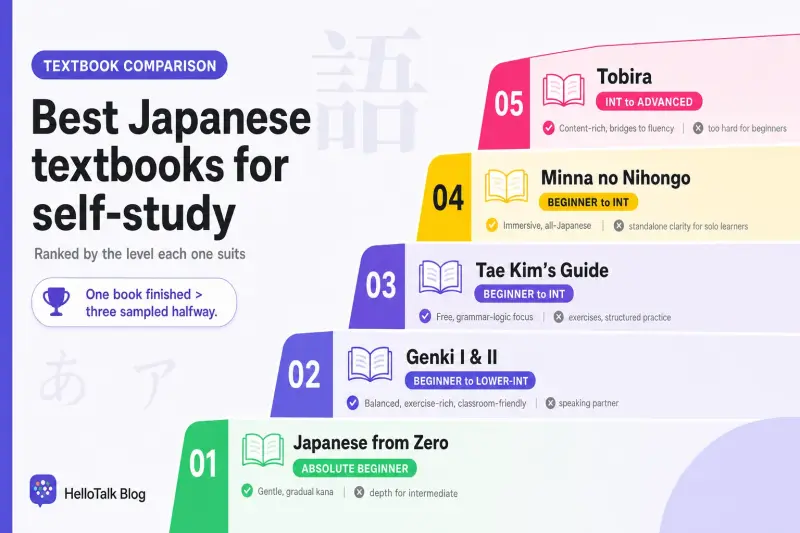
The comparison also makes clear where output practice has to come from.
If you want the most self-study-friendly option, Genki is the common recommendation because its exercises and clear layout work without a teacher. If you prefer a free, logic-first explanation of grammar, Tae Kim's Guide is excellent and pairs well with a workbook. Once you finish a beginner series, Tobira is the standard bridge to intermediate. The point is not to collect textbooks. One textbook finished cover to cover teaches you more than three sampled halfway. Pick one, commit, and produce sentences as you go rather than reading passively.
A textbook gives you grammar in order, but it cannot correct your pronunciation, react to what you say, or teach you the difference between how Japanese is written and how it is actually spoken. That requires a real person. HelloTalk fills this half by connecting you with native Japanese speakers directly. With 70M+ registered users, 200+ countries, and 260+ languages, and named the 2017 Google Play Best Social App with an iOS App Store Today feature in Japan, it gives a solo learner the conversation partner a textbook assumes you already have: Chat-based learning shows translation, transcription, and real-time grammar correction inside the chat, so you can take a sentence pattern straight from your textbook and try it on a real person. Moments lets you post a sentence for correction by several native speakers, turning textbook grammar into natural phrasing. Voicerooms and Livestreams give you live audio rooms to listen in on, which teaches the spoken rhythm textbooks leave out. AI learning tools score pronunciation and explain grammar fixes, useful when you have no teacher to ask. Because 90% of core features are free, adding this speaking layer to your textbook routine costs nothing.
Work one chapter at a time, do every exercise out loud, and then use each new grammar point in a real message or voice note within a day or two. That single habit, applying grammar to a live conversation while it is fresh, is what turns a textbook into spoken ability. Our perfect Japanese learning stack for beginners shows how to slot a textbook into a full weekly routine.
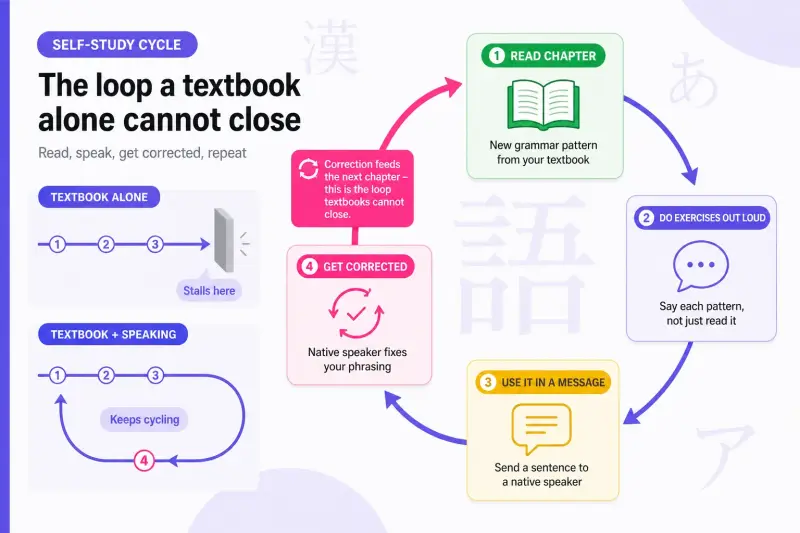
Sampling many textbooks. Finishing one beats dabbling in five. Reading exercises silently. Say them out loud; Japanese is a spoken language. Delaying speaking until the book is done. Apply each chapter to real conversation as you go. Ignoring listening. Pair the book with native audio so written and spoken Japanese connect.
Genki is the most common self-study pick because its clear layout and exercises work without a teacher. Tae Kim's Guide is a strong free alternative focused on grammar logic.
You can learn to read and understand grammar, but not to speak fluently. Textbooks leave out live pronunciation and conversation, so pair one with real speaking practice.
Genki is generally friendlier for solo study because its explanations are in English and self-contained. Minna no Nihongo is immersive but needs its companion grammar book to be clear.
For clear grammar progression, a textbook still helps. Apps and SRS handle habit, vocabulary, and kanji, while a textbook orders the grammar in a way most apps do not.
Take each new grammar point and use it in a message or voice note to a native speaker within a day. A language exchange app makes this practical without living in Japan.
At a steady chapter a week, a beginner book like Genki I takes a few months. Speed matters less than finishing it and speaking the material as you go.
The best Japanese textbook is the one you finish, used out loud, with the speaking half covered by real conversation. Choose one, commit to it, and apply each chapter to live practice. Start that practice today by finding a native Japanese speaker on HelloTalk.