
The Perfect Japanese Learning Stack for Beginners
Most Japanese guides hand you a pile of resources and wish you luck. The problem is not finding tools; it is knowing how they fit together and in what order to use them each week. A Japanese learning stack works when each tool covers one job and they run in parallel, not when you finish one resource before touching the next.

This guide assembles a complete beginner stack and turns it into a weekly routine. If you are still choosing individual pieces, our Japanese learning tools comparison and Genki vs WaniKani vs Duolingo guide cover the options in detail.
The Four-Layer Stack
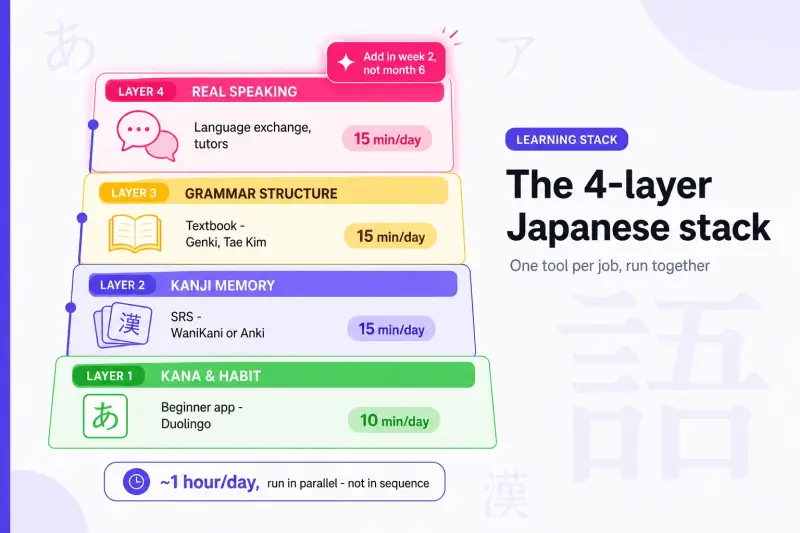
A beginner stack needs exactly four layers: kana and habit, kanji memory, grammar structure, and real speaking, and skipping any one of them creates the plateau most learners blame on the language. Here is the stack and the job each layer does.
| Layer | Tool type | Example | Daily time |
|---|---|---|---|
| 1. Kana and habit | Beginner app | Duolingo | 10 min |
| 2. Kanji memory | SRS | WaniKani or Anki | 15 min |
| 3. Grammar structure | Textbook | Genki, Tae Kim | 15 min |
| 4. Real speaking | Language exchange | HelloTalk, tutors | 15 min |
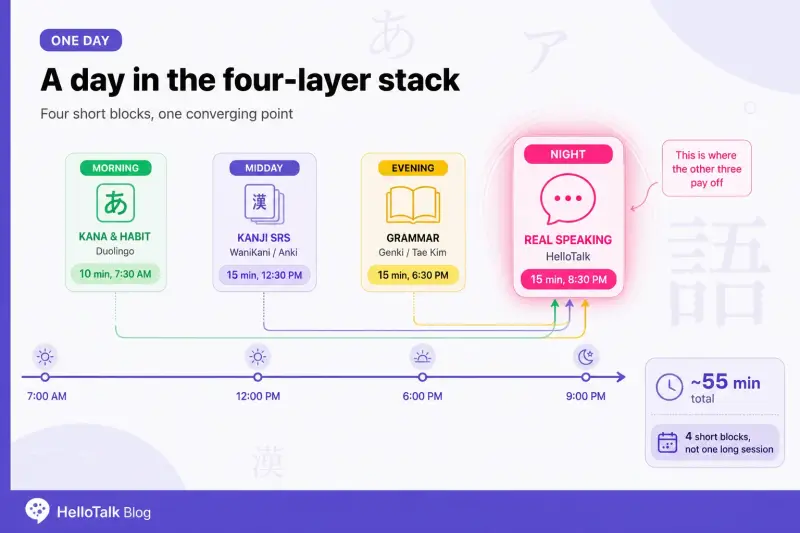
Four layers, about an hour total, split so no single part feels heavy. You can trim to 40 minutes on busy days by shortening layers one and three.
Why the Speaking Layer Cannot Wait
The instinct is to save speaking until you feel ready. Beginners who add the speaking layer in week two, not month six, build usable Japanese far faster, because speaking is what converts recognized kanji and studied grammar into recall. Waiting only makes the first conversation scarier, never easier. Japanese has spoken features the other three layers cannot teach: pitch accent, the shift between casual and polite registers, and how sentences get shortened in real speech. Only interaction with native speakers builds those. HelloTalk is the practical way to run this layer without living in Japan. It connects you with native Japanese speakers across 70M+ registered users in 200+ countries and 260+ languages, was the 2017 Google Play Best Social App, and holds an iOS App Store Today feature in Japan. The features that fit a beginner stack: Chat-based learning puts translation, transcription, and real-time grammar correction inside the chat, so you can message with kanji readings visible and practice above your level. Moments lets you post a sentence and get corrections from several native speakers, which upgrades textbook grammar to natural phrasing. Voicerooms and Livestreams give you live audio rooms to join as a listener first, training your ear for pitch and rhythm. AI learning tools score pronunciation and explain grammar fixes on demand, covering the hours no partner is online. With over 1 billion messages daily on the platform and 90% of core features free, the speaking layer is both active and free.
A Beginner's Weekly Routine
| Day | Layers to run | Speaking focus |
|---|---|---|
| Mon | Kana app, SRS, grammar | Send 2 short text messages |
| Tue | SRS, grammar | Post one sentence to Moments |
| Wed | Kana app, SRS | 5-minute voice message exchange |
| Thu | SRS, grammar | Join a listening-only voice room |
| Fri | Kana app, SRS, grammar | Send a voice note using this week's grammar |
| Sat | SRS, review | 10-minute conversation |
| Sun | Light review, rest | Optional Moments post |
The SRS runs daily because spaced repetition breaks if you skip. Everything else flexes around your week.
How the Layers Reinforce Each Other
Grammar from your textbook gives you sentence patterns, the SRS supplies the kanji and vocabulary to fill them, the kana app keeps the base sharp, and speaking forces you to retrieve all of it under real conditions. For choosing the grammar layer, see our best Japanese textbooks for self-study, and for the wider beginner picture, our effective online resources for Japanese beginners guide.
Most beginner stacks survive the first fortnight and then stall. We wrote up the three failure points that hit in week three.
Common Mistakes
Running layers in sequence. Finish nothing before speaking and the earlier layers fade. Dropping the SRS on busy days. The backlog compounds fast; keep it daily even if short. Over-studying grammar. One chapter used out loud beats three read silently. Postponing speaking. It is the layer that makes the other three pay off.
Frequently Asked Questions
What is the best way for a beginner to learn Japanese?
Build a four-layer stack: a kana app, an SRS for kanji, a textbook for grammar, and real speaking practice. Run them in parallel and add speaking by week two.
How much time does a Japanese learning stack take daily?
About an hour split across four short sessions, and as little as 40 minutes on busy days. Consistency matters more than long sessions.
Do I really need four tools to learn Japanese?
Japanese has four distinct jobs: kana, kanji, grammar, and speaking. One tool rarely covers more than one well, so a small stack beats a single app.
When should a beginner start speaking Japanese?
By week two, once you have basic kana and a few phrases. Early speaking turns recognition into recall and keeps the first conversation from getting scarier.
Can I build this stack for free?
Mostly. Duolingo, Anki, Tae Kim's Guide, and a language exchange app are free. An SRS like WaniKani and tutors are paid but optional.
How do I keep the stack from feeling overwhelming?
Assign one tool per job, keep sessions short, and run the SRS daily while flexing the rest around your week. Overwhelm comes from too many tools, not too much Japanese.
Build Your Stack This Week
The perfect Japanese stack for a beginner is four layers run in parallel, with speaking added early so everything else pays off. Set up your four tools and start the routine this week. The layer to begin today is speaking, so find a native Japanese speaker on HelloTalk and send your first message.