
Genki vs WaniKani vs Duolingo for Japanese: Which Does What
This is one of the most searched matchups in Japanese learning, and the honest answer surprises people. Genki, WaniKani, and Duolingo are not three options to choose between; they are three tools for three different jobs, and the strongest beginners use all three plus one thing none of them provide. Framing it as a winner-take-all pick is the mistake.
Here is what each one is genuinely for, where each falls short, and how they fit together. For the wider set of options, see our Japanese learning tools comparison.
Duolingo builds your first habit and kana, WaniKani drills kanji into long-term memory, and Genki gives you the grammar backbone; the piece all three miss is real speaking. Read that again before you pick, because it settles most of the debate.
| Tool | Job it does | Where it wins | Where it fails |
|---|---|---|---|
| Duolingo | Kana and daily habit | Free, gentle, hard to quit | Thin grammar, weak on kanji and speaking |
| WaniKani | Kanji and vocabulary via SRS | Structured radicals-to-kanji path | Paid, punishing if you skip days, kanji only |
| Genki | Grammar and structure | Clear beginner-to-intermediate progression | Passive if you only read, no speaking partner |
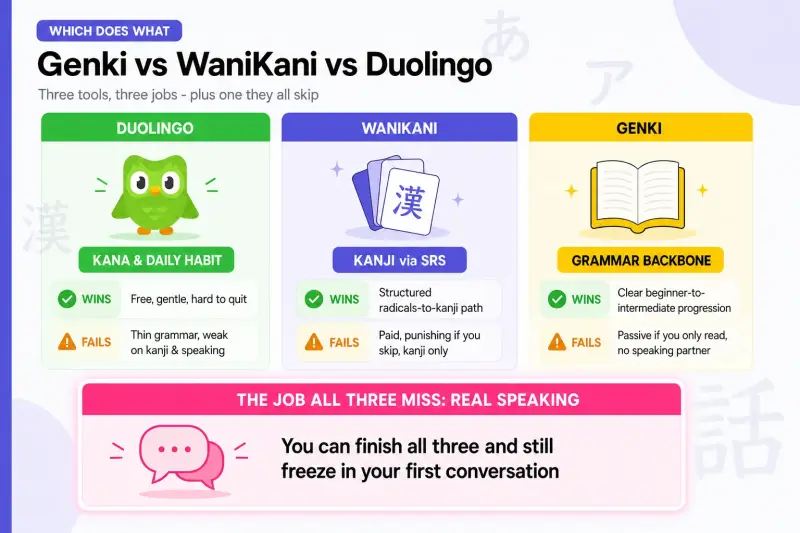
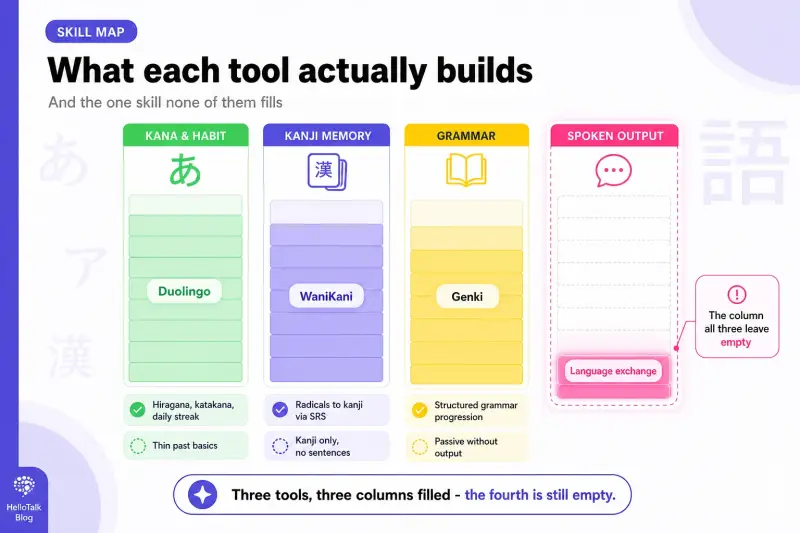
Start with Duolingo if you have not learned hiragana and katakana yet; it makes the first two weeks painless and builds the daily habit everything else depends on. Move WaniKani in once kana feels comfortable, because it turns the intimidating wall of kanji into a paced, radical-based climb. Add Genki as your grammar spine when you want to build real sentences, working through it chapter by chapter rather than sampling. The trap is thinking that finishing all three means you can speak. You can complete Duolingo's Japanese tree, hit WaniKani level 30, and read all of Genki, and still freeze in your first conversation, because none of these three tools trains output with a real person.
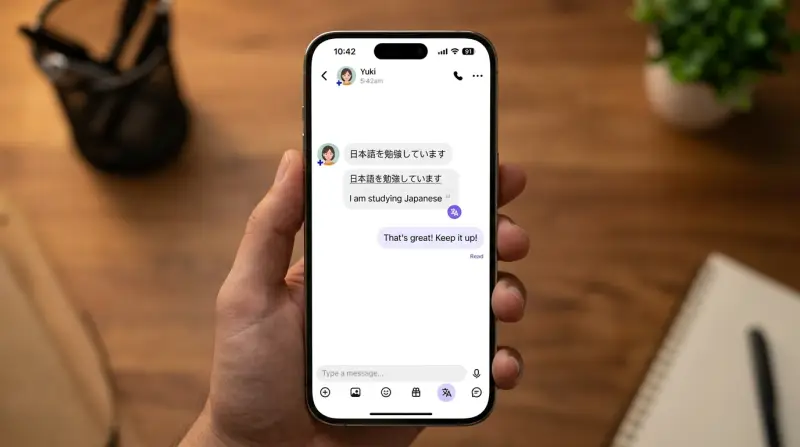
Speaking is a separate skill that only real interaction builds. Japanese makes this especially clear: pitch accent, the switch between casual and polite registers, and how native speakers actually shorten sentences are things a flashcard or textbook cannot teach you to produce. HelloTalk covers this missing job by connecting you with native Japanese speakers directly. With 70M+ registered users across 200+ countries, and named the 2017 Google Play Best Social App with an iOS App Store Today feature in Japan, it has a large, active Japanese community. The features that matter for a learner leaving Genki and WaniKani behind: Chat-based learning shows translation, transcription, and real-time grammar correction inside the chat, so you can message with kanji readings visible and learn from every fix. Moments lets you post a sentence for correction by several native speakers, which reveals the natural phrasing a textbook smooths over. Voicerooms and Livestreams give you live audio rooms to join as a listener first, training your ear for pitch before you speak. AI learning tools score pronunciation and explain grammar corrections on demand. Because 90% of core features are free, adding the speaking job to a Genki-and-WaniKani routine costs nothing.
Run them in layers, not in sequence. Duolingo and WaniKani daily for kana and kanji, Genki two or three times a week for grammar, and native-speaker chats from week two so the grammar and kanji become usable. Our Japanese learning stack for beginners lays this out as a weekly plan, and our best Japanese textbooks guide covers alternatives to Genki.
Picking one and ignoring the others' jobs. They do not overlap enough to replace each other. Letting WaniKani reviews pile up. The SRS only works if you review daily. Reading Genki without producing sentences. Grammar you never speak stays passive. Skipping speaking entirely. The three tools set you up to talk, so actually talk.
They do different jobs. Genki teaches grammar structure clearly, while Duolingo builds kana and a daily habit. For grammar depth Genki wins, but most beginners benefit from using both.
Yes, if kanji is your goal. Duolingo is light on kanji, while WaniKani is built specifically to drill it into long-term memory through spaced repetition. They complement each other.
Duolingo covers kana and vocabulary but is thin on kanji, grammar depth, and speaking. Most learners who rely on it alone can recognize far more than they can say.
No. All three build knowledge and recognition, not spoken output. For speaking you need real conversation practice, such as a language exchange app with native speakers.
Duolingo first for kana, WaniKani once kana is comfortable, Genki as your grammar spine, and speaking practice added by week two so it all becomes usable.
With a daily stack plus speaking from week two, many learners manage simple conversations within a few months. Skipping speaking pushes that milestone much further out.
Together, their roles become clearer when you look at how the three writing systems divide the work.
Genki, WaniKani, and Duolingo each do one job well, and together they build a strong base, but the base only pays off when you start speaking with real people. Add that layer early. The simplest first step is to find a native Japanese speaker on HelloTalk and send one short message today.