AI Conversation vs Real Human Practice Which Actually Improves Your Language Faster

You sit down to practice Spanish. You can open an AI chatbot that answers instantly at 2am, never judges your terrible accent, and lets you repeat the same sentence twelve times. Or you can message a real person in Madrid who might take an hour to reply, correct you in ways that sting a little, and use slang no textbook ever taught you. Which one actually moves your speaking forward faster?
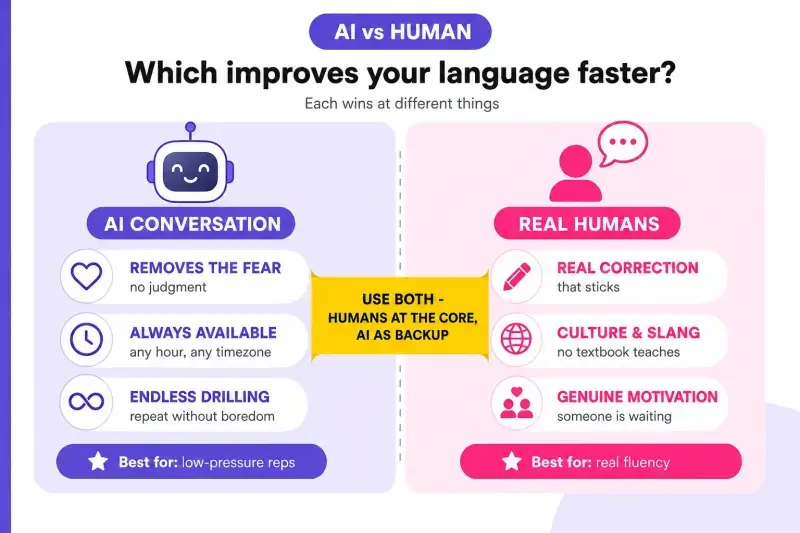
For raw repetition, low pressure, and round-the-clock availability, AI conversation wins. For real fluency, cultural accuracy, natural rhythm, and the motivation to keep going, practice with real humans wins, and the research-backed move is to use both: humans as your core, AI as the backup for the hours nobody is online. This is not an either-or fight, and treating it like one is why a lot of learners stall. If you want the bigger picture of how regular practice compounds, start with our guide to premium app features that help you practice more often.
Where AI conversation genuinely helps
Let's be fair to AI, because it does real things well.
It removes the fear. Speaking anxiety is one of the most documented reasons adults quit a language. A bot has no opinion of you. You can mangle a verb conjugation forty times in a row and the only witness is a piece of software. For shy learners, that psychological safety is the difference between practicing and avoiding practice entirely.
It is available at any hour. Real people sleep, work, and live in other time zones. AI does not. If your only free window is midnight on a Tuesday, an AI conversation partner is there. That availability matters more than people admit, because the best practice schedule is the one you actually keep.
It lets you drill. Want to repeat the past subjunctive until it stops feeling foreign? A human partner gets bored. AI does not. Tools like AI pronunciation scoring can flag the exact sound you keep missing, the rolled r or the nasal vowel, and let you attempt it again and again with instant feedback. For mechanical accuracy and isolated skill drilling, this is genuinely useful.
So AI is a strong low-stakes practice room. The trouble starts when learners mistake the practice room for the real game.
Where real humans are irreplaceable
Here is the honest gap, and it is wider than the marketing around AI usually admits.
Real context. Language lives inside situations: a tense negotiation, a flirt, a joke that lands or dies, a grandmother explaining a recipe. A real conversation carries stakes, timing, and unpredictability that a model cannot fully fake. You learn what to say when the other person frowns, interrupts, or misunderstands you.
Cultural correction. A native speaker will tell you that the phrase you learned is technically correct but sounds like a 1950s textbook, or that it is rude in their region, or that nobody says it that way anymore. AI often defaults to a flattened, average register and rarely flags these social missteps reliably. This is exactly the kind of correction that comes from real people, which is why social feedback increases how much you practice and how fast you improve.
Natural spoken rhythm. Real speech is full of fillers, false starts, slang, and regional accents. Talking with actual humans trains your ear for the messy version of the language you will meet in real life, not the clean studio version.
Emotional accountability. This one is underrated. When a real person is waiting for your reply, you show up. A friendship, a mutual exchange, a person who genuinely wants to hear from you: that creates a kind of motivation no notification can match. AI cannot be disappointed in you, and that is precisely why it is easier to ghost.
AI vs real human practice, head to head
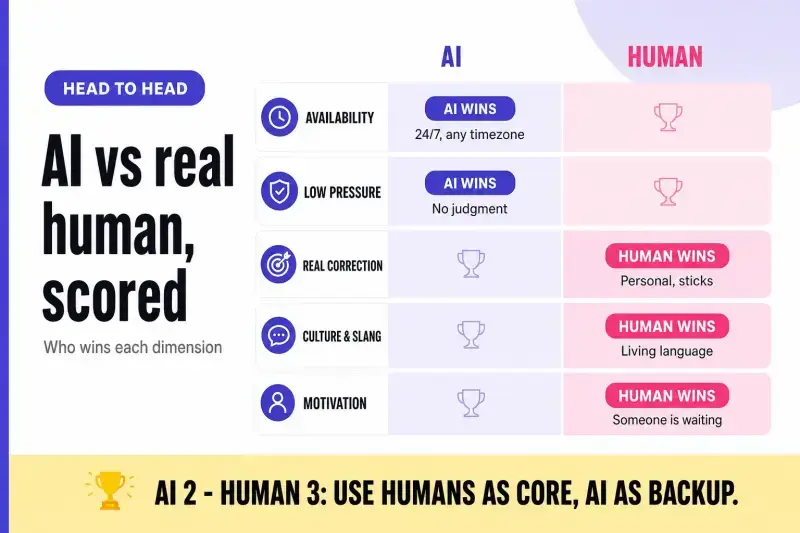
Here is a direct comparison across the dimensions that actually decide how fast you improve.
| Dimension | AI conversation | Real human practice |
|---|---|---|
| Feedback quality | Fast and consistent on grammar and pronunciation mechanics; weak on nuance and register | Slower but catches tone, slang, regional usage, and social appropriateness |
| Availability | 24/7, instant, no scheduling | Depends on time zones and the other person's life |
| Cost | Often bundled free or low-cost inside an app | Tutors are paid by the hour; language-exchange partners are free |
| Teaches cultural context | Limited; tends toward a flattened, average register | Strong; native speakers correct what is technically right but socially off |
| Natural spoken rhythm | Clean and predictable, not how people really talk | Authentic fillers, accents, slang, and unpredictability |
| Motivation and persistence | Easy to ghost; no emotional stake | Real relationships and mutual exchange keep you coming back |
| Best used for | Low-pressure drilling, off-hours backup | Core fluency, real-world readiness |
Notice the pattern: AI scores on speed, access, and comfort. Humans score on everything tied to actually sounding fluent and not quitting. The fastest learners do not pick one column. They use both.
How HelloTalk gives you both, with humans at the core
This is the part most apps get backwards. They lead with a chatbot and bolt on real people as an afterthought. HelloTalk does the opposite: real native speakers are the core, and AI is the backup for the hours when nobody is online.
With over 70M+ registered users across 200+ countries speaking 260+ languages, you message real native speakers directly through Chat-based learning, with built-in translation, transcription, read-aloud, and real-time grammar correction so a conversation never stalls just because you got stuck on a word. Post a short text or voice clip to Moments and multiple native speakers can correct you at once, which is social feedback at scale. Drop into Voicerooms or Livestreams, where you can listen first as audience and speak when you are ready, easing into real spoken rhythm without the cold-open panic.
Then there are the AI learning tools, positioned exactly where they belong: as backup. AI pronunciation scoring points to the specific sounds you are getting wrong, and AI grammar correction explains your mistakes in real time. Use them at midnight when your exchange partner in Seoul is asleep, then take what you drilled back to a real conversation the next day.
Crucially, the core social feedback is not locked behind a paywall. About 90% of HelloTalk's core features are free, with optional VIP unlocks like unlimited translation, multi-language learning, and an ad-free experience. The platform processes 1 billion+ messages exchanged daily and earned both the 2017 Google Play Best Social App award and a 2024 global Google Play homepage feature. If you want to know which paid extras actually earn their keep, see our breakdown of features worth paying for.
How to choose, day to day
You do not choose once. You choose per session, based on what you need.
-
Use AI when you want to drill a sound or structure, you feel too nervous to talk to a person yet, or it is the middle of the night and you just need reps.
-
Use a real person when you want to sound natural, learn slang and cultural rules, prepare for a real situation like travel or work, or you need the accountability of someone expecting you.
-
The common mistake: treating AI as the destination. It is excellent scaffolding and a terrible replacement. If your only practice partner has been a chatbot for three months, your grammar may be tidy while your real conversations still freeze.
-
The other mistake: refusing AI entirely out of purism. Skipping the off-hours drilling just means fewer reps. Fewer reps means slower progress.
FAQ
Can AI conversation replace talking to native speakers?
No. AI is excellent for low-pressure drilling and off-hours practice, but it cannot reliably teach cultural register, regional slang, or the unpredictable rhythm of real speech. Native speakers remain essential for genuine fluency.
Which improves my speaking faster, AI or real people?
For mechanical accuracy and sheer repetition, AI is faster and more available. For fluency that holds up in real conversations, real humans are faster because they correct nuance and keep you motivated. Combining them beats either alone.
Is AI language practice worth it at all?
Yes, as a supplement. It is great for building confidence before you talk to a person, for drilling pronunciation, and for practicing when no human partner is awake. Just don't let it become your only practice.
Why is motivation higher with human practice?
Because a real person creates emotional accountability. When someone is waiting for your reply or expects you in a Voiceroom, you show up. AI carries no social stake, which makes it easy to abandon.
Does HelloTalk use AI or real humans?
Both, with humans as the core. You practice with real native speakers through chat, Moments, and Voicerooms, and AI pronunciation scoring and grammar correction serve as backup when no one is online.
How much does it cost to practice with both?
On HelloTalk, the core social feedback and the AI tools sit inside an app where about 90% of core features are free. Hiring a private tutor separately means paying by the hour, while language-exchange partners cost nothing.
Start practicing with real people, backed by AI
If you only remember one thing: AI is your practice room, real humans are the real game, and the smartest learners use both. Drill with AI when nobody is online, then take it to a real native speaker the moment one is. HelloTalk is built exactly that way, with millions of real speakers at the center and AI ready as backup.
Try HelloTalk