Is a Language App Subscription Worth It in 2026

Before you tap "subscribe" on yet another language app, it helps to know exactly what your money buys. The pricing world splits into three very different shapes: monthly subscriptions, one-time lifetime deals, and pay-per-lesson tutoring. Each one solves a different problem, and each one quietly assumes something about how you study.
A language app subscription is worth it in 2026 only when the paid tier removes a real friction in your routine: locked review tools, ad interruptions, or access to a live human. If the feature you actually need is correction and conversation, much of that is available for free, so paying first and learning second is the most common mistake. That single idea reframes the whole "subscription vs lifetime vs pay-per-hour" question, and it pairs closely with the broader breakdown in our guide to premium language app features that help you practice more often.
Let's go model by model, then look at where a free social layer changes the math entirely.
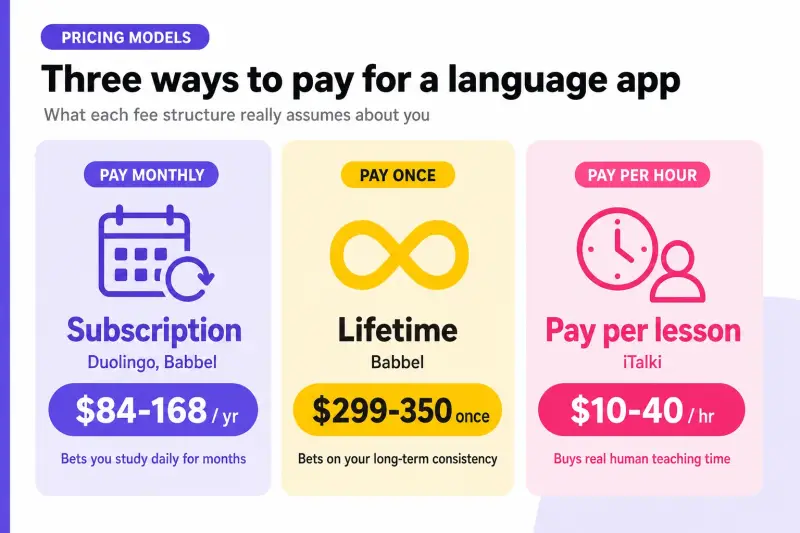
Infographic comparing subscription, lifetime, and pay-per-lesson language app pricing models
The three pricing models, and what each one is really selling
Pricing is not just a number. The structure tells you what kind of learner the product was built for.
Subscription (Duolingo, Babbel). You pay monthly or yearly for ongoing access to a course library and a set of premium tools. The bet is that you study a little every day for months. Duolingo's Super plan runs about $84 per year, while its AI-heavy Max tier sits around $168 per year (roughly $29.99 if you buy month to month). The free version stays usable but adds hearts and lives that pause you when you make mistakes. Babbel takes a similar subscription path at about $8.95 per month on a 12-month plan, around $107 for the year, with retail monthly pricing closer to $15 to $18 if you avoid the annual commitment.
Lifetime (Babbel). One payment, permanent access. Babbel's lifetime deal typically lands between $299 and $350. The appeal is obvious: no recurring charge, and if you study for three years it costs less than three annual renewals. The risk is equally obvious. You are betting on your own consistency years out, and most people overestimate how long they will keep a streak.
Pay-per-lesson (iTalki). No subscription at all. You buy time with a real teacher. Community Tutors on iTalki charge roughly $10 to $20 an hour, while Professional Tutors run about $20 to $40 an hour. The platform takes a commission per lesson (around 21% on a single booking, with gentler rates on lesson packages). You pay for human attention, which no algorithm fully replaces.
Side-by-side: what your fee actually buys
Here is the part most "best language app" lists skip. Not the price, but what the price unlocks and who that suits.
| Product | Pricing model | Price (2026) | What the fee buys | Best fit for |
|---|---|---|---|---|
| Duolingo | Subscription | Super ~$84/yr; Max ~$168/yr (~$29.99/mo) | No hearts limit, offline lessons, AI Max features; gamified solo drills | Beginners who want daily habit-building and don't mind solo practice |
| Babbel | Subscription or lifetime | ~$8.95/mo on 12-mo plan (~$107/yr); lifetime $299-350 | Structured grammar-led courses, review manager, full unit access | Adults who like a syllabus and plan to study one language seriously |
| iTalki | Pay-per-lesson | Community Tutor $10-20/hr; Pro Tutor $20-40/hr (~21% platform fee) | Live one-on-one time with a real teacher, custom feedback | Intermediate+ learners ready to speak and want personal correction |
| HelloTalk | Free core + optional VIP | Core social features free; VIP roughly $5-10/mo | Optional extras (unlimited translation, multi-language, ad-free); core feedback stays free | Anyone who wants real native-speaker correction without a paywall first |
The pattern is clear. Duolingo and Babbel sell structure and convenience. iTalki sells a human. The thing none of those three give you for free is the messy, daily, low-stakes practice of talking to real people. That is the gap worth examining.
Where HelloTalk changes the calculation
HelloTalk approaches the question from the opposite end. Instead of locking practice behind a tier, about 90% of its core features are free, and the part most apps charge for, native-speaker feedback, is not behind a paywall at all.
That matters because feedback is the engine of progress. On HelloTalk you can message native speakers directly through chat-based learning, with translation, transcription, read-aloud, and real-time grammar correction built into the conversation. Post a short text or voice clip to Moments and several native speakers can correct the same sentence at once, free. Drop into Voicerooms to listen first and speak when you're ready, or join a livestream lesson. When nobody's online, AI pronunciation scoring and grammar correction act as a backup, not a replacement for real people. We dig deeper into why that human layer drives consistency in our piece on how social feedback increases language practice.
The scale is what makes free feedback realistic rather than a slogan: over 70M+ registered users across 200+ countries speaking 260+ languages, with 1 billion+ messages exchanged daily. A two-time Google Play honoree (Best Social App in 2017, a global homepage feature in 2024), HelloTalk reserves VIP, roughly $5 to $10 per month with annual pricing lower, for conveniences like unlimited translation, multi-language study, and removing ads. The core social loop costs nothing.
How to choose without overpaying
A few rules of thumb that save money and frustration:
-
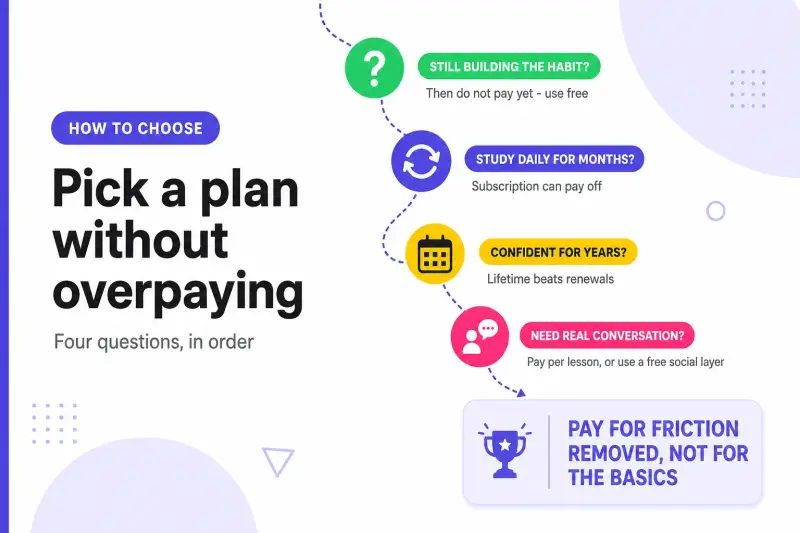
Don't pay before you've practiced. Spend two weeks in a free tier first. If you stop opening the app, no subscription would have saved you.
-
Match the model to your level. Pure beginners get more from structured subscription apps. Intermediate learners who can already form sentences get far more from live conversation.
-
Be honest about lifetime deals. A $300 lifetime plan only beats annual pricing if you're genuinely studying three-plus years from now.
-
Don't pay for feedback you can get free. Native-speaker correction is the single most valuable input, and it isn't always something you have to buy.
-
Separate "want" from "friction." Pay to remove a real blocker (ads, hearts, no human), not for a feature you simply find appealing in the moment.
Decision-flow infographic with four questions for choosing a language app plan without overpaying
For a closer look at which paid upgrades genuinely move the needle, see our breakdown of language app features worth paying for.
FAQ
Is a language app subscription worth it in 2026?
It's worth it when the paid tier removes a friction you actually hit, such as ad interruptions, daily limits, or lack of a real conversation partner. If your main need is feedback and speaking practice, you can get a lot of that free, so test before you commit.
Which is cheaper over time, Babbel subscription or lifetime?
Babbel's 12-month plan costs around $107 per year, while lifetime runs $299 to $350. Lifetime wins only if you keep studying past roughly three years. Most learners overestimate their long-term consistency, so the annual plan is the safer bet for newcomers.
Is iTalki worth the per-lesson cost?
For intermediate learners who can already build sentences, yes. Community Tutors at $10 to $20 an hour give you real correction and speaking time that solo apps can't. Beginners may want to build basic vocabulary first before spending on live lessons.
Can I learn a language without paying for any subscription?
Yes. Free tiers handle vocabulary and grammar drills, and apps like HelloTalk keep native-speaker feedback and conversation free, with about 90% of core features available at no cost. Paid plans then become optional conveniences rather than requirements.
What does HelloTalk's VIP actually unlock?
VIP, roughly $5 to $10 per month with lower annual pricing, adds conveniences like unlimited translation, multi-language study, and an ad-free experience. The core social loop, including chatting with native speakers and getting corrections in Moments, stays free.
Should beginners use Duolingo or a tutor on iTalki?
Beginners usually get more early momentum from a structured app like Duolingo, which builds a daily habit and basic vocabulary. Once you can hold a simple conversation, shifting some budget toward live tutoring or free native-speaker chat pays off faster.
The bottom line
Subscriptions, lifetime deals, and pay-per-lesson all make sense for specific people. The honest answer to "is it worth it" is: only after you know what friction you're paying to remove. Start with the free practice you can actually sustain, add native-speaker feedback at no cost, and pay for upgrades once you know they fit your routine.
Want to test that approach before spending a cent? Try HelloTalk and start talking with native speakers today.