Japanese Learning Tools Compared: Apps, Textbooks, and SRS
Learning Japanese means juggling more moving parts than most languages: two syllabaries, thousands of kanji, and a grammar that reorders the sentence. The reason beginners feel overwhelmed is not that Japanese is impossibly hard; it is that they try to make one tool do a job that actually needs four. No single app teaches kana, kanji, grammar, and speaking well.

This guide compares the main categories of Japanese learning tools by the job they do, so you can assemble a stack instead of hopping between apps. For the specific three-app kanji debate, see our Genki vs WaniKani vs Duolingo comparison. For a broader beginner starting point, our effective online resources for Japanese beginners guide covers the ground first.
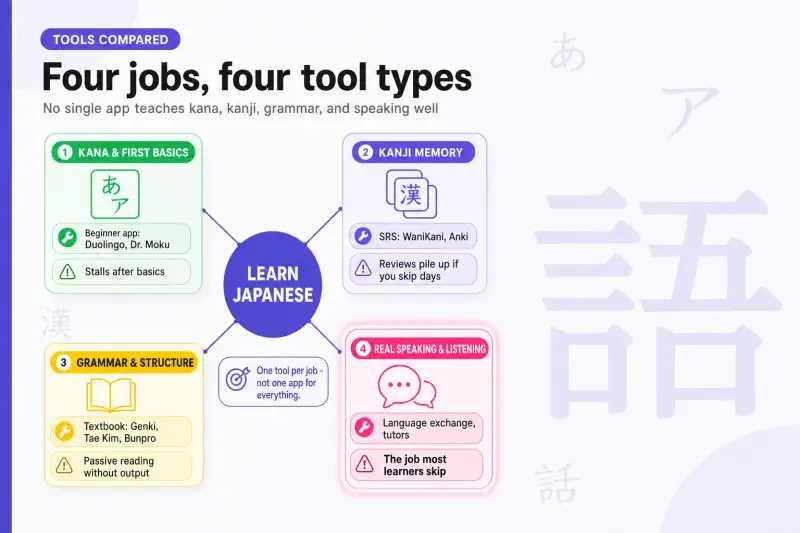
A working Japanese setup covers four separate jobs: kana and basics, kanji memory, grammar structure, and real speaking, and the best tool for each is rarely the same one.
| Job | Best tool type | Common picks | Watch out for |
|---|---|---|---|
| Kana and first basics | Beginner app | Duolingo, Dr. Moku | Stalls after the basics |
| Kanji memory | Spaced repetition (SRS) | WaniKani, Anki | Reviews pile up if you skip days |
| Grammar and structure | Textbook or course | Genki, Tae Kim, Bunpro | Passive reading without output |
| Real speaking and listening | Language exchange | HelloTalk, tutors | Needs a base first |
Most learners already own tools for the first three jobs and completely skip the fourth, which is why they can read more than they can say.
This division makes more sense once you see why Japanese resources split this way.
A beginner app is good for kana and momentum, but it flattens out once real grammar starts. An SRS like WaniKani or Anki is the most efficient way to hold kanji in memory, but it rewards daily consistency and punishes gaps. A textbook such as Genki gives you the clearest grammar progression, but reading grammar is not the same as producing it. The tool almost everyone under-invests in is the speaking one, and it is the only tool that turns recognition into recall. You can recognize a kanji and still be unable to say the sentence it belongs to.
Japanese has features that only real interaction teaches: pitch accent, the natural rhythm of casual versus polite speech, and how sentences actually get shortened in conversation. A textbook cannot give you that. Native speakers can. HelloTalk is built for this layer, connecting you with native Japanese speakers across a community of 70M+ registered users in 200+ countries and 260+ languages. Its features map onto the parts of Japanese that textbooks struggle with:
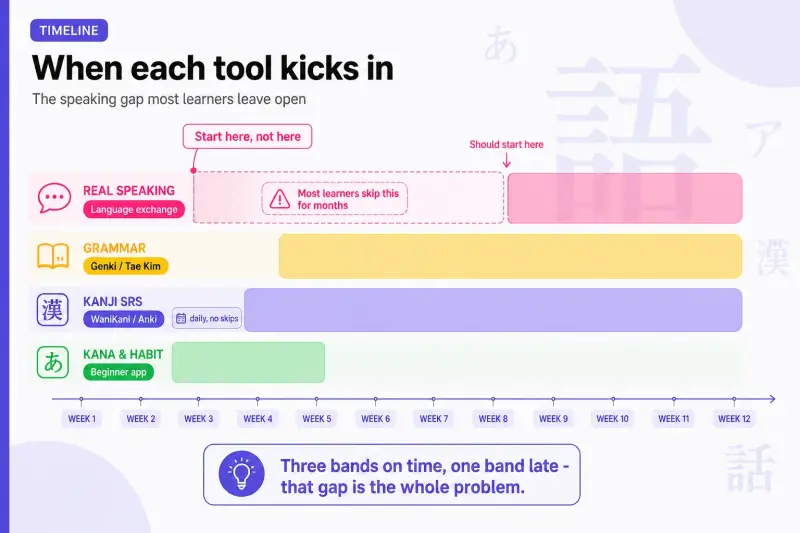
Pick one tool per job and no more. A kana app for week one, an SRS you can commit to daily for kanji, one grammar source you finish rather than sample, and a speaking outlet you start by week two. For choosing the grammar source, our best Japanese textbooks for self-study guide compares the main options, and our perfect Japanese learning stack for beginners shows how the pieces fit into a weekly routine.
Listening material is the piece this stack leaves undecided, and the comparison of beginner Japanese audio resources with text shows how to confirm transcript support for the exact lesson or episode your own account opens.
Four types: a beginner app for kana, an SRS for kanji, a textbook or course for grammar, and a speaking outlet like language exchange. Covering all four is what separates learners who progress from those who stall.
No. Apps are good for kana and vocabulary, but Japanese also needs kanji memory, grammar structure, and real speaking practice. Most learners need a small stack, not one app.
A spaced repetition system. WaniKani offers a guided path, while Anki is free and fully customizable. Both work only if you review daily.
For clear grammar progression, yes. A textbook like Genki explains structure in an order apps rarely match. Pair it with speaking so the grammar becomes usable.
Use a language exchange app to talk with native speakers directly. Voice messages let you practice pitch and rhythm at your own pace, and corrections come from real people.
By week two, once you have basic kana and a few phrases. Early speaking turns your recognition into recall and builds confidence before habits harden.
Learning Japanese well is about assigning one tool to each job and adding the speaking layer early, not collecting apps. Cover kana, kanji, grammar, and speaking, and the language stops feeling overwhelming. Start the speaking job today by finding a native Japanese speaker on HelloTalk.