
What Should a Language Learner Study First? Choosing Topics That Matter
New learners spend more energy choosing what to study than actually studying, and the fear is understandable: get the order wrong and you waste months. The good news is that the right sequence is fairly settled. The topics a language learner should study first are the ones that let you say and understand the most with the least effort, which means high-frequency words, survival phrases, and the present tense, in that order. Almost everything else can wait.

This guide lays out what to study first, what to postpone, and how to sequence topics so each one builds on the last. For the methods behind studying them, see our language learning strategies that actually work.
The Topic Sequence That Works
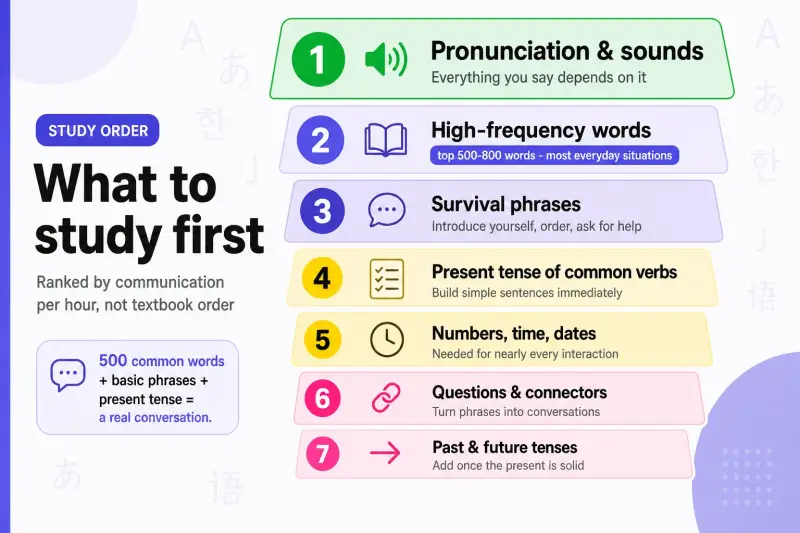
Study topics in order of usefulness per hour, not in the order a textbook happens to list them. The first topics should give you the most communication for the least study time. Here is that order.
| Priority | Topic | Why it comes first |
|---|---|---|
| 1 | Pronunciation and sounds | Everything you say depends on it |
| 2 | High-frequency words (top 500 to 800) | Cover most everyday situations |
| 3 | Survival phrases | Introduce yourself, order, ask for help |
| 4 | Present tense of common verbs | Build simple sentences immediately |
| 5 | Numbers, time, dates | Needed for nearly every real interaction |
| 6 | Questions and connectors | Turn phrases into conversations |
| 7 | Past and future tenses | Add once the present is solid |
What to Study First, and Why
Start with sounds, because mispronounced words are misunderstood no matter how correct the grammar. Move to the few hundred words that appear constantly, since a small set of high-frequency vocabulary covers a surprising share of daily speech. Add survival phrases so you can function in real situations early, then the present tense so you can build your own sentences instead of only reciting memorized lines. A learner who knows 500 common words, basic phrases, and the present tense can hold a simple conversation, while a learner who studied advanced grammar but few words often cannot. Usefulness beats completeness in the early months.
What to Postpone
Skip advanced tenses, formal writing, idioms, and rare vocabulary at the start. They feel like progress but return little for a beginner. Grammar you cannot yet use in a sentence is grammar you will forget before you need it.
Turning Topics Into Real Ability
Studying a topic is only half the work. You lock it in by using it with a real person soon after. This is where a language exchange platform makes the sequence stick. HelloTalk connects you with native speakers across 70M+ registered users in 200+ countries and 260+ languages, so each topic you study has an immediate place to be used:
- Chat-based learning provides translation, transcription, and real-time grammar correction, so you can test a new phrase or verb form in a message and get corrected on the spot.
- Moments lets you post a sentence using the week's topic and get corrections from several native speakers.
- Voicerooms and Livestreams give you live audio rooms to hear the topics you are studying used naturally by native speakers.
- AI learning tools score pronunciation and explain grammar, which reinforces the exact topic you just studied. With 90% of core features free and over 1 billion messages daily, applying each new topic to a real conversation costs nothing and can happen the same day.
How to Build Your Study Order
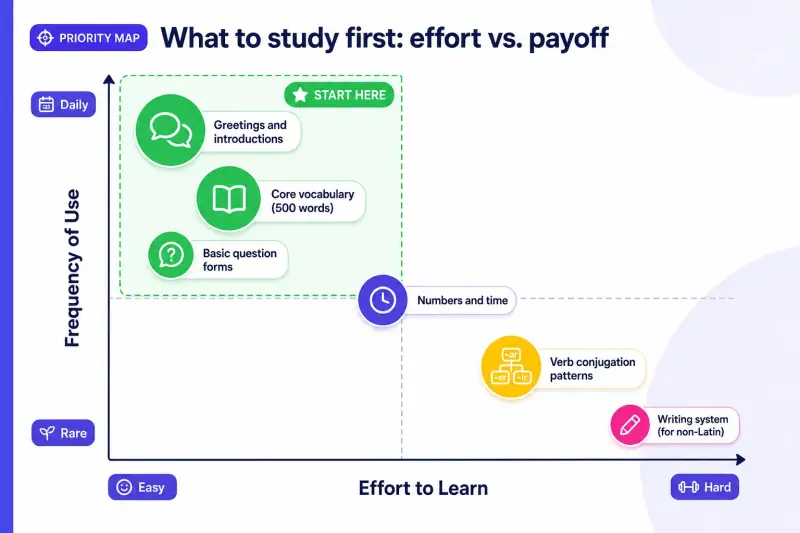
Pick the next topic from the priority list, study it for a few days, and use it in a real message or voice note before moving on. That simple loop keeps you learning the useful thing next and using it while it is fresh. Our input vs output guide explains why using a topic matters as much as studying it, and our strategy by goal guide shows how the order shifts if your goal is travel, work, or exams.
Common Mistakes
- Starting with grammar rules. Words and phrases open up communication faster than rules do.
- Chasing rare vocabulary. The common few hundred words carry most conversations.
- Studying topics you never use. If you will not say it soon, it will not stick.
- Never producing what you study. A topic used in conversation is a topic learned.
Frequently Asked Questions
What should I learn first in a new language?
Pronunciation, then the few hundred most common words, then survival phrases, then the present tense. This order lets you communicate the most with the least study.
How many words do I need to have a basic conversation?
Around 500 to 800 high-frequency words cover most everyday situations, which is a realistic first-quarter target for a beginner.
Should I study grammar or vocabulary first?
Vocabulary and basic phrases first, then just enough present-tense grammar to build simple sentences. Advanced grammar is more useful once you are already speaking.
What topics should I skip as a beginner?
Advanced tenses, formal writing, idioms, and rare vocabulary. They return little early on and are easier to learn once you have a base.
How do I make what I study actually stick?
Use each topic in a real conversation soon after studying it. Applying a phrase or verb form with a native speaker locks it in far better than review alone.
How long should I spend on each topic?
A few days of focused study, then use it in real practice before moving on. Depth on the useful topics beats rushing through everything.
Study the Useful Thing Next
The right first topics are the ones that give you the most communication per hour: sounds, common words, survival phrases, and the present tense. Study them in that order and use each one right away. The fastest way to make a new topic stick is to use it, so try it with a native speaker on HelloTalk today.