How to Choose an English Speaking App: What Actually Matters
There are dozens of English speaking apps, and the app store rankings will not tell you which one fits you, because they rank by downloads, not by whether people actually learn to speak. The right English speaking app is the one that gets you talking with real people most often, not the one with the most features or the highest rating. Once you judge apps by that single measure, the choice gets much simpler.
This guide is a decision framework rather than a ranking. For a ranked shortlist to apply it to, see our best English speaking apps guide; here we show how to choose well and test fast.
The Features That Actually Matter
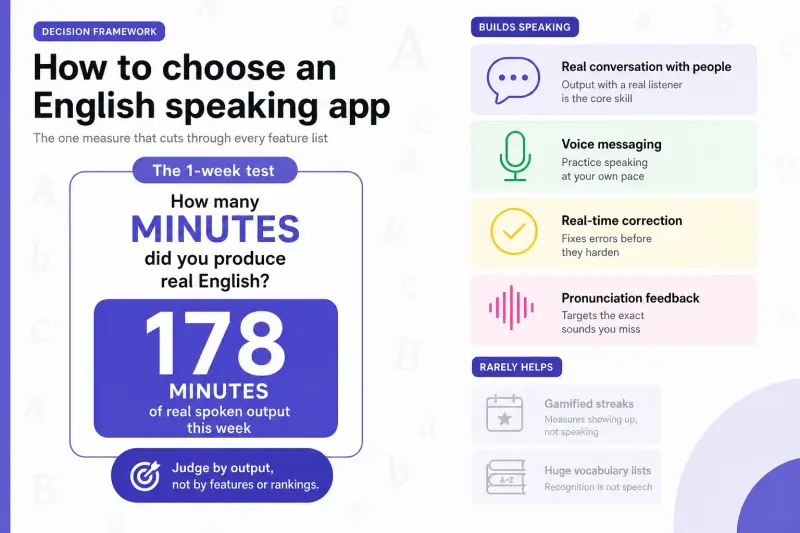
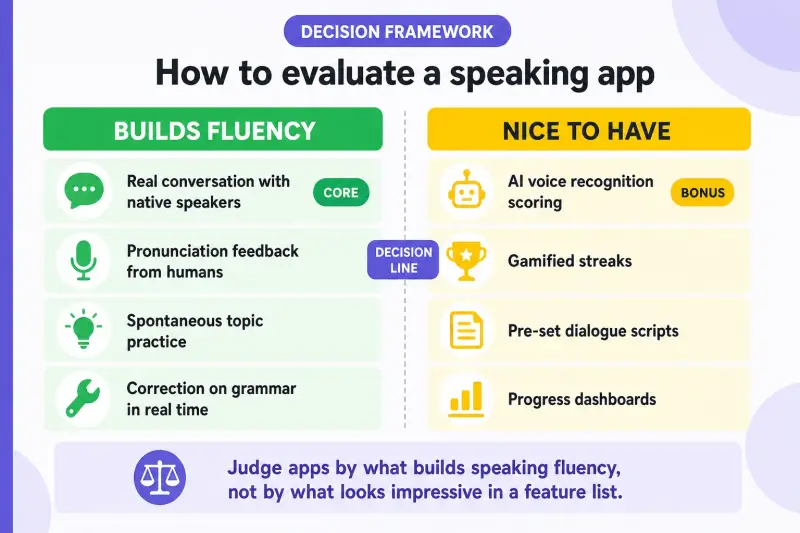
Most app comparisons list features that look impressive and change little. The ones that predict real speaking progress are narrower. An English speaking app is worth your time only if it gives you real speaking output, honest feedback, and enough people or prompts to keep you talking daily. Everything else is secondary.
| Feature | Does it build speaking? | Why |
|---|---|---|
| Real conversation with people | Yes, most | Output with a real listener is the core skill |
| Voice messaging | Yes | Lets you practice speaking at your own pace |
| Real-time correction | Yes | Fixes errors before they harden |
| Pronunciation feedback | Yes | Targets the exact sounds you miss |
| Gamified streaks | Rarely | Measures showing up, not speaking |
| Huge vocabulary lists | Rarely | Recognition is not the same as speech |
How to Test an App in One Week
Do not commit based on marketing. In the first week, measure one thing: how many minutes did you actually spend producing English out loud or in writing to a real person or realistic prompt? An app that keeps that number high is working. An app where you mostly tapped multiple-choice answers is not, however fun it felt. If after a week you have recognized a lot of English but spoken almost none, the app is training the wrong skill, and you should switch. This test cuts through every feature list.
Where Real-People Apps Fit
The apps that score highest on real output are the ones that connect you with actual speakers, because a real listener is the thing that forces genuine speaking. HelloTalk is built around this, connecting English learners with fluent and native speakers across 70M+ registered users in 200+ countries and 260+ languages:
- Chat-based learning puts translation, transcription, and real-time grammar correction in the chat, so messaging a native speaker is speaking practice with instant feedback.
- Moments lets you post in English and collect corrections from several speakers, which is more feedback than a single class or tutor gives.
- Voicerooms and Livestreams are live English audio rooms you can join as a listener, then speak in when ready, plus interactive livestreams for structured practice.
- AI learning tools score pronunciation and explain grammar, so you can rehearse privately before speaking live. Because you can send voice messages at your own pace and 90% of core features are free, an app like this keeps daily output high without a subscription, which is exactly what the one-week test rewards.
Matching the App to Your Situation
If you are a beginner, prioritize an app with gentle prompts and correction. If you are stuck at intermediate, prioritize real conversation volume, since output is your bottleneck. If you are preparing for a specific goal, our guide to practicing English speaking and daily English speaking routine help you turn the app into a habit.
Common Mistakes
- Choosing by app store rank. Downloads measure popularity, not learning.
- Being won over by streaks. A long streak with no speaking still leaves you unable to talk.
- Collecting apps. One app used daily for real output beats four opened occasionally.
- Judging before you test output. Measure spoken practice in week one, then decide.
Frequently Asked Questions
What is the best English speaking app?
The best one for you is whichever keeps you speaking with real people most often. Apps built around real conversation and voice practice tend to build fluency faster than quiz-based ones.
How do I know if an English app is actually working?
After a week, check how much English you actually produced out loud or in writing to a real person. High output means it works; mostly tapping answers means it does not.
Are free English speaking apps good enough?
Yes, many are. A language exchange app gives you real speaking practice with native speakers at no cost, since most core features are free. Paid apps can help but are not required.
Do gamified apps help with speaking?
They help with habit and vocabulary, but streaks and points measure showing up, not speaking. For fluency, prioritize apps that produce real spoken output.
How many English apps should I use?
One for real speaking is the priority. You can add a second for vocabulary, but more than two usually reduces consistency rather than helping.
What features matter most in an English speaking app?
Real conversation with people, voice messaging, real-time correction, and pronunciation feedback. These build spoken skill. Streaks and big word lists matter far less.
Choose by Output, Then Start Talking
The right English speaking app is simply the one that keeps you producing real English every day, so judge apps by output, not by features or rankings, and run the one-week test. Once you have picked one, the only thing that matters is using it, so start speaking with a native English speaker on HelloTalk today.