Best English Speaking Apps in 2026 (Tested)
Most "best English speaking app" lists are written by people who never opened the apps. We did the opposite. Over several weeks we used each one the way a real learner would, someone who can read English fine but freezes the moment it's time to talk, and judged them on one question: does this actually get me speaking, or just tapping?
The honest answer up front: there's no single best app for everyone, because they're built for different jobs. An app that perfects your accent won't give you a real conversation. A free game won't make you fluent. The smart move is to match the app to your gap. Here's the quick comparison, then the full breakdown.
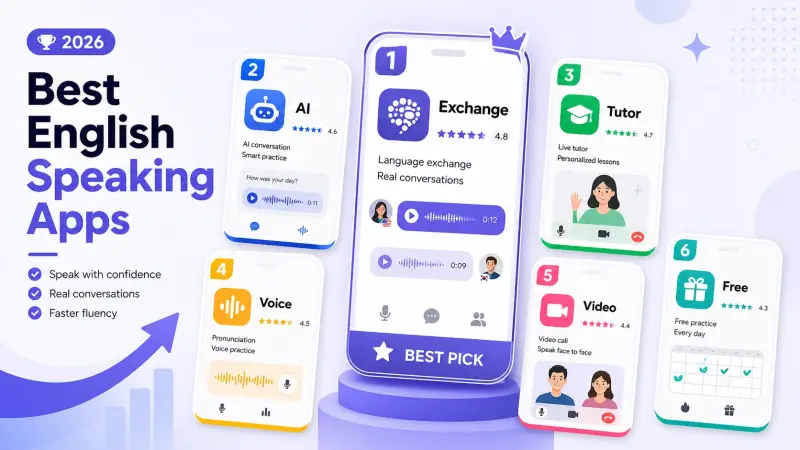
Quick comparison
| App | Best for | How you practice | Price | Platform |
|---|---|---|---|---|
| HelloTalk | Real conversation with native speakers | Text, voice, video with language partners | Free / Premium | iOS, Android, Web |
| Speak | AI conversation practice | Spoken back-and-forth with an AI tutor | Paid (free trial) | iOS, Android |
| ELSA Speak | Pronunciation & accent | AI speech analysis on words/sentences | Free / Premium | iOS, Android |
| Speaky | A simple free exchange alternative | Text, voice, video with partners | Free / Premium | iOS, Android, Web |
| Cambly | On-demand native tutors | Live 1-on-1 video lessons | Paid | iOS, Android, Web |
| italki | Affordable 1-on-1 lessons | Booked video lessons with teachers | Pay per lesson | iOS, Android, Web |
| Babbel | Structured beginner courses | Guided lessons + speech recognition | Paid (free trial) | iOS, Android, Web |
| Busuu | Course + community feedback | Lessons + corrections from native speakers | Free / Premium | iOS, Android, Web |
| Pimsleur | Hands-free audio speaking | Listen-and-repeat audio drills | Paid (free trial) | iOS, Android, Web |
| Duolingo | A free daily foundation | Gamified bite-size exercises | Free / Premium | iOS, Android, Web |
The best English speaking apps, reviewed
1. HelloTalk: Best for real conversation with native speakers
If your problem is that you've studied for years and still can't talk, the fix isn't another lesson, it's a real person to talk to. HelloTalk is a language exchange app with 70M+ registered users across 200+ countries: it pairs you with native English speakers who are learning your language, so you help each other and nobody pays a tutor. Because your partner is also a nervous learner, the fear of being judged mostly disappears. It was named Google Play's Best Social App in 2017 and featured on Google Play's global homepage in 2024.
What makes it work for speaking specifically is the on-ramp. You can start in text to warm up, switch to voice messages (record, listen back, re-record until you're happy), join Voicerooms to practice in a group, and step up to live video calls when the nerves fade. Built-in translation and correction tools let you fix each other's sentences without breaking the conversation.
Pros: Genuinely free to start; real humans, not scripts; gentle progression from text to video; huge global community. Cons: It's an exchange, not a structured course, there's no fixed curriculum holding your hand, and partner quality varies. You get out what you put in. Best for: Learners who understand English but need real speaking reps to break the silence.
2. Speak: Best for AI conversation practice
Speak is built around one idea: get conversational reps without needing a live person on the other end. Its AI tutor holds spoken conversations, reacts to what you say, and gives feedback on how you said it. It's polished and the speech recognition is strong.
Pros: Unlimited low-pressure speaking; available 24/7; good for building confidence before talking to humans. Cons: No free tier worth much, it's a paid app. And like all AI, it's predictable in a way real people aren't. Best for: Shy learners who want to drill conversation privately before facing a real partner. (More options like it in our best AI English speaking apps guide.)
3. ELSA Speak: Best for pronunciation and accent
ELSA isn't a conversation app, it's a pronunciation coach. It listens to you say words and sentences, then shows you exactly which sounds are off and how to fix them, down to the syllable. If people often ask you to repeat yourself, this is the targeted tool.
Pros: Outstanding pronunciation feedback; clear, specific corrections; solid free tier. Cons: Narrow, it sharpens how you sound, not what you can say in a real exchange. Use it alongside a conversation app, not instead of one. Best for: Learners whose grammar is fine but whose accent gets in the way of being understood.
4. Speaky: a free language exchange alternative
Speaky is a lighter language exchange option that connects you with partners worldwide by text, voice, and video. It has fewer features and a smaller community than HelloTalk, but it is a fine free way to widen your pool of potential partners.
Pros: Free and simple; a global community; text, voice, and video all supported. Cons: Fewer features and a smaller, less active community than HelloTalk. Best for: A free backup for finding extra exchange partners.
5. Cambly: Best for on-demand native tutors
Cambly connects you to native-speaking tutors for live video lessons, instantly, with no booking required, tap and you're talking to a real person within seconds. It records every call so you can review.
Pros: Immediate real-human speaking practice; no scheduling; native tutors. Cons: Paid, and not cheap for daily use; tutor quality varies since many aren't certified teachers. Best for: Learners who'll pay for guaranteed, on-demand conversation time.
6. italki: Best for affordable 1-on-1 lessons
italki is a marketplace of teachers, both professional instructors and cheaper "community tutors", you book by the lesson. It's the go-to for structured speaking practice with a real teacher without the price of a local language school.
Pros: Huge range of prices and teaching styles; you pick the teacher; great for steady, structured progress. Cons: Requires booking and scheduling; you have to shop around to find the right teacher. Best for: Learners who want real lessons and feedback but on a flexible budget.
7. Babbel: Best for structured beginner courses
Babbel is a classic structured course: tidy, well-designed lessons that build vocabulary and grammar with some speech-recognition practice mixed in. It's strong for getting off the ground but lighter on open conversation.
Pros: Clear curriculum; practical, real-world dialogues; good for absolute beginners. Cons: Speaking practice is scripted, not free-form; you'll outgrow it once you can hold a basic conversation. Best for: Beginners who want a guided path before jumping into live practice.
8. Busuu: Best for course plus community feedback
Busuu blends structured lessons with a clever twist: you can submit short writing and speaking exercises and have native speakers correct them. It's a middle ground between a solo course and real interaction.
Pros: Structured path + real human corrections; CEFR-aligned; useful free tier. Cons: Feedback is asynchronous, not live conversation; correction quality varies by who responds. Best for: Self-paced learners who want occasional native feedback without a live call.
9. Pimsleur: Best for hands-free audio speaking
Pimsleur is audio-first: 30-minute listen-and-repeat sessions you can do while driving or walking. It drills you to say things out loud constantly, which is rarer than it should be.
Pros: Forces spoken output; perfect for commutes; trains rhythm and recall. Cons: Old-school and repetitive; audio-only means no visual or real-conversation element. Best for: Busy learners who want to practice speaking with their hands and eyes occupied.
10. Duolingo: Best for a free daily foundation
Duolingo is the gamified habit-builder everyone knows. It's excellent at keeping you coming back daily and building basic vocabulary, but its speaking exercises are limited and scripted, it won't make you conversational on its own.
Pros: Free, fun, genuinely habit-forming; great vocabulary base. Cons: Minimal real speaking practice; the gamification can feel like progress when little speaking is happening. Best for: Building a daily streak and foundation, pair it with a real conversation app. (See more in our best free English speaking apps round-up.)
How to choose the right English speaking app
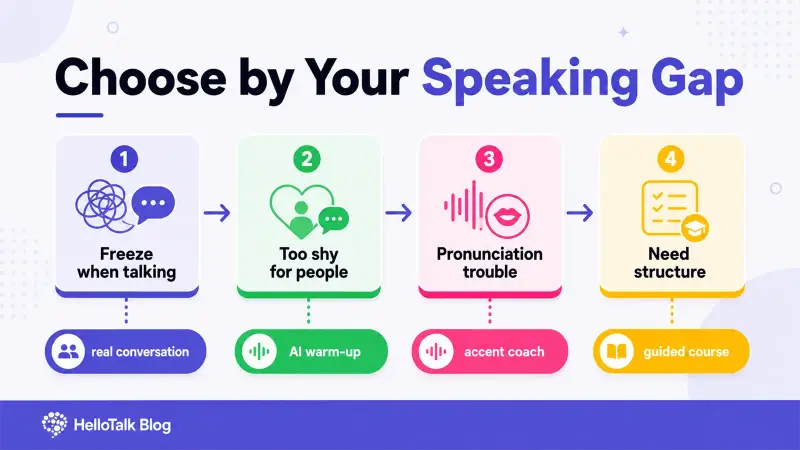
Don't pick by ranking, pick by the gap that's holding you back:
- "I can read but freeze when I talk." Your gap is real conversation. Go with a language exchange app like HelloTalk or Speaky, or pay for on-demand tutors via Cambly / italki.
- "I'm too shy to talk to a person yet." Start with an AI partner (Speak) to kill the fear, then graduate to humans. Here's the full AI app comparison.
- "People ask me to repeat myself." Your gap is pronunciation, use ELSA Speak alongside a conversation app.
- "I'm a beginner and need structure." Start with Babbel or Busuu, then move to live practice as soon as you can form sentences.
- "I have zero budget." Plenty of these are free to start, see the best free English speaking apps.
Most fluent learners end up using two: one to build the mechanics (an AI tutor or pronunciation coach) and one for the real reps (a human conversation app). For the full method behind combining them, read our pillar guide on how to practice English speaking without a teacher.
A note on scope: this list is about apps for speaking English specifically. If you want a fast, low-commitment daily option, see our pick of the top English learning apps for quick daily practice. And if you're weighing app types across any language, not just English, our deeper breakdown of language learning apps compared explains why most of them leave you unable to actually speak.
FAQ
What is the best app to learn English speaking fluently? There's no universal winner. For pure fluency, the ability to react in real time, nothing beats talking to real people, so a language exchange app like HelloTalk or a tutor platform like italki delivers the most. AI apps like Speak are the best bridge to get there if you're not ready to talk to a human yet.
Can an app really make me fluent without a teacher? Yes, if it gives you real output and feedback. Apps that only quiz you (the gamified ones) build vocabulary but not fluency. Apps that get you speaking, to AI or to people, are the ones that work. Pair a practice app with a conversation app and you don't need a paid teacher.
Which English speaking app is best for shy beginners? Start with an AI conversation app where there's no judgment, then move to text and voice messages with a language partner before live calls. HelloTalk's text-to-voice-to-video progression is built for exactly this gradual build-up of confidence.
Are free English speaking apps good enough? Many are. HelloTalk and Duolingo are genuinely useful for free, and several others offer real value before any paywall. We break down which free apps are actually worth it in our free English speaking apps guide.
How much time per day should I spend? About 20-30 focused minutes a day produces noticeable improvement in 4-6 weeks. Consistency matters far more than long, occasional sessions.
The bottom line
If we had to name one starting point for the learner who can read English but can't speak it, it's a real conversation, and that's what HelloTalk is built for. It's free to start, connects you with native speakers who want to learn your language too, and walks you from your first nervous text all the way to a live video chat.
Use a pronunciation coach or an AI tutor on the side if you need them. But the day you actually start talking to a real person is the day your English stops being something you know and becomes something you can do.