Language Learning Apps Compared by the Job Each One Actually Does

The Quick Answer: Match the App to the Skill You Need to Train
Almost every "which app is better" argument goes nowhere because the apps are not competing for the same job. A flashcard app and a conversation app are about as comparable as a dictionary and a dinner party. So the question worth asking is not which app wins, but which skill you are currently worst at, and which tool was built to train that specific thing.
Here is the short version, the one I give friends who ask over coffee. If you cannot read a basic sentence yet, start with a structured course app like Duolingo, Babbel or Busuu. If you know words but forget them, use Anki or Memrise. If you need to pass an exam or prep for an interview, book paid sessions with a tutor on italki or Cambly. If your mouth does not cooperate when you try to speak, drill with ELSA or Speak. And if you can form sentences but freeze with real people, you need a community, which is where HelloTalk sits.
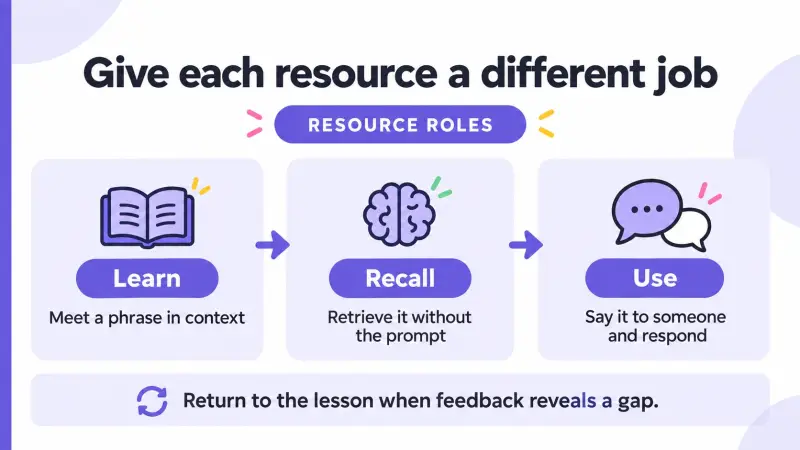
Most learners stall not because they chose a bad app but because they chose two apps that train the exact same skill. Two vocabulary tools is a wasted subscription. A course app plus a conversation app is a full learning loop.
One more thing before the comparison. Nobody sticks with a tool that feels like homework forever. The apps that survive on your phone past month three are the ones with a social or emotional hook, whether that is a streak, a tutor who remembers your name, or a stranger in Osaka who replies to your voice note. Keep that in mind while reading the table below, because retention matters more than feature lists.
What Learning Job Is Each Language App Best Suited For?
Read the table by column, not by row. The "Core learning job" column tells you what the app was designed to do, "Feedback" tells you who or what corrects your mistakes, and "Limitations" is the honest part that marketing pages skip. The new "Best for" column describes the learner profile the app genuinely fits, so you can find your own situation before you compare features.
| App | Core learning job | Practice format | Feedback | Best for | Limitations |
|---|---|---|---|---|---|
| Duolingo | Build a daily habit and absorb beginner grammar | Short gamified drills, streaks, multiple choice | Automated right or wrong, minimal explanation | Absolute beginners who need momentum before anything else | Very little open-ended output; plateaus fast at intermediate level |
| Babbel and Busuu | Teach practical dialogue and grammar in sequence | Scripted lessons around everyday situations | Automated scoring, plus community corrections on Busuu | Learners who want a syllabus and clear unit progression | Conversation is scripted, so real replies still feel unrehearsed |
| Anki | Move vocabulary into long-term memory | User-built flashcards on a spaced repetition schedule | None; you grade your own recall | Exam candidates and heavy vocabulary builders who like control | Setup is fiddly, the interface is plain, and it teaches zero speaking |
| Memrise | Recognise words and phrases in native speech | Flashcards plus short clips of real speakers | Automated recall checks | Learners who want spaced repetition without building decks | Course quality varies by language and contributor |
| italki | Structured one-on-one lessons toward a goal | Scheduled video calls, paid per session | Live human correction from a tutor | Anyone with a deadline such as IELTS, a move, or a job interview | Scheduling friction, and cost rises with frequency |
| Cambly | Unscripted speaking time with a native tutor | On-demand video calls, paid per session | Live human correction, often light and conversational | Learners who want instant speaking practice without booking ahead | Tutor consistency varies; no curriculum unless you build one |
| ELSA and Speak | Rehearse pronunciation and spoken fluency with AI | Repeat-after-me drills and AI roleplay dialogues | Instant AI scoring on sounds, stress and pace | Learners whose grammar is fine but whose accent blocks understanding | The AI never misunderstands you the way a human will |
| HelloTalk | Connect lessons with real use, feedback, and further practice | Text and voice chat, Moments, Voicerooms, and interactive live learning | In-chat and community feedback to review alongside the lesson topic | Learners building a routine that links study, conversation, and review | Set a topic for each exchange and return to the feedback; browsing alone leaves the cycle unfinished |
| Speaky | Find language exchange partners for casual chat | Text-first chat with matched partners | Peer corrections when partners offer them | Learners who want a simple, low-pressure partner search | Smaller active base, and correction tooling is thinner |
Notice that no app scores well in every column, including HelloTalk. That is the point. An app built for conversation should not be expected to teach you the subjunctive in order, and a course app should not be blamed for not introducing you to anyone.
Duolingo, Babbel, and Busuu for Structured Lessons and Daily Practice
Course apps do one thing very well: they decide what you learn next so you do not have to. For a beginner staring at a new alphabet, that is worth a lot. Duolingo is the easiest to start and the hardest to quit, because the streak mechanic borrows from games rather than textbooks. It gets you to fifteen minutes a day, which is genuinely most of the battle in month one.
Babbel takes a more grown-up approach. Lessons are built around situations you will actually face, like ordering, renting or complaining politely, and the grammar notes explain why a form works instead of just marking it wrong. If you learn better with an explanation in front of you, Babbel is the more satisfying of the three.
Busuu sits in between, with a course spine plus a community layer where native speakers review short written or spoken submissions. That community review is the closest a course app gets to real feedback, and it is a real strength worth naming.
The shared ceiling is the same for all three. Scripted practice never surprises you. You can finish a whole unit on directions and still panic when a stranger answers your question with a phrase the app never showed you. That gap is not a flaw in the courses, it is just outside their job description. I usually suggest running a course app in the morning and spending evenings somewhere unscripted, which is the pattern described in this comparison of language learning chat apps and how they differ.
Anki and Memrise for Vocabulary Review and Recall
Vocabulary is the one part of language learning where the science is settled. Spaced repetition moves words into long-term memory far more reliably than rereading a vocabulary list ever will. Anki is the purest version of that idea and, despite an interface that looks like it was designed in a different decade, it remains the tool serious learners keep coming back to.
The reason Anki works is that it shows you a card right before you would have forgotten it. You control the decks, the images, the audio, the example sentences. That control is also the cost: building good cards takes time, and plenty of people quit during setup rather than during review.
Memrise smooths that out. Decks are pre-built, and the short video clips of native speakers saying the target phrase are more useful than they first appear, because they train your ear for the speed real people talk at. Course quality varies by language, so check your specific pair before committing.
Where both tools stop is production. Recognising a word on a card is not the same as retrieving it mid-sentence while someone waits for you to finish. I have met learners with 4,000 reviewed cards who still could not order lunch, and the fix was never more cards. It was using the words in a conversation within a day or two of learning them, which is exactly the loop that flashcards cannot close on their own.
italki and Cambly for Scheduled One-on-One Speaking With Tutors
Tutors solve a problem that no algorithm handles well: they notice the mistake you keep making and they make you fix it. On italki you browse teachers, book slots and pay per session, and the structure that comes with a recurring appointment is the real product. If you have a dated goal such as an IELTS sitting, a relocation or a job interview, italki's scheduling model is the better fit precisely because it forces a calendar on you.
Cambly runs the other way round. You open the app and you are talking to someone within a minute, no booking. For learners who need reps rather than a syllabus, that immediacy is hard to beat. Preply occupies similar ground with a marketplace feel closer to italki's.
All three are paid per session, and that shapes how you use them. Paid time is best spent on things only a human can do: correcting the error you cannot hear yourself, pushing you past your comfortable vocabulary, explaining why your sentence is grammatically fine but sounds odd. Spending a tutor session reviewing flashcards is an expensive way to do something free.
The honest limitation is frequency. Most people can sustain one or two tutor sessions a week, and language does not grow on two hours a week of speaking. Between sessions you still need somewhere to speak badly without an appointment and without a meter running.
ELSA and Speak for AI-Guided Pronunciation and Speaking Rehearsal
This category barely existed a few years ago and is now the fastest-moving one. ELSA listens to you say a word and tells you which sound you missed, down to the specific vowel, with a score you can chase. For learners whose grammar is solid but whose accent makes them hard to follow, that targeted feedback is genuinely useful and faster than waiting for a human to politely say "sorry, again?"
Speak leans into roleplay. You hold a spoken conversation with an AI that stays patient forever, never checks the clock and never makes you feel slow. As a rehearsal room, it is excellent. Say the same three sentences twelve times with nobody judging you, then go use them.
The limit of AI speaking practice is that it is too kind. The AI understands you even when a real person would not. It does not interrupt, mishear your tone, switch to slang, or answer with a question you did not prepare for. Real conversation is partly a stress test, and AI removes the stress that you actually need to train against.
HelloTalk sits on both sides of this line, because the HelloTalk AI learning tools include AI pronunciation scoring, AI grammar correction that explains the fix rather than just flagging it, and picture translation for the word you can see but cannot name. The difference is that the same app also puts a human on the other end afterwards, so the rehearsal has somewhere to go.
HelloTalk and Speaky: Which Community Actually Replies
Every language exchange app promises native speakers. The question that decides whether an exchange app is worth your evening is narrower than that. A language exchange app is only as good as the share of your messages that get a reply within a day. By that measure the two are not equivalent, and it is worth being specific about why.
Speaky is a clean, simple product. You state your languages, you get matched, you chat by text. For learners who want a low-pressure partner search without a busy feed, it does the job, and the simplicity is a legitimate reason some people prefer it. It is a decent place to meet one or two steady partners if you are patient about the search.
The difference is density and tooling. HelloTalk hosts 70M+ registered users across 200+ countries studying 260+ languages, and over 1 billion messages move through the HelloTalk platform daily, which is why a beginner-level message in a common language pair usually gets an answer the same evening rather than next week. Density is not a vanity metric in language exchange. It is the difference between practising tonight and waiting for someone to log in.
Correction quality is the second dimension where the gap shows. HelloTalk builds correcting into the conversation itself: in-chat translation lets you check a phrase without leaving the thread, and in-chat correction lets your partner rewrite your sentence inline so you see the fixed version next to your original. That chat based learning design matters because most people will not correct you if correcting is awkward. Make it one tap and they do it.
Beyond one-to-one chat, HelloTalk gives you three more routes to a reply. Moments works like a public feed where you post a few sentences or a voice clip and several native speakers correct the same post from different angles, which is often more instructive than one partner's opinion. HelloTalk Voicerooms and Livestreams run around the clock, and you can join as a silent listener first, which is how most nervous learners get their first hour of live audio without having to speak. And the HelloTalk AI learning tools let you sanity-check a sentence privately before you send it to a person.
Cost structure is worth a plain word too. HelloTalk keeps 90% of core features free, so you can test whether the community replies to you before you decide anything about upgrading. HelloTalk has also been recognised outside its own bubble, with a 2017 Google Play Best Social App award and a 2024 global Google Play homepage feature.
None of that makes HelloTalk a course. HelloTalk will not teach you grammar in order, will not hand you a syllabus, and expects you to arrive with enough language to start a sentence. If you want a deeper feature-by-feature breakdown, see this side-by-side look at language exchange platforms.
How to Combine Two Apps Without Duplicating the Same Job
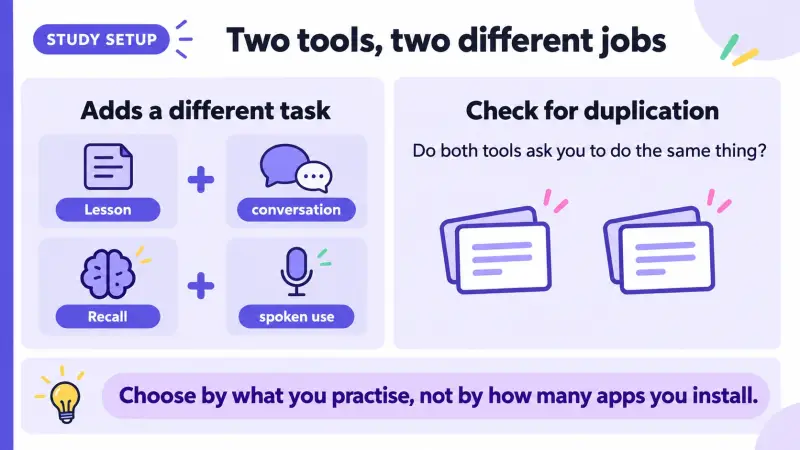
Two apps is the sweet spot for most learners. Three is usually one too many, and two apps from the same category is the most common wasted purchase in this whole category. Two apps that train different skills compound, while two apps that train the same skill just split your attention.
Read the table below by the third column first. "When it is overkill" is the part that saves you money, because it tells you when the second app is not adding a new job at all. The same logic runs per language, and the picks shift once a specific language is on the table, which is why there are separate rundowns for Italian learning apps and Thai learning apps rather than one list claiming to settle every language at once.
| Pairing | Why it works | When it is overkill |
|---|---|---|
| Duolingo plus HelloTalk | A course feeds you new structures daily and the community gives you somewhere to use them the same evening | If you cannot yet build a three-word sentence, stay on the course alone for a few more weeks |
| Anki plus italki | Flashcards load the vocabulary and paid tutor sessions force you to produce it under mild pressure | If you only have one or two speaking sessions a month, the deck will outrun what you can actually use |
| ELSA plus HelloTalk | AI drills fix specific sounds in private and voicerooms test whether real listeners understand you | If people already understand you fine, the pronunciation scores become a hobby rather than a need |
| Babbel plus Cambly | Situational lessons give you the script and on-demand calls let you run that script with a human | If your goal is a specific exam, a booked tutor with a syllabus beats unscripted calls |
| Memrise plus Anki | Almost never; both are spaced repetition tools doing the same recall job | This is the textbook duplicate, so pick one deck system and spend the time saved on speaking |
The pattern across all of these is simple. One app should put new language into your head, and the other should force it out of your mouth. If you cannot say in one sentence which of your two apps does which, you probably have two of the same thing.
Frequently Asked Questions About Choosing a Language Learning App
Do I really need more than one language learning app?
Most people do, but only two, and only if they train different skills. One app to supply new language, one app to use it. If you are in your first month and still learning the sounds and script, a single course app is enough, and adding a conversation app too early mostly produces anxiety.
Can AI practice replace talking to real people?
Not yet, though it is a good warm-up. AI tools like ELSA and Speak are patient, available at 3am and great for repetition. What they cannot reproduce is being misunderstood, interrupted or answered with slang, and coping with those moments is a separate skill you can only train on humans.
What is the actual difference between a tutor app and a language exchange app?
A tutor app buys you structured attention, paid per session, from someone whose job is to correct you. An exchange app gives you a peer who is learning your language, free in most cases, with correction that depends on goodwill rather than obligation. Tutors are better for deadlines; exchange is better for volume and for the confidence that only comes from many low-stakes conversations.
How do I tell if two of my apps are doing the same job?
Ask what each one asks you to produce. If both ask you to recognise a word and tap the right answer, they are the same tool with different graphics. If one asks you to recall silently and the other asks you to speak out loud to a person, they are different jobs and worth keeping both.
Do I have to pay to test whether a community app works for me?
No, and you should not. HelloTalk keeps 90% of core features free, which is enough to send messages, post to Moments, get corrections and sit in a voiceroom. Judge an exchange community on one thing before spending anything: how many of your first ten messages got a reply.
I know a lot of words but freeze when someone speaks to me. Which app fixes that?
That is a retrieval and nerves problem, not a knowledge problem, so more flashcards will not help. Pick something with live humans and low stakes. Listening silently in a HelloTalk voiceroom for a week, then sending voice notes instead of text, is the least painful path I have seen work.
Is there an app that does everything well?
No, and the ones that claim to usually do several things at a mediocre level. Two apps chosen for two different jobs will beat one app trying to cover the whole range.
The One App Choice Most Learners Get Backwards
The mistake I see most often is sequencing. People decide they will start talking to real people once they are ready, and "ready" keeps moving. They finish another course unit, add another 500 flashcards, run another month of pronunciation drills, and still have not had a conversation that could go wrong.
It should run the other way round. Start talking earlier than feels comfortable, at a level that feels embarrassing, and let the real conversations tell you what to study next. You find out in one evening that you cannot handle past tense in speech, or that you have no words for your own job, and suddenly your course app and your flashcards have a purpose instead of a syllabus.
That is the practical reason a community sits at the centre of a two-app setup rather than at the end of it. HelloTalk works for that because the barrier to a first exchange is low: type a sentence, use in-chat translation when you get stuck, let a native speaker fix it with in-chat correction, and listen in a voiceroom before you ever speak in one. Competitors do parts of this well, and Anki's spaced repetition or italki's scheduled lessons remain the better tool for their own jobs.
So pick your two apps by job, not by brand. One to feed you, one to force you. Then measure progress by something honest, like whether last week you said anything out loud to a person in your target language, and not by a streak counter. If the community half of that pair is the piece you are missing, find a language exchange partner on HelloTalk and start with one sentence.