Language Learning Chat Apps in 2026, Ranked by Who Actually Replies

Most people who download a language learning chat app are not looking for another course. They already know the grammar rules well enough to pass a quiz. What they want is the thing a textbook cannot fake: a real person who writes back in their own slang, at their own speed.
That is the only ranking dimension that matters here. Not lesson count, not streak design. The question is whether you send a message and get a reply. This article sorts six chat apps for 2026 by that standard and says where each falls short.
What Separates a Chat App From a Course App
A course app owns the path. It decides what you learn in week one, what unlocks in week four, and when you are ready for the past tense. The content is fixed and the feedback is automated.
A chat app hands the path to you. You find someone learning your language who speaks the one you want, and you start typing. The syllabus is whatever the two of you feel like discussing that night.
That difference shows up fast. Course apps build recognition, which is why people who finish a long streak can read a menu and still freeze at the counter. Chat apps build production, which is messier but is the skill you were missing. A chat app teaches you to produce language under mild social pressure, which is the exact skill that course apps leave untouched. HelloTalk sits in the chat category.
The tradeoff is real. Nothing is sequenced, so you can spend six weeks on food and weather and never touch a conditional. Learners who need structure often run a course app and a chat app side by side. A chat app is also not a tutoring marketplace: it gives you unpaid peers, not a teacher who prepares material.
Quick Comparison: Six Chat Apps at a Glance
The table below is sorted by how reliably you get a human reply. Read three columns first: whether native speakers are on the platform at all, what the chat looks like when you open it, and who the app is built for. The last column is what most comparison posts leave out, so it is filled in for every app including HelloTalk.
| App | Native speakers | Chat format | Free tier | Best for | Not for |
|---|---|---|---|---|---|
| HelloTalk | Yes, very large pool, 200+ countries and 260+ languages | Text, voice notes, calls, Moments posts, group voicerooms | Yes, 90% of core features free | Learners who want daily unscripted chat with native speakers and correction inside the thread | Learners who want to observe without contributing or revisiting feedback; the practice cycle requires active participation |
| Speaky | Yes, smaller pool, mostly text | One to one text chat with translation help | Yes, core matching is free | Learners who want a simple partner finder, nothing else | Learners who want voice rooms or a public feedback feed |
| HiNative | Yes, large answering pool, question and answer format | Short questions answered by natives, not ongoing threads | Yes, asking basic questions is free | Learners who want one specific sentence or nuance checked quickly | Learners who want a continuing relationship with one partner |
| Hilokal | Yes, hosted live audio rooms | Group voice rooms with hosts, plus study tools | Yes, joining rooms is free | Learners who learn best by listening to a hosted room and speaking when called on | Learners who prefer text and want to avoid live audio entirely |
| Slowly | Yes, pen pal matching by interest | Letters, delivered on a delay based on distance | Yes, core letter writing is free | Learners who want long considered writing practice without reply pressure | Learners who need same day back and forth or any speaking practice |
| Duolingo | No, practice partners are automated | Bite sized exercises plus scripted AI chat | Yes, most lessons free with ads | Absolute beginners building vocabulary and daily habit | Intermediate learners who need real people and unpredictable replies |
One note. "Native speakers: yes" is doing heavy lifting, because pool size changes everything, and an app with a thin user base technically has native speakers and practically has silence.
Three well known names are deliberately absent from that table, because they are not chat products and comparing them here would flatter them. Busuu is a graded course that adds asynchronous peer correction on short writing submissions, so a native speaker does read your work, but only after a lesson tells you what to write. italki is a tutoring marketplace: the conversation is real, prepared, and paid per session, which makes it excellent for exam preparation and a poor fit for the eleven at night impulse to say something. ELSA is a pronunciation engine that scores individual sounds and never answers you. Each of those wins its own job. None of them answers the question this page is about, which is who replies when you open the app with nothing planned to say.
1. HelloTalk, Best Overall for Chatting With Native Speakers
HelloTalk ranks first for one unglamorous reason: reply rate. HelloTalk carries more than 70 million registered users across 200+ countries, which is the reason a message sent at two in the morning still gets answered. Scale is not a vanity metric here. A partner who goes quiet for a week kills momentum faster than any grammar gap.
HelloTalk is a language exchange app by design. You list the language you speak and the one you are learning, and HelloTalk's matching surfaces people whose pair mirrors yours. Emma helps David with English because David helps Emma with Spanish, and that symmetry is why conversations keep going.
Chat based learning, with the tools inside the message thread
HelloTalk builds translation and correction into the conversation, so you never leave the thread to figure out what someone said. Long press a message and HelloTalk gives you in-chat translation. Tap again and HelloTalk adds transcription for characters and tones, plus text to speech so you can hear how the sentence should land.
Correction runs the same way. HelloTalk's in-chat correction tool lets your partner grab your sentence, strike the wrong part, type the natural version, and send it back under the original. You see the mistake and the fix side by side. In-chat correction works because the feedback arrives while you still remember why you chose the wrong word. Correction delivered a day later is trivia.
Voice notes and calls sit in the same thread. Typing is a safe on-ramp, voice is where the skill lives, and having both in one place means you move up without changing apps.
Moments, correction from a crowd instead of one partner
Moments is HelloTalk's public feed, and it is the entry point for people who freeze at direct messages. Sarah posted three lines about her commute, got four corrections and two follow-up questions, and had three running conversations by week's end without sending a cold opener. HelloTalk processes over 1 billion messages daily, and plenty of those threads start as a public post.
Voicerooms and Livestreams, listening before you speak
Voicerooms are multi-speaker audio rooms running around the clock, hosted by learners and native speakers across HelloTalk's language list. You can join as a listener and say nothing, and that option is the whole point. HelloTalk was named Google Play's Best Social App in 2017 and featured on the Google Play global homepage in 2024, and the community is why the rooms stay busy at odd hours. Which of the three formats to use on a given day, typing, recorded voice, or a live room, is its own decision, and this guide to picking a format by how much pressure you can take works through it.
AI learning tools, for the reps nobody wants to ask a human for
Some practice is too repetitive to ask a partner for. HelloTalk offers AI pronunciation scoring that tells you which syllable went wrong, AI grammar correction that explains why a sentence was off instead of just rewriting it, and image translation for the menu or sign you cannot parse. These are a warm-up lane, not the main road. You drill with AI so you do not spend a partner's patience on your fortieth attempt at one sound, then take the sentence into a real conversation.
Where HelloTalk is weak
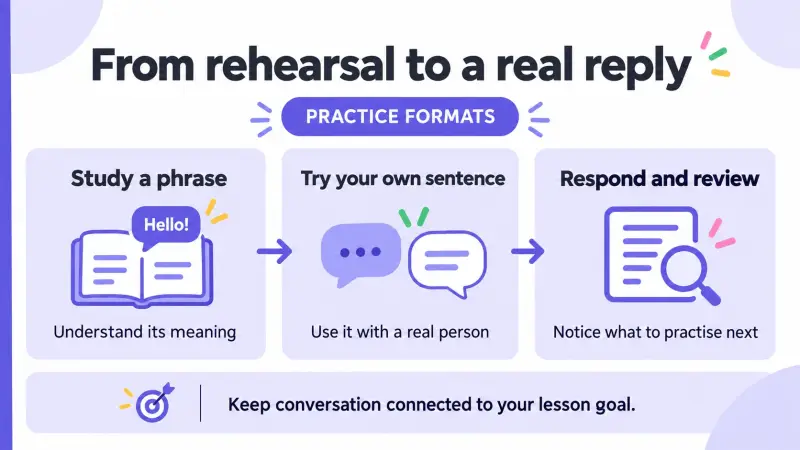
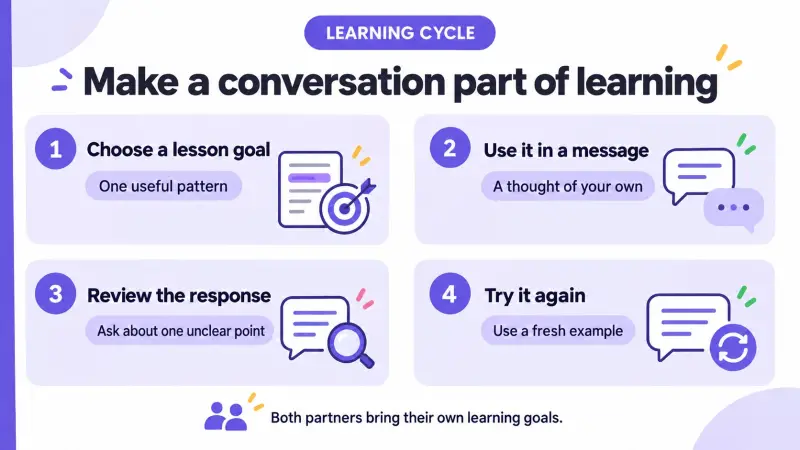
Build HelloTalk into the same sequence as your lessons. Choose one pattern you have just studied, use it in a short message, review the response and any correction, then try it again in a voice note. A beginner can keep that task to a greeting or a single sentence and expand it as the lessons progress. The guide to whether HelloTalk suits beginners shows how to make those first learning-and-practice sessions manageable.
Pricing follows the same logic. HelloTalk keeps 90% of core features free. VIP adds convenience layers like extra language slots and expanded translation, sold as regional monthly, yearly, or lifetime options (see in-app quote).
2. Speaky, HiNative, Hilokal, and Slowly, What Each One Does Differently
Once you understand the chat category, the other apps sort themselves quickly. Each solves a narrower problem, and narrow is not a criticism.
Speaky is the minimalist option. It finds you a partner and gets out of the way: no feed, no audio room, no toolbox layered on the conversation, which some people prefer. The limit is the pool. Speaky's user base is thinner, so reply rates swing hard by language pair, and there is no community layer to fall back on when messages go quiet.
HiNative is not really a chat app, it is an answer engine staffed by people. You post a single question, native speakers tell you which version sounds natural, and that is the end of the exchange. For settling one specific doubt it is faster than any conversation. It will not give you a partner who remembers what you talked about last week.
Hilokal takes the opposite bet and puts hosted live audio first. Rooms have a host steering the topic, which solves the awkward silence problem that kills unstructured voice chat. The cost is that you learn on the room's schedule and in front of an audience, which is a lot of pressure for a first attempt.
Slowly is the slowest tool here by design. Letters arrive on a delay based on real geographic distance, so a reply can take days. That removes reply anxiety completely and produces unusually thoughtful writing practice. It also means Slowly trains none of your speaking and cannot help you when you need a sentence checked tonight.
Duolingo is the strongest habit builder in the category and the weakest conversation tool. Its exercise design is genuinely good at moving vocabulary into long-term memory, and its scripted AI chat is a safe rehearsal space. But the replies are generated: always patient, always grammatical, never surprising. Scripted practice partners never misunderstand you, which is exactly why they cannot prepare you for a real conversation. Real speakers interrupt, use slang, and change topic mid-sentence, and that unpredictability is what you are training for.
The pattern: course apps make you ready to talk, chat apps make you able to talk. For the exchange mechanics, this breakdown of HelloTalk against other language chat apps goes deeper.
Best Chat App by What You Want to Practice
Ranking apps overall is useful once. After that, the better question is which app fits the thing you are fixing this month. The table below maps five practice goals to the place they happen and the reason that pick wins. Use it as a router: find your row, ignore the rest.
| What you want to practice | Where it happens | Why this one |
|---|---|---|
| Typing every day in short bursts | HelloTalk one to one chat | Correction lands inside the same thread, so you fix the sentence you wanted to write |
| Voice without scheduling | HelloTalk voice notes and calls | Recorded voice removes live timing pressure while still training real mouth movement |
| Live listening at natural speed | HelloTalk Voicerooms and Livestreams | Rooms run around the clock and you can join silently until you are ready |
| Scheduled one to one lessons | italki | A paid teacher prepares material and holds you to a path, which peer chat cannot do |
| Pronunciation drilling | ELSA, or HelloTalk AI pronunciation scoring | Instant per-sound feedback and unlimited repetition without using up a partner's patience |
If your goal is not on that list, it is usually reading or grammar, and neither belongs in a chat app.
Where Chat Apps Stop Being Enough
Chat apps have a ceiling, and pretending otherwise wastes people's time.
The first ceiling is coverage. Left alone, you will talk about the same eight topics forever. Your fluency on food, travel, work, and weekend plans gets strong while whole areas of the language stay blank. Fixing that means steering conversations somewhere uncomfortable, or adding a course that forces new territory.
The second ceiling is accuracy. Peers correct what is obviously wrong and rarely correct what is merely unnatural, because they understand you fine and nobody wants to be a pedant. Peer correction catches errors that break meaning and misses the ones that only make you sound foreign. That polish usually needs a paid teacher.
The third ceiling is your tolerance for silence. Some weeks nobody has time, threads die, and motivation follows. This is where community features matter more than matching, because a feed or an audio room gives you somewhere to go when your partner is busy. The fourth is testing: exam formats are specific and you have to train them directly.
None of that argues against chat apps. It argues for treating one as the production half of a two-part setup, and the rundown of the best language exchange apps is a reasonable place to pick that half if HelloTalk is not your fit.
Frequently Asked Questions About Language Learning Chat Apps
Which language learning chat app actually gets the most replies?
HelloTalk does, and the reason is pool size rather than any clever matching trick. With more than 70 million registered users across 200+ countries and 260+ languages, there is almost always someone awake who wants to practice your native language. Smaller platforms match you fine in English to Spanish and go quiet in rarer pairs.
Can I use a chat app as a complete beginner?
You can, but not as your only tool. With a few hundred words you can hold a slow text conversation, especially with in-chat translation in the thread. Before that point, spend 2-4 weeks on a course app to build enough vocabulary that a conversation has somewhere to go.
Is a chat app better than a paid tutor?
They are not competing for the same job. A tutor gives structure, correction on subtle errors, and accountability for an hour a week. A chat app gives volume and practice on the days you would otherwise do nothing. Most learners who progress fast use both, with the chat app carrying the daily reps.
How much does HelloTalk cost to use properly?
Most of it costs nothing. HelloTalk keeps 90% of core features free, including one to one chat, voice notes, Moments, and voicerooms. VIP adds convenience layers such as additional language slots and expanded translation, priced as regional monthly, yearly, or lifetime options (see in-app quote).
What do I say to open a conversation so it does not die immediately?
Skip "hi, can we practice." Ask something specific that only that person can answer, based on their profile or last Moments post. Alex asking "is this slang phrase normal in your city or just online" gets a reply almost every time, because it gives the other person an easy expert role.
Do I need to correct my partner for the exchange to work?
Yes, and it is the part people neglect. Exchange runs on reciprocity, and partners who receive nothing drift away. Rewriting one awkward sentence per conversation keeps it balanced.
Can these apps replace living in the country?
No, but they close a real part of the gap. Immersion gives you volume you cannot manufacture at home. A chat app gives you the daily contact and correction that used to require a plane ticket, which is why learners who have never left home now arrive on a first trip already able to hold a conversation. To try the conversation side directly, HelloTalk is free to join.
The Reply That Changes How You Use a Chat App
Almost everyone who sticks with a chat app can name the moment it clicked. Not a lesson, not a milestone screen. A reply. Someone wrote back with a joke you understood, or corrected a phrase in a way that finally made the rule obvious, and the app stopped feeling like homework.
That moment is the actual product. Everything above is a way of reaching it sooner: pick a platform with enough people that your messages get answered, use correction tools that work inside the conversation, and move to voice before you feel ready.
So the practical version is short. For the best chance of a real reply today, start with HelloTalk and post in Moments before sending a direct message. If you need structure more than conversation, start with a course app and add chat in a month.
Whichever you pick, send the first message tonight. The gap between people who make progress and people who delete the app in a week is almost never talent. It is whether they got a reply early enough to believe the thing works.