Best Language Exchange Apps in 2026: 8 Top Picks for Real Speaking Practice
Most language learners hit the same wall: months of study, solid grammar, decent vocabulary, but the moment a native speaker talks at normal speed, everything falls apart. The gap between knowing a language and using it with a real person is where fluency is actually built, and that's exactly what language exchange apps are supposed to close.
The problem is that most apps claiming to offer language exchange don't actually prioritize the exchange. They add a "find a partner" button onto a self-study platform and call it done. This guide covers the platforms that take exchange seriously, compares them honestly, and helps you find the one that fits how you actually learn.
If you're new to language exchange as a concept, our complete guide to language exchange explains how the method works, what to look for in a partner, and a 60-minute session template you can start using this week.
Quick Picks: Best Language Exchange Apps by Use Case
| Use Case | Best App |
|---|---|
| Best overall for real conversation | HelloTalk |
| Best free language exchange app | HelloTalk |
| Best for structured learning + peer feedback | Busuu |
| Best for beginners taking first steps | Speaky |
| Best for pen-pal style correspondence | InterPals |
| Best for paid tutor-led sessions | italki |
| Best for habit building and vocabulary | Duolingo |
How We Ranked These Apps
Every app in this list was evaluated against the same criteria. Ranking higher required doing more of these things well.
Community size and active user density. A large registered user base means nothing if the active users aren't there. Partner availability at different hours, in different time zones, matters for daily practice.
Free tier depth. Language learning is a long-term commitment. Apps that put core exchange features behind a paywall immediately are ranked lower than those that let you practice meaningfully before asking you to pay.
Speaking and voice features. Text-based exchange builds reading and writing skills. Voice messages, audio rooms, and real-time speaking tools are what build spoken fluency. Apps without voice features are ranked lower on this list.
In-app correction quality. Getting feedback in context, immediately after you've produced something, is categorically more useful than reviewing errors later. Correction tools built into the chat interface beat separate feedback workflows.
Partner matching quality. Matching by shared interests produces better conversations than matching by language pair alone. Better conversations mean longer exchanges, which means more learning.
Two apps in this list, italki and Duolingo, are not language exchange platforms in the traditional sense. They appear here because they're frequently compared against exchange apps and because understanding where they fit helps you decide whether you need them alongside an exchange app or instead of one.
Quick Comparison: All 8 Apps at a Glance
| App | Best For | Community Size | Free Tier | Voice Features | Correction Tools |
|---|---|---|---|---|---|
| HelloTalk | Real conversation and community scale | 70M+ users, 260+ languages | 90% of features free | Voicerooms, voice messages, AI pronunciation | In-chat grammar correction, AI tools |
| Busuu | Structured curriculum with peer writing feedback | 120M+ users | Limited (core content paywalled) | No live voice | Asynchronous peer writing feedback |
| Speaky | Frictionless first steps | Not disclosed | Core features free | Basic | None |
| InterPals | Pen-pal correspondence | ~5M users | Free | None | None |
| italki | Paid tutor-led sessions | Large tutor marketplace | Browse only, sessions paid | Yes (video sessions) | Teacher-led |
| Duolingo | Habit building and vocabulary reinforcement | 500M+ registered | Core content free | Pronunciation exercises only | Automated only |
| Hellopal | Voice and video focus | Not disclosed | Core features free | Yes | Limited |
| HiNative | Q&A language help | Not disclosed | Limited | No | Community answers |
HelloTalk — Best Overall for Real Conversation
-
Best for: Learners who want always-available practice across multiple formats, not just scheduled 1:1 chats
-
Community: 70M+ users, 200+ countries, 260+ languages
-
Platforms: iOS, Android
-
Free tier: 90% of features free
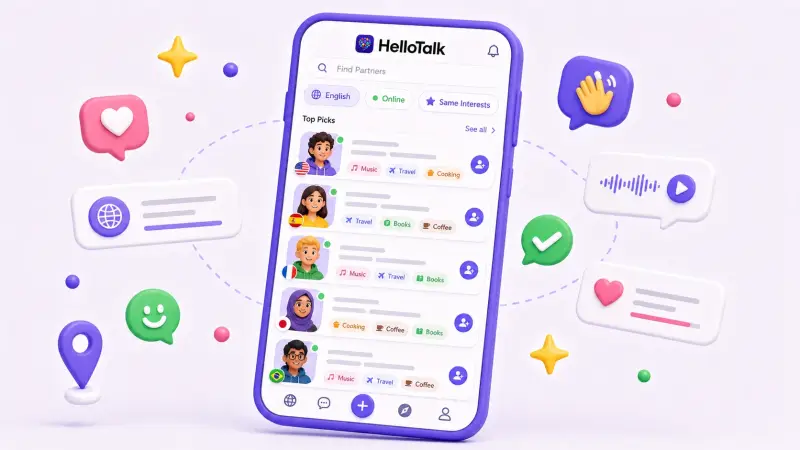
HelloTalk is the largest dedicated language exchange platform available. With 70 million users across more than 200 countries and support for over 260 languages, the practical effect is that active speakers of almost any language you're studying are online at any hour of the day. You're not waiting weeks for a match or hoping someone responds.
HelloTalk has been recognized across both major app platforms. It won Google Play's Best Social App award in 2017 and received a global Google Play homepage feature in 2024. On iOS, HelloTalk has received App Store Today recommendations in Japan, South Korea, and China, where its community is especially active among learners of Japanese and Korean.
The matching system goes beyond basic language filters. You can connect with people based on shared interests, which changes the quality of conversations significantly. Two people who both follow basketball or share an interest in cooking have something to actually talk about. Real topics produce real conversation, and real conversation builds fluency faster than drills built around vocabulary lists. This interest-based matching is one of the more underappreciated differences between HelloTalk and lighter platforms.
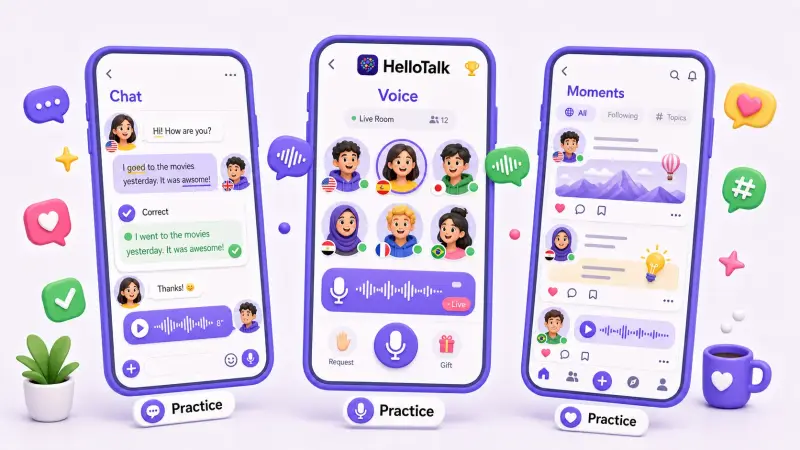
Moments functions as a broadcast-style practice tool: you post something in your target language, a sentence, a question, a short observation, and native speakers correct it, respond to it, or both. You get feedback from multiple people without scheduling anything. It's practice that works in gaps between other tasks.
Voicerooms and Livestreams address one of the recurring frustrations in language exchange: what happens when your regular partner is offline. Voicerooms are always-on audio spaces where you can drop in, listen to fluent conversation, speak when ready, or absorb the rhythm of the language passively. Livestreams add structured sessions led by hosts. Both give you ambient practice that feels nothing like a formal lesson.
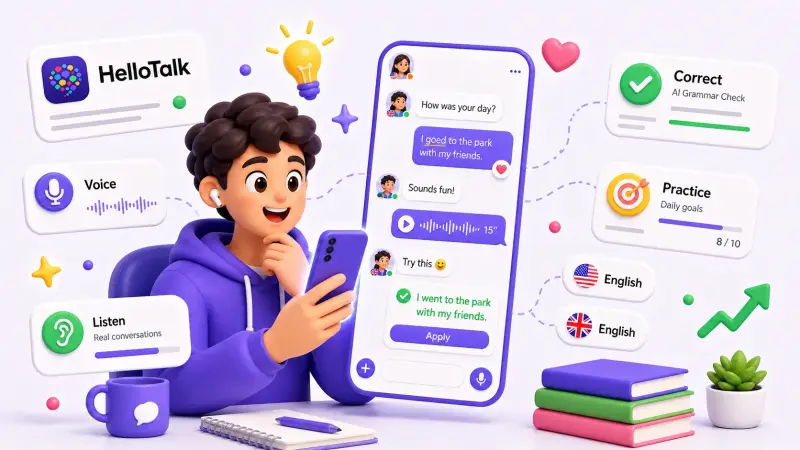
Inside chat, the Chat-based Learning and AI Learning Tools modules handle grammar correction, translation, AI pronunciation scoring, and text-to-speech without leaving the conversation. No switching apps, no interrupting the thread.
Pros:
-
Largest active community of any dedicated exchange platform, with partners available across time zones
-
Multiple practice formats beyond 1:1 chat, including Moments, Voicerooms, and Livestreams
-
Interest-based matching produces more natural, sustained conversations
-
90% of features available without paying
Cons:
-
Finding a long-term partner still requires your own effort: the platform connects you, but the relationship is yours to build
-
Some advanced features, including unlimited translations and certain AI tools, require HelloTalk VIP
-
Voicerooms and Moments are less structured than lesson-based formats, which suits some learners but not all
Busuu — Best for Structured Curriculum With Peer Feedback
-
Best for: Learners who want a course-style progression combined with some authentic writing feedback from native speakers
-
Community: 120M+ users
-
Platforms: iOS, Android, Web
-
Free tier: Limited (core content behind paywall)
Busuu is primarily a structured course platform with a peer feedback layer added on top. You work through lesson sequences with clear grammar and vocabulary goals, then submit writing exercises to native speakers in the Busuu community for correction. The courses are well-organized, with logical progression between topics and consistent lesson formats.
The peer feedback component is real and can produce useful written corrections, but the cycle is slow by design. Responses take hours to days, not minutes. For learners who want real-time conversation practice, Busuu's model doesn't support that. The platform is built around lesson completion, not open-ended exchange between two people. If you're doing a language learning apps comparison, this distinction matters: Busuu belongs more in the structured learning category than the exchange category.
The free tier is limited. A significant portion of the course content, including audio lessons and grammar review, sits behind the premium subscription. You can explore the platform without paying, but progression stalls quickly.
Pros:
-
Well-structured course progression with clear grammar and vocabulary targets
-
Peer writing feedback from native speakers adds authentic input beyond automated checks
-
Clean, consistent interface across iOS, Android, and web
Cons:
-
Core content requires a paid subscription to access fully
-
Peer feedback is asynchronous and not suited for real-time speaking practice
-
Not a true exchange platform: the relationship is more student-to-content than learner-to-learner
Speaky — Best for Frictionless First Steps
-
Best for: First-time language exchange users who want the lowest-friction introduction to the format
-
Platforms: iOS, Android, Web
-
Free tier: Core features free
Speaky's main strength is its onboarding. Setup takes a few minutes, finding a partner requires almost no friction, and the interface doesn't demand much from you. If you've never used a language exchange app and want to understand what the format actually feels like before committing to a more feature-heavy platform, Speaky gets you there quickly.
Past those first few interactions, the limitations become more apparent. Matching is thin: you can filter by language, but there's no interest-based pairing and no community features beyond 1:1 chat. There are no correction tools built into the interface, no translation support, and no community spaces for practice when a partner isn't available. What you have is essentially a chat app with a language filter applied. The platform works as a starting point but doesn't offer much infrastructure for learners who want more than text exchange.
Pros:
-
Minimal setup and very low barrier to first conversation
-
Core features are free without a subscription
-
Available across iOS, Android, and web
Cons:
-
No interest-based matching, which limits conversation quality and partner retention
-
No in-chat correction tools, translation support, or speaking practice features
-
Doesn't scale well: most users outgrow it quickly once they want more than basic chat
InterPals — Best for Pen-Pal Correspondence
-
Best for: Learners who prefer written correspondence and cultural connection over real-time speaking practice
-
Community: ~5M users
-
Platforms: Web, App
-
Free tier: Free
Evaluated on language learning outcomes, InterPals ranks last in this comparison. There is no speaking practice, no real-time exchange, no correction tools, and no way to hear the language spoken. Asynchronous letter-writing develops a narrow slice of written reading comprehension and nothing else. For learners whose primary goal is spoken fluency, consistent feedback, or daily practice, InterPals provides no infrastructure for any of it.
Where InterPals does have genuine value is outside the scope of this guide: building international friendships through thoughtful written correspondence at a relaxed pace. That use case is well-served by the platform and covered in apps to meet international friends, which compares platforms built for cross-cultural connection rather than language acquisition. For a direct side-by-side of InterPals and HelloTalk on their own terms, see InterPals vs HelloTalk.
Pros:
-
Genuinely suited to pen-pal correspondence and cultural exchange
-
Free to use with no paywalled core features
-
Established community with users who understand the correspondence format
Cons:
-
No speaking, voice, or video features of any kind
-
No in-app correction tools or translation support
-
Not designed for fluency-building: works better for cultural connection than language practice
italki — Best for Paid Tutor-Led Practice
-
Best for: Learners with a budget who want structured lessons with a qualified or community tutor
-
Platforms: iOS, Android, Web
-
Free tier: Browse only; all sessions are paid
italki is not a language exchange platform. It's a marketplace where you book paid sessions with professional teachers or community tutors. The distinction matters because the dynamic is different: you're paying someone to teach you, not entering a reciprocal exchange. That's not a criticism, just a clarification that helps you place it correctly alongside the other apps on this list.
Where italki earns its place here is in the learner profile it serves. If you want structured grammar instruction, JLPT or IELTS preparation, consistent lesson progression, or the accountability of a scheduled session with a specific teacher, italki is one of the better places to find that. The tutor marketplace is large, filtering by native language and teaching style is genuinely useful, and community tutors (informal teachers at lower rates) make it accessible without a large budget.
The realistic use case for most learners is to run italki alongside HelloTalk, not instead of it: one or two structured sessions per week for targeted grammar or exam prep, with HelloTalk handling the daily practice volume.
Pros:
-
Large tutor marketplace with native speakers across most major languages
-
Flexible scheduling and wide range of price points via community tutors
-
Useful for structured exam preparation and grammar-focused sessions
Cons:
-
Every session costs money; there's no way to practice free through the platform
-
Not an exchange model: you're the student, not a mutual learner
-
Session quality varies widely depending on the tutor
Duolingo — Best for Habit Building, Not True Exchange
-
Best for: Learners who want a consistent daily habit and vocabulary foundation
-
Platforms: iOS, Android, Web
-
Free tier: Extensive (core content free, ads or subscription for premium)
Duolingo belongs on this list because it's the app most learners already have installed, and because understanding where it fits prevents a common mistake: treating it as a substitute for real conversation practice.
Duolingo is genuinely good at one thing: getting you to open a language learning app every day. The streak mechanic, the gamified lessons, the low time commitment, these work. If you've never studied a language before and you need a foothold into vocabulary and basic grammar, Duolingo provides that with minimal friction.
What Duolingo doesn't do is put you in contact with another human being. Speaking exercises are pattern-matching against a recording. There's no native speaker on the other end, no unpredictable response, no correction from someone who actually speaks the language. This is fine for foundation-building. It stops being fine when learners spend a year on Duolingo and discover they still can't hold a real conversation.
The typical path that works: use Duolingo to build vocabulary and keep a daily habit, then use HelloTalk to turn that vocabulary into actual conversation.
Pros:
-
Very effective at building a consistent daily practice habit
-
Wide language coverage with structured lesson paths
-
Free core content with no partner-matching required
Cons:
-
No native speaker interaction of any kind
-
Speaking exercises are scripted and assessed by automation, not real people
-
Does not build conversational fluency or spontaneous production skills
How to Choose the Right Language Exchange App
The right choice depends on what you're actually trying to accomplish. A quick framework:
-
If you want the largest community and the most practice formats available (chat, audio rooms, broadcast correction, structured sessions): choose HelloTalk. The combination of scale and varied practice modes makes it suited for learners at any stage.
-
If you want a structured course with clear grammar targets and some authentic peer writing feedback: choose Busuu. Accept that it's more of a study tool than a true exchange platform.
-
If you've never tried language exchange before and want the simplest possible entry point: start with Speaky. Treat it as an introduction, not a long-term home.
-
If you want scheduled sessions with a qualified teacher and have a budget for it: use italki alongside HelloTalk.
-
If you need a daily habit anchor and vocabulary foundation: Duolingo. Then graduate to real conversation on HelloTalk.
-
If building international friendships is your primary goal rather than language fluency: that use case is better served elsewhere. See apps to meet international friends for platforms built around cross-cultural connection.
The app that works best is the one you'll open every day. Language exchange requires repetition over weeks and months, not a one-time effort. A feature-rich platform you abandon after two sessions builds less fluency than a simpler one you use consistently.
Once you've chosen a platform, the language-specific guides below go deeper on daily exchange practice for the most common target languages: Spanish · Japanese · French · Korean · German
Reply rate is the one criterion this ranking cannot settle from feature lists alone, because it depends on who is actually active in your language pair. Our breakdown of six language exchange communities compared by reply rate and correction quality works through that question platform by platform.
FAQ
What is language exchange and how does it work? Language exchange is a mutual practice arrangement where two people help each other with their respective native languages. You help your partner with your language while they help you with theirs. Both people bring something to offer, which changes the dynamic compared to one-way tutoring or app-based study. Dedicated platforms match users by language pair, learning goals, or shared interests, and provide tools to support that practice.
Are language exchange apps effective for building speaking fluency? Yes, when used consistently. The key distinction is between apps that support real conversation, with voice features, speaking rooms, and real-time feedback, and apps that only offer text chat. Text exchange builds reading and writing skills but doesn't develop listening comprehension or speaking fluency the same way. Platforms with audio and video support, or ambient listening features like Voicerooms, close that gap more effectively.
Which language exchange app has the most users? HelloTalk has the largest community of any dedicated exchange platform, with 70 million users across 200+ countries and support for 260+ languages. Busuu reports 120 million registered accounts, though its platform functions more as a structured course tool than an exchange platform in the traditional sense.
How much do language exchange apps cost? Cost structures vary significantly. HelloTalk offers 90% of its features for free, with a VIP tier for additional tools. InterPals and Speaky are free at the core feature level. Busuu requires a premium subscription to access most of its course content. Free tiers across platforms are generally sufficient for casual learners, while more serious learners may find value in paid features depending on their goals.
Can I learn multiple languages at once on these platforms? Most platforms allow you to list multiple target languages on your profile. HelloTalk supports 260+ languages and lets you connect with speakers across all of them. In practice, learners making real progress tend to focus on one language at a time, since consistent practice with the same partners over an extended period is what builds fluency. The platforms support multiple languages technically, but the learning benefit comes from depth rather than breadth.
Is HelloTalk suitable for complete beginners? Yes. The platform is used by learners at every level, from absolute beginners to near-fluent speakers. Beginners often start with text-based exchange, using the built-in translation and correction tools to manage the gap in proficiency. As your level improves, you can shift toward voice messages, Voicerooms, and eventually live conversation. The community is large enough that you can find patient partners at any stage.
What is the best free language exchange app? HelloTalk offers the most complete free experience among dedicated exchange platforms. Core features including partner matching, text and voice messaging, Moments, Voicerooms, and the basic AI tools are all available without payment. For learners who want real conversation practice without a financial commitment, HelloTalk's free tier covers everything needed to build a meaningful daily practice routine.
Are language exchange apps safe? Any app where you talk with strangers carries some risk, and no platform removes it entirely. HelloTalk sets out its rules and tools on its safety page: policies against harassment, impersonation, scams, spam, and sharing private information without permission, enforced through a combination of technology, human moderation, and reports from the community. Content or accounts that break those rules can be restricted or removed. On your side, the practical habits are the same everywhere. Keep early conversations in the app, share personal details at your own pace, and block or report anyone who makes you uncomfortable, without needing to justify it.
What is the difference between a language exchange app and a language learning app? A language learning app (Duolingo, Babbel, Rosetta Stone) teaches you language content through exercises, lessons, and drills. You consume input and complete tasks. A language exchange app (HelloTalk, Speaky, InterPals) connects you with another human being who speaks the language you're learning. You produce output, receive feedback, and have actual conversations. Both have value, but they develop different skills. Language learning apps build vocabulary and grammar knowledge. Language exchange apps build the ability to use that knowledge in real interaction. Most serious learners need both.