
Best Apps for Meeting International Friends in 2026 - What Actually Works
You match with someone in Tokyo or São Paulo, exchange a handful of messages over a few days, and then the conversation quietly disappears. Not because either of you was rude or uninterested. It fades because there was nothing holding it together, no real reason to keep showing up for each other.
That gap between "meeting" someone online and building a genuine international friendship is the central problem with most apps in this space. Random chat apps keep you talking until the novelty wears off. Interest-based platforms run out of steam once the opening topics are exhausted. Apps built for romance or social matching operate on entirely different dynamics. You end up with a long list of acquaintances from other countries and very few people you'd actually call friends.
The international friendships that stick tend to have one thing in common: they're built around a shared purpose, not just a shared desire to "meet people." Language exchange is one of the most powerful structures for this, and the best apps in this category either use that structure directly or give you something equivalent. This guide covers nine apps worth your time in 2026, what each one is actually good for, and how to make real connections through them.
Why Most Apps Don't Produce Real International Friendships
Most social matching apps work on a single premise: two people find each other interesting, start talking, and either the connection sustains itself or it doesn't. The problem with this for international friendships is that it puts all the weight on raw conversational chemistry between people who don't yet share cultural context, references, or sometimes even a comfortable shared language. When that chemistry doesn't immediately spark, the conversation dies.
Language exchange shifts this dynamic in a concrete way. When you're learning your partner's language and they're learning yours, neither of you is a passive participant. The motivation to come back isn't just "I liked talking to them," it's "I need to practice, and this person actually helps me." That mutual investment creates accountability in both directions. You start noticing things in your week that you want to tell them about, and that noticing is the difference between a language partner and a friend.
There's also a structural advantage: every session has built-in direction. When dead air hits in a random chat, both people tend to exit. When it hits in a language exchange, one of you pulls out a phrase that's been confusing you, and the session keeps going. More importantly, practicing a language authentically means discussing real things, work, food, music, how different cultures relate to time or family or public space. The language is the medium through which a genuine cross-cultural friendship forms. That's why this category of app consistently outperforms general social platforms for building lasting international connections.
The Best Apps for Meeting International Friends
1. HelloTalk
- Best for: Language exchange with deep community features and ambient daily practice
- Platforms: iOS, Android
- Free to use: 90% of features free; VIP available
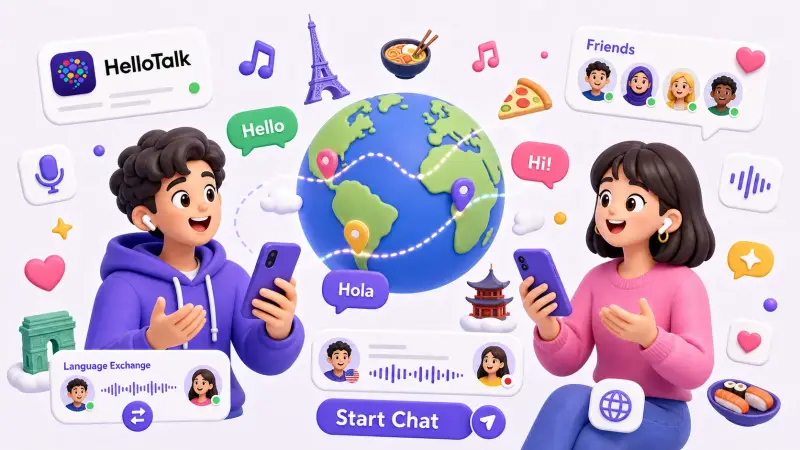
HelloTalk was built for language exchange, which turns out to be one of the most durable structures for international friendship. The dynamic is different from apps built purely for social connection: both people have a genuine reason to keep showing up. You need their language, they need yours. That mutual investment doesn't fade after the first few exchanges the way novelty-driven connections do.
The features that make HelloTalk effective for language learning are the same ones that keep cross-cultural friendships alive past the first conversation. Translation, AI correction, and phonetic tools sit directly inside the chat window — when you don't know how to say something, you find out immediately and keep going, rather than sending a half-formed message and hoping your partner fills in the gap. Conversations stay in motion. Friendships form through sustained momentum, not through good intentions that stall at a vocabulary wall.
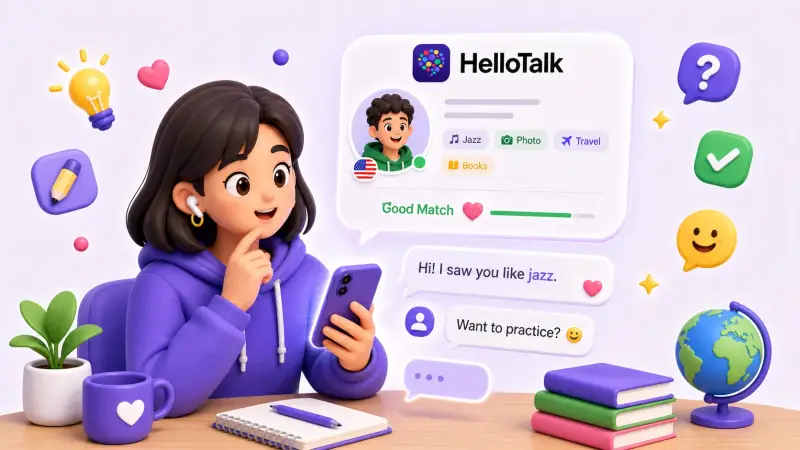
The matching system goes deeper than language level. You set interest tags on your profile covering music, cooking, sports, travel, film, tech, or whatever actually describes you. HelloTalk then surfaces partners who share those interests and speak your target language. A conversation about Brazilian jazz between enthusiasts in São Paulo and Seoul has a completely different quality than a generic "let's practice English" exchange, and those shared interests are what give early conversations something real to hold onto.
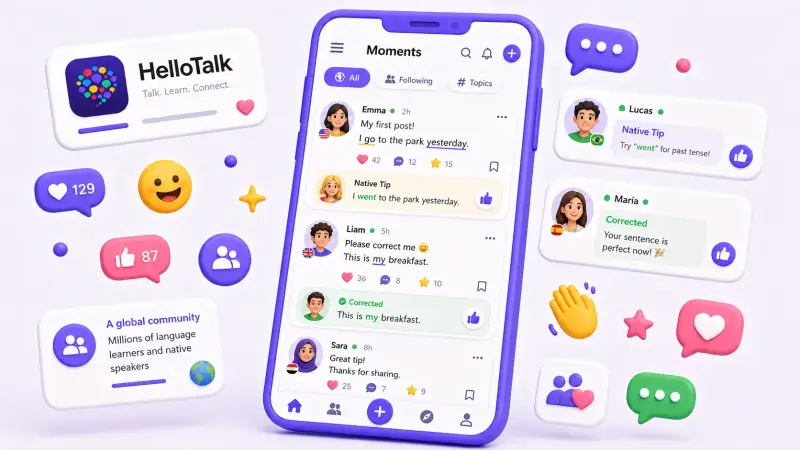
With 70M+ users across 200+ countries and 260+ languages supported, the breadth of people available is something no pure social app can match. HelloTalk received Google Play's Best Social App award in 2017 and was featured on Google Play's global homepage in 2024. On iOS, it has earned App Store Today recommendations in Japan, South Korea, and China - a reflection of its particularly strong communities for learners of Japanese and Korean. The Moments feed creates a community layer above 1:1 chat, letting you post photos, short writing, or questions in your target language. Over weeks, this builds into something that looks more like following a friend than using a study tool. Voicerooms and Livestreams extend this further, giving you shared real-time experiences with international speakers that most messaging apps can't replicate.
A real scenario: Lena, a documentary filmmaker in Berlin, set her HelloTalk profile with interest tags for jazz, street food, and urban photography, then filtered for Japanese speakers who shared at least one of those interests. Within her first week she matched with Kenji in Osaka, who photographs street markets and is learning German. Their first session started with him explaining why a specific fish market draws photographers, and ended with her describing a Berlin neighborhood she shoots in regularly. Three months later they still talk twice a week. The language exchange is still the formal structure, but at this point they're genuinely friends who happen to be helping each other with German and Japanese.
For a full breakdown of what HelloTalk offers as a practice platform, see our language learning apps comparison.
2. InterPals
- Best for: Pen-pal correspondence and cultural exchange at a relaxed pace
- Platforms: Web, mobile app
- Free to use: Yes
InterPals is built for written exchanges at an asynchronous pace, suited for people who prefer composing thoughtful messages over real-time conversation. The community skews toward genuine curiosity about other cultures rather than structured language drilling. If you're deciding between this and HelloTalk, the InterPals vs HelloTalk comparison covers the key differences.
3. Slowly
- Best for: Reflective pen-pal friendships with a distance-based twist
- Platforms: iOS, Android
- Free to use: Yes, with premium option
Slowly delivers messages based on the real-world distance between you and your pen pal, so a message to a neighboring country might arrive in hours while one sent across the globe takes a day or two. This creates a letter-writing rhythm that some people find more meaningful than instant messaging. It's not built for rapid language feedback, but for slow-burn cross-cultural connection it's genuinely distinctive.
4. Speaky
- Best for: Quick, low-friction first contact with native speakers
- Platforms: iOS, Android, Web
- Free to use: Core features free
Speaky keeps the barrier to entry low: you pick the languages you speak and want to learn, and you're matched with native speakers almost immediately. It's useful for getting your first international conversations started without overthinking the setup. The experience is more casual than structured, which works well if you want to test the waters before committing to a regular exchange schedule.
5. Bumble BFF
- Best for: Meeting friends locally or while traveling internationally
- Platforms: iOS, Android
- Free to use: Core features free
Bumble's friend-finding mode works in most major cities worldwide and is particularly useful when you're traveling or have recently relocated. You browse through profiles in a familiar card-swipe format, but the intent is explicitly friendship. If you're spending time abroad and want to meet locals or other internationals in the same city, Bumble BFF gives you a fast, low-stakes way to make that happen.
6. Meetup
- Best for: In-person connection with locals and travelers around shared interests
- Platforms: iOS, Android, Web
- Free to use: Free to join events (organizers pay)
Meetup is organized around activities rather than profiles, which means you show up to a cooking class, a language practice session, or a hiking group and the conversation starter is built in. It's active in hundreds of cities globally, and many groups are specifically designed for international visitors or expats. If you're already in a place and want to meet people face to face, this is one of the most practical tools available.
7. Couchsurfing
- Best for: Travel-based connections and local meetups while abroad
- Platforms: iOS, Android, Web
- Free to use: Membership required (previously free)
Couchsurfing has shifted to a paid membership model, but its core community of travelers and locals who genuinely want to connect remains active in many countries. Beyond hosting, the Hangouts feature lets you signal when you're available to meet locals in whatever city you're in. It's best used when you're already traveling rather than as a tool for building remote friendships from home.
8. Discord (Language Learning Servers)
- Best for: Finding international communities around specific languages or interests
- Platforms: iOS, Android, Web, Desktop
- Free to use: Yes
Discord's language learning servers, including Language Sloth, LearnEnglish, and dozens of language-specific communities, host thousands of international members and run live voice channels around the clock. You can drop into a conversation with speakers from multiple countries at almost any hour. It's less structured than a dedicated language app but more dynamic for meeting a wide range of people from a specific linguistic or cultural background.
9. InterNations
- Best for: Expats and professionals building international networks
- Platforms: iOS, Android, Web
- Free to use: Basic membership free; premium available
InterNations is designed for people who have moved internationally or work across borders, with communities in over 420 cities worldwide. Events are organized around professional networking and cultural integration, which gives interactions a bit more substance than casual social apps. If you're an expat or frequent international traveler looking to build a network with real-world utility, this is the most focused platform for that purpose.
How to Start a Conversation That Actually Goes Somewhere
The difference between a conversation that dies after two messages and one that becomes a weekly routine usually comes down to the first message and how you structure the first few sessions.
Step 1: Build a profile that reflects who you actually are. "Studying Japanese" is a goal, not a person. Add the things you genuinely do and care about: the music you listen to, the sports you follow, the food you cook, the work you do. These details give potential partners a real opening for a first message, and they determine who finds you in searches.
Step 2: Use interest filters when searching for partners. On apps that support it, filter by both language and shared interests simultaneously. A partner who speaks your target language and shares your interest in film photography is a more durable connection than a random native speaker with no overlapping context.
Step 3: Open with something specific. A message that says "hi, want to exchange?" gets ignored. Reference something from their profile or a post they've made. "I saw you posted about hiking in Hokkaido. I've been working on natural Japanese for outdoor scenes, and your photo captions were exactly the kind of phrasing I was looking for. Would you be open to a language exchange?" That message gets a response.
Step 4: Keep the first session short. Fifteen to twenty minutes is enough to find out whether there's real conversational chemistry before committing to a regular schedule. Some matches feel natural immediately; others feel like work. Short first sessions let you figure this out without either person feeling obligated to continue.
Step 5: Suggest a regular time. "Would you want to do this same time next week?" is the message that separates a one-time conversation from a friendship. Consistency is what turns a match into something real.
A real scenario: David, a software developer in Chicago learning Mandarin, filtered for Mandarin speakers on HelloTalk who listed technology as an interest. He found Marcus in Taipei, a product designer who'd posted a photo of his workspace setup. David's first message referenced the setup specifically and asked about a piece of equipment in the photo, mixing basic Mandarin with English. Marcus responded within an hour. They kept their first session to 20 minutes, and within a month had settled into a Tuesday/Friday routine that's still going six months later.
How to Make International Friendships Last
Most international friendships that fade out follow the same pattern: a few strong early conversations, sessions that gradually get longer and less frequent, then silence. The friendship didn't fail because of incompatibility. It faded because of inconsistency.
Three habits separate the connections that last from the ones that don't.
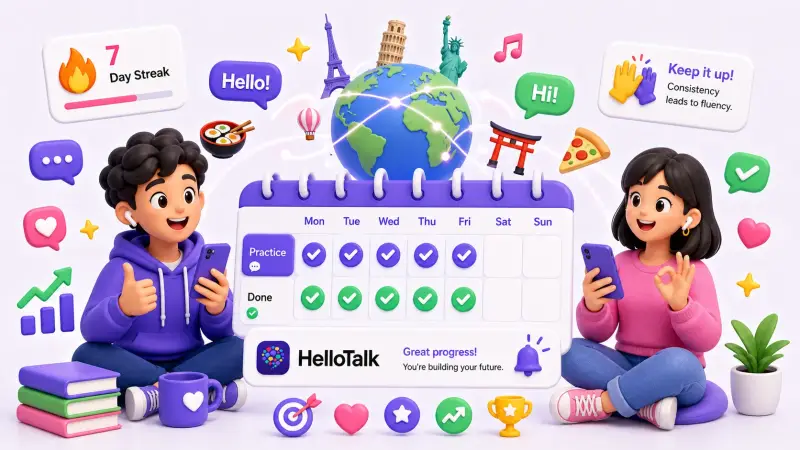
- Prioritize regular cadence over long sessions. A 15-minute daily conversation builds more relationship than a two-hour session once a month. The daily check-in becomes part of how you experience your own week. You start noticing things during the day that you want to tell your partner about, and that noticing is the difference between a language partner and a friend.
- Create shared experiences outside the practice structure. Watching the same show and comparing notes. Following the same news story from different national perspectives. Both trying the same recipe and reporting back. These parallel experiences give you something to talk about that isn't just language study, and they start to mirror the texture of real friendship.
- Use your app's social feed to stay present between sessions. When you can see what your partner posted about their weekend, or they can see a photo you shared from a walk, you stay in each other's lives without needing to schedule it. You walk into your next session already knowing something about their week.
The point where a friendship becomes real is usually identifiable: it's when the language stops being the barrier and starts being the medium. You're no longer carefully constructing sentences. You're just talking. Getting there takes consistent time and a real reason to keep showing up. Language exchange gives you that reason from the start.
Safety Tips for Meeting People Online Internationally
Building connections across borders is genuinely rewarding, but it comes with the same cautions that apply to any online interaction with strangers.
- Keep early conversations on the app itself before sharing personal contact information like your phone number, email, or social media profiles.
- Use the app's built-in block and report tools freely. You don't owe anyone a continued conversation, and these tools exist specifically so you can exit uncomfortable situations without friction.
- If you've connected through a travel app and are considering an in-person meeting, video call first. A live video conversation gives you a much better read on someone than text exchanges alone.
- Trust your instincts. If a conversation makes you uncomfortable or a request feels off, end it. Genuine people understand boundaries; anyone who pushes back hard on reasonable ones is telling you something important.
- Avoid sharing your exact location, workplace, or daily routine early in a connection. These details can wait until you've built enough trust to know they're in good hands.
- Be especially cautious with anyone who escalates quickly toward financial topics, claims of emergency, or requests to move off-platform immediately after first contact.
FAQ
What's the best free app for meeting international friends? HelloTalk offers the most complete free experience in this category, with the majority of its features available without a paid subscription. InterPals and Discord are also fully free. Slowly and Speaky offer free core access with optional upgrades.
Can you make real friends on language exchange apps? Yes, and language exchange apps tend to produce more durable international friendships than general social platforms. The shared purpose and mutual investment built into the format give both people a real reason to keep showing up, which is the foundation of any lasting friendship. Many users report connections that last years and, in some cases, lead to in-person visits.
Which app is best for making friends while traveling? Bumble BFF, Meetup, and Couchsurfing are the strongest options when you're physically in a new place and want to connect with locals or other travelers. Meetup in particular is organized around activities, so the social friction of meeting strangers is much lower. HelloTalk is also useful for connecting with locals before you arrive somewhere new.
Is HelloTalk good for making friends, not just language practice? Yes. The Moments feed, Voicerooms, and Livestream features create a social layer that goes well beyond 1:1 study sessions. Many users who started on HelloTalk for language practice report that the friendships they built through the platform became the more significant outcome.
How long does it take to make real international friends through an app? There's no fixed timeline, but users who practice consistently, two to three times a week, and who put effort into the early conversation setup, typically report feeling genuinely connected to a partner within two to three months. The consistency of contact matters far more than the length of individual sessions.
Do I need to speak another language to use these apps? No. Several apps on this list, including Bumble BFF, Meetup, Couchsurfing, and InterNations, work entirely in English or your native language. For language exchange apps like HelloTalk, you don't need to be advanced in your target language to start. Many users begin as complete beginners and find that their partners are patient and motivated to help, since they're getting the same support in return.