
Language Learning Websites Compared by Who Is on the Other End

Most comparisons of language learning websites line the products up and describe their features one after another. Lesson counts, language lists, offline mode, streak mechanics. After reading four of those you still have no way to pick one.
There is a shorter question that sorts the whole field in one move. When you produce a sentence in the language you are learning, who or what is on the other end of it? There are only three answers, and every website you have considered belongs to exactly one of them.
We are the HelloTalk content team, and HelloTalk appears on this list. The HelloTalk entry below carries the same two columns as every other entry, including a plain statement of what HelloTalk does not do.
This article sorts six well-known sites by the type of response they give you and ends with a table naming the type you are currently missing. If you want the version organised around apps rather than websites, our comparison of language learning apps covers that ground separately.
Every Language Website Answers to One of Three Teachers
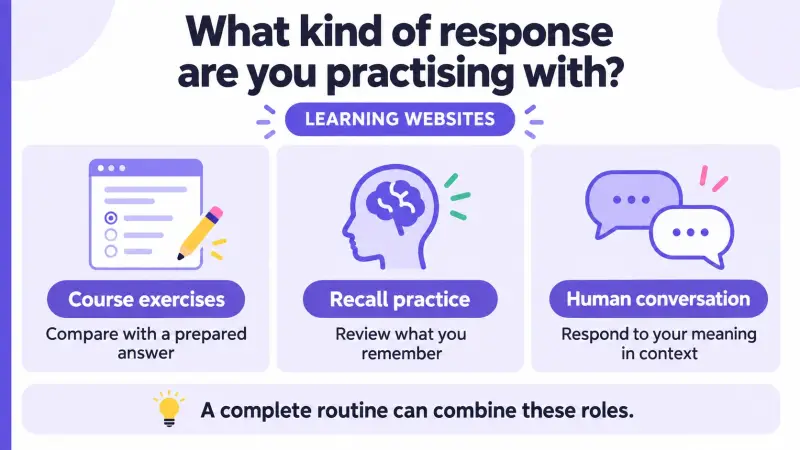
Behind every language learning website there is a responder: a mechanism that receives your output and sends something back. There are three of them, and the distinction is structural rather than a matter of degree.
The first is a program. Someone wrote a course, sequenced it into units, and built exercises with predetermined right answers, and the program checks your input against a stored key. Babbel, Rosetta Stone, and Busuu are built this way. The course was written before you arrived and gives your sentence the same response it gives everyone else's.
The second is an algorithm. Nobody wrote a lesson path for you. A scheduling engine tracks which items you recalled, how recently, and how confidently, then decides what to show next. Memrise, Anki, and Pimsleur run on variants of this. It is responsive in a real sense, because tomorrow depends on today, but it responds to your recall history, not your meaning.
The third is a person, who reads or hears what you produced, works out what you were trying to say, notices the gap, and reacts. HelloTalk and italki are organised around this. A person is the only responder that can tell you your grammar was flawless and nobody says it that way.
The three responder types are not three qualities of the same thing, they are three different transactions, and a website can only be built around one of them at a time. Products add features from the other categories at the edges, but the core transaction stays fixed, and that core is what you are actually buying.
None of the three is better in general. A program is the only one that gives you an ordered path through a grammar system you have never seen. An algorithm is the only one that keeps two thousand items alive in your memory for a year without you deciding what to review. A person is the only one who can tell you whether what you said landed. Learners stall when they run one type for months and mistake it for the whole activity.
Six Websites Sorted by Who Responds When You Produce Something
One note on how to read the table. The middle column is the honest strength of that responder, and the last column is what the same structure makes impossible. The failures listed are not bugs anyone will fix, because they follow from how the product is built. Read the last column first if you are choosing.
| Website | Who responds to you | What that response is good at | Where it fails |
|---|---|---|---|
| Babbel | A program | Short dialogue-shaped lessons with grammar explained in plain language, sequenced by a course writer who knew what order things go in | The dialogue was written before you arrived, so it never adapts to the sentence you actually wanted to make |
| Rosetta Stone | A program | Image and sound pairing that builds meaning without translating, plus speech scoring against a reference waveform | Scoring compares your sound to a stored model, so a sentence can pass while being something no speaker would say |
| Memrise | An algorithm | Spaced repetition over vocabulary, with native-speaker video clips attached to items so words arrive with a real voice | Recognition of a known item is not production of a new sentence, and the gap between the two stays invisible |
| Pimsleur | An algorithm | Graded interval recall delivered through audio, which trains your mouth and ear while your eyes are busy elsewhere | Nothing hears your answer, so a pronunciation error made on day three is still there on day ninety |
| italki | A person | Scheduled lessons with a chosen tutor who can plan a sequence, assign follow-up, and correct systematically across sessions | Practice happens only inside booked slots, and paid lessons mean the amount you speak is limited by your budget |
| HelloTalk | A person | Unscheduled conversation with native speakers who correct you inside the chat, with in-chat translation and in-chat correction available on every message | Choose a lesson objective before the exchange and review the feedback afterward; different partners may offer different explanations |
Six rows, three responder types, two entries each. That is what the field looks like once you stop sorting by price tier and start sorting by mechanism, and it is why a learner can own three subscriptions and still be missing an entire category. The next three sections take each type in turn and say who it is right for.
When a Program Is Responding: Babbel, Rosetta Stone, and Busuu
A program is a course that was written once and is now being played back to you. The writer made decisions you would not know how to make: that possessives come before the past tense, that the polite register arrives before the casual one, that twelve units is the right size for the first plateau. The single thing a written course gives you that nothing else does is the correct order, decided by someone who already knows the language.
Babbel is the most conversational of the three. Its lessons are built around short exchanges of the kind you would actually have, and it explains grammar in ordinary sentences rather than terminology. What it cannot do is depart from its script, so the moment your question becomes "how would I say this specific thing," the program has nothing.
Rosetta Stone removes translation instead. You see an image, hear a phrase, and build the association directly, a genuine fix for learners who get tangled translating word by word. Its speech feature scores pronunciation against a stored reference, useful for gross errors and unreliable for fine ones, and it cannot tell you that your well-pronounced sentence is a construction nobody uses.
Busuu adds a hybrid element by routing some written exercises to its community for review, a real step outside the category. That model gives you feedback from a person, with a wait of hours or days and no conversation around it. It answers "was this correct" but not "what would you have said instead."
The program category is strong for the first stretch and then hits a wall built into it. You will know the forms and you will have finished the units, and your first unscripted exchange will still go badly, because the course never tested you against an unpredictable person.
When an Algorithm Is Responding: Memrise, Anki, and Pimsleur
An algorithm has no opinion about your sentences. It has a schedule. Every item you have studied carries a timestamp and a difficulty estimate, and the engine calculates when you are about to forget it, then shows it to you just before that happens.
Memrise builds spaced repetition around vocabulary and attaches short clips of native speakers saying the item, which fixes the problem of learning a word in a voice that does not exist. Anki does the same scheduling with nothing attached, an empty engine with total control, which is why learners with specific vocabulary needs end up there and casual learners bounce off within a week. Pimsleur applies interval logic to audio, prompting you to produce a phrase before you hear the model, training the physical act of speaking under time pressure.
Spaced repetition is the only mechanism that reliably keeps two thousand items available in your memory for a year, and no amount of conversation practice replaces it. If you have ever known a word on Monday and lost it by Friday, this category is what you are missing.
The failure is the same for all three. The algorithm scores whether retrieval happened, not whether the language was appropriate. It cannot tell you that the word you have drilled four hundred times is formal to the point of sounding strange in a casual message. Pimsleur never hears your answer at all, so nothing checks whether the sound you produced matches the one you were prompted with. A learner who runs only this category ends up with a large passive inventory and no evidence about which parts survive a real conversation. Our look at free English learning apps compared shows how common this is at the free tier, where drilling is cheap to provide and human feedback is not.
When a Person Is Responding: HelloTalk and italki
A person answers the question the other two cannot process: not "is this correct" but "did this work." A native speaker reading your message reconstructs what you meant, compares it to what you wrote, and reacts to the difference. That reaction holds information no answer key and no scheduler has, including the most useful case of all, the sentence that is grammatically fine and socially wrong.
HelloTalk is built around unscheduled conversation. The HelloTalk platform connects learners with native speakers across 200+ countries and 260+ languages, with 70M+ registered users and over 1 billion messages daily. Because the exchange is mutual, the person correcting your Spanish is practising their English with you, which keeps volume high without a booking system. HelloTalk keeps 90% of core features free, and the app was named 2017 Google Play Best Social App and received a 2024 global Google Play homepage feature.
Correction happens inside the conversation rather than after it. HelloTalk provides in-chat translation and in-chat correction on individual messages, along with transcription and read-aloud, so a partner can mark up your sentence without either of you leaving the thread. HelloTalk's Moments feed is a public post several native speakers can correct at once. HelloTalk's Voicerooms and Livestreams run around the clock and can be entered as a listener first. HelloTalk's AI learning tools add pronunciation scoring that names the specific sound you missed, grammar correction with an explanation attached, and image translation.
Use HelloTalk as part of the same plan as your lessons. Take one studied pattern into a conversation, review how a partner responds, and practise the revised version before the next lesson. HelloTalk's interactive learning, Moments, and voice activities offer different settings for that cycle. Agree on a specific feedback question and return to a lesson explanation when a correction needs more context.
italki occupies the scheduled half of the same category. You pick a tutor, book paid lessons, and get a person who can plan across sessions, assign homework, and track a weakness over a month. That continuity is its real advantage. The constraint is structural: your speaking time equals your booking, and nothing happens on days you did not book. One scheduled session for structure plus daily unscheduled messaging for volume is a common arrangement, which is why the two sit in the same responder type without competing directly. Our breakdown of how HelloTalk compares to other language chat apps goes into that split.
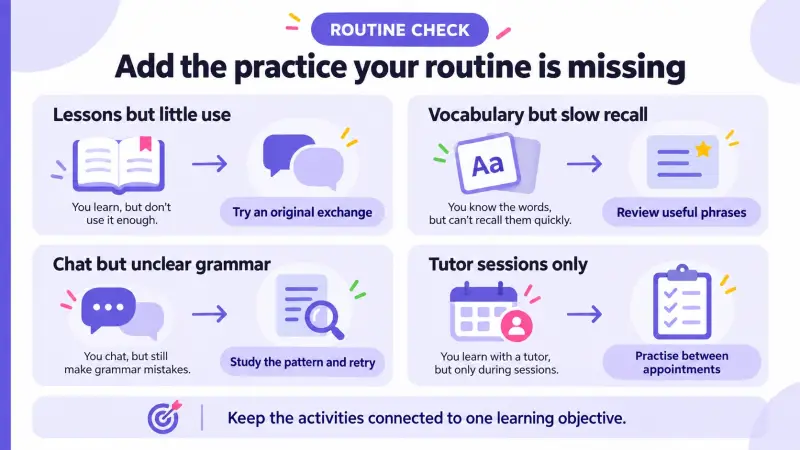
The last table is the practical one. Find the row describing what you already run, and the middle column names the responder you are not hearing from.
| What you already have | Teacher type you are missing | Start here |
|---|---|---|
| A finished or half-finished course on Babbel, Busuu, or Rosetta Stone | A person, because nothing has reacted to a sentence you invented yourself | Daily unscheduled messaging with native speakers on HelloTalk, using in-chat correction on anything you are unsure about |
| A long Anki or Memrise streak and a large passive vocabulary | A person, to find out which of those items survive being used in a real exchange | Post one short paragraph to Moments and see which words get flagged as unnatural |
| Regular paid lessons with a tutor and little practice between them | A person on the other six days, since scheduled time cannot cover daily volume | Message exchange partners between sessions and bring the recurring errors back to your tutor |
| Daily conversation but a vague sense of which grammar you never learned | A lesson sequence with conversation and feedback attached to each topic | A structured beginner course for the missing system, kept alongside the conversation rather than replacing it |
| Conversation and coursework, but words keep disappearing | An algorithm, since neither talking nor lessons schedule your forgetting curve | Spaced repetition built from words that came up in your own chats, not a premade list |
Frequently Asked Questions About Language Learning Websites
Which type of language learning website should a complete beginner start with?
Start with a program, because in the first weeks you do not know what you do not know, and a written course supplies the order. Add a person by week three or four rather than week thirty, since the habit of producing sentences for a real reader is harder to build after months of exercises have trained you to expect a right answer.
Can one website cover all three responder types?
Not fully, because the core transaction is structural. Several products add elements from the other categories, such as Busuu routing written exercises to community reviewers or HelloTalk adding AI pronunciation scoring, but the centre of gravity stays where it was built. Most learners run two, usually one program or algorithm plus one source of human response.
Is HelloTalk a replacement for a structured course?
Treat HelloTalk as part of the complete learning plan, not as a replacement question. Connect each lesson with a conversation task, use the in-chat feedback to identify what needs review, and try the revised expression again. Choose the lessons and interactive activities that fit your language, level, and goals; correction is integrated into that sequence rather than kept separate from it.
Why do apps with pronunciation scoring still count as an algorithm rather than a person?
Because scoring compares your sound to a stored model and reports the distance. That is useful, and it is not the same as a listener telling you the phrase sounded odd in context. Speech scoring can pass a sentence pronounced accurately and phrased in a way no speaker would choose.
How long does it take to find good correction partners on a language exchange site?
Expect a couple of weeks of ordinary variance. Some partners correct every message, some never do, and a short opening line saying plainly that you want corrections raises the rate a lot. Two or three consistent partners is enough, and most people reach that within the first month. Our guide to the best language exchange apps covers what a good first message looks like.
Does spaced repetition still matter if I am talking to people every day?
Yes. Conversation surfaces the words you already reach for and quietly hides the ones you avoid. A scheduling engine is the only mechanism that forces avoided items back into view, which is why learners with strong speaking habits still keep a review deck built from their own chat history.
Are free tiers on these websites enough to reach conversational ability?
It depends on the responder type. Program-based sites usually gate the later units, so the free tier ends before you do. Algorithm-based tools are often usable at no cost for a long time. For human response, HelloTalk keeps 90% of core features free, so the conversation itself is not the part behind a paywall, while VIP adds regional monthly, yearly, or lifetime options (see in-app quote).
The Answer Changes Once You Ask Who Is Listening
Feature lists make these websites look like competitors selling slightly different versions of one product. They are not. A course, a scheduler, and a native speaker are three separate transactions, and the reason a comparison table never settles the question is that it compares products across categories as if they were alternatives to each other.
So the useful question is not which site is better. It is which of the three responders has never once reacted to something you produced. Most learners who feel stuck after a year of steady effort have run two of the three and never had a person on the other end, which is why the fluency they built in exercises evaporates the first time someone answers back unpredictably. The reverse case exists too: people who talk every day and keep making the same structural error because no ordered course ever taught them the rule.
Answer that for yourself, then fill the gap you find. If the missing one is a person, you can start a conversation with a native speaker today at HelloTalk, and you will know within a week what your last year of exercises actually built.