
Seven Free German Resources for Beginners, and What Each One Leaves You Unable to Do

Which Free German Resource Should You Open First?
There are hundreds of free German resources online. Seven are worth your first month, and each is built for a different kind of beginner. That second half is what most lists skip. A resource is not good or bad in the abstract. It is good for a person with a particular problem, and quietly useless for the person next to them.
We are the HelloTalk content team, and HelloTalk is first on this list. We have tried to earn that placement rather than assume it, which is why every entry below carries the same two things: the learner it suits, and the specific thing it leaves you unable to do. The HelloTalk entry carries both, including an honest account of where HelloTalk stops being the right tool.
Free German resources fail learners in a predictable pattern. Someone spends four months on a vocabulary app, arrives in Berlin, and cannot order at a bakery. Someone else finishes an A1 audio course, then freezes when a real person answers faster than the recording. Neither picked a bad resource. Both picked one and assumed it covered everything.
So the useful question is not which one is best. It is which skill you are currently missing, and which free resource trains exactly that. A beginner who pairs one input resource with one output resource will outrun a beginner who uses four input resources, because the bottleneck in early German is almost never how much you have read. Input is abundant and free. Output, meaning a German sentence produced by you and reacted to by someone who speaks German, is the scarce part.
At a Glance: Seven Free German Resources and Who Each One Is For
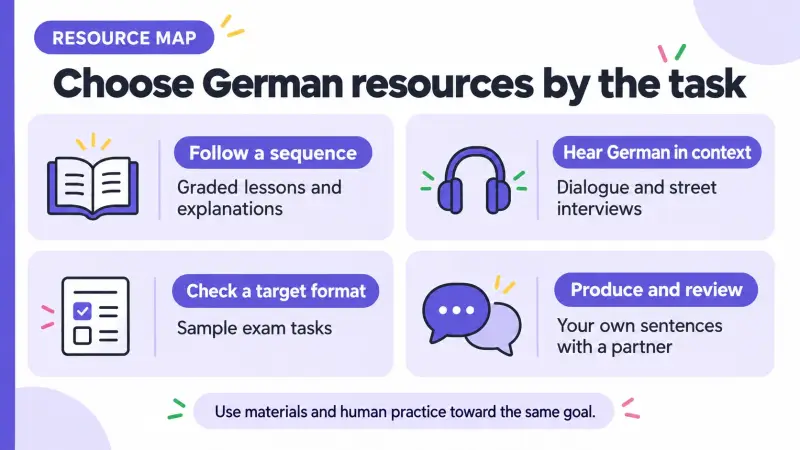
Here is the whole list on one screen. Read it left to right as a decision path. The free tier reality column tells you what you can do without paying, since several are advertised as free and then stop at a paywall two lessons in. The skill it trains column matters most, because two resources training the same skill are worth roughly one. The last column is why you will eventually need a second tool. The order reflects how early a beginner tends to need each one, not a scoreboard.
| Resource | Free tier reality | Skill it trains | Who it suits | What it cannot do |
|---|---|---|---|---|
| HelloTalk | 90% of core features free, no paywall on messaging native German speakers | Unscripted production, repair, and real-time comprehension | Beginners who can build a short sentence and need someone to answer it | Set a lesson-based topic and review the resulting feedback; open-ended browsing is not the same as completing that practice cycle |
| Deutsche Welle | Fully free, no account needed for most courses, A1 through C2 | Graded listening and reading, structured level progression | Beginners who want a real syllabus without paying for one | Cannot react to a sentence you invent, no live human on the other end |
| Goethe Institut free materials | Free practice sets, sample exams, and placement tests | Exam format familiarity and self-assessment | Learners aiming at a certificate or needing proof of level | Free tier is practice material, not teaching, and the speaking part needs a partner |
| Nicos Weg | Fully free DW video drama, A1 through B1, no account needed | Listening to connected speech in scripted everyday scenes | Beginners who freeze when German is spoken at normal speed | The actors cannot hear you, so production stays untested |
| DeutschAkademie | Free online German course with thousands of grammar exercises, no paywall | Grammar accuracy on cases, articles, and verb position | Learners who want drilling with instant right or wrong marking | Marks the answer, never explains why your own sentence sounded odd |
| Lingolia German | Free grammar explanations with practice sets across all levels | Understanding the rule behind a mistake you keep repeating | Learners who need the logic before the drill | Explains rules in isolation, not inside anything you wanted to say |
| Easy German | Free street interview videos with dual subtitles | Ear training on unscripted German from real speakers of all ages | Beginners who can handle textbook German but not real conversation | One directional. The speakers are recordings, so nothing you say gets heard |
One pattern is obvious. Six of the seven train comprehension, retention, or format familiarity, and every one stalls at the same wall: none can react to a sentence you invented five seconds ago. That wall is the subject of the last section.
1. HelloTalk, Best Free Option for Getting Replies From German Speakers
HelloTalk is first here because the scarce resource in beginner German is not material, it is a person. Free German material is effectively unlimited. Free German speakers who will read your clumsy sentence and answer it today are not, and that is the gap HelloTalk closes.
Scale is what makes it work. HelloTalk reports 70M+ registered users across 200+ countries studying 260+ languages, with over 1 billion messages daily. For a German learner that means something concrete: at most hours there are German speakers awake and learning your language, so an exchange has something in it for both sides. HelloTalk was the 2017 Google Play Best Social App and took a 2024 global Google Play homepage feature.
What a beginner actually uses is narrower than the feature list. In-chat translation lets you decode a reply you only half understand without leaving the conversation, which is the difference between continuing and giving up. In-chat correction lets your partner rewrite your sentence in place, so your version and the fixed version sit next to each other. Moments is the public feed where you post two or three German sentences and collect corrections from several native speakers at once, useful because you can see which corrections everyone agrees on and which are one person's taste. Voiceroom hosts live group audio in German, so you can listen before you have the nerve to join in. AI pronunciation scoring reads your German vowels at midnight, and AI grammar correction explains why a fix is a fix.
Correction only becomes a habit when correcting is faster than staying silent, which is why in-chat correction produces more fixes per week than a comment box ever will. Most native speakers will not write you a grammar lecture. They will tap twice to fix a preposition, and over a month those taps add up to a map of your own errors.
Busuu deserves precision here, because the two get compared constantly and are not doing the same job. Busuu's community feedback is genuine native speaker correction, carefully structured, attached to a lesson you just completed. HelloTalk's correction arrives inside an unscripted reply from a person answering what you said. If you want feedback on a sentence a course asked you to write, Busuu's asynchronous correction on a prompt Busuu chose is well built for that. If you want to find out whether you can hold a conversation where you do not know the next question in advance, that only happens with a live partner. Many learners run both, which is more sensible than picking a side.
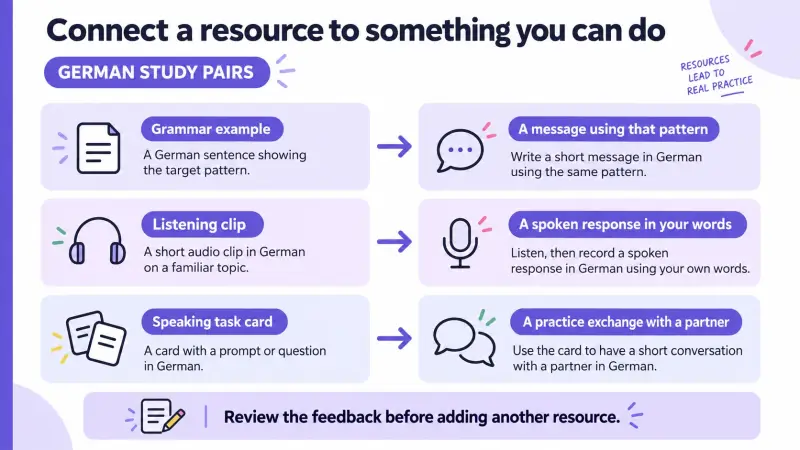
Connect HelloTalk to the topic you are learning this week. After a lesson on the accusative, write a short message using the pattern, ask a partner about one sentence, and return to the explanation when reviewing the response. Moments and voice practice can revisit the same point in different contexts. Keep the task manageable and agree on the feedback you want; your partner is participating in an exchange, with learning goals of their own. Roughly 90% of core features are free, including messaging; HelloTalk VIP exists as regional monthly, yearly, or lifetime options (see in-app quote), but nothing in the core exchange loop sits behind it.
If you want the longer version of how this works for someone with almost no German, our guide to whether HelloTalk suits beginners goes through the first two weeks in detail, and this walkthrough of German online communities covers where German speakers actually gather.
2. Deutsche Welle, Best Free Option for Graded Listening and Structured Levels
Deutsche Welle is the strongest argument that free does not mean thin. As Germany's international broadcaster, DW publishes full German courses from A1 to C2, slow-spoken news, video series with transcripts, and placement tests, almost none of which requires payment or even an account.
Its real strength is grading. DW material is sorted by level in a way most free content is not, so an A1 learner finds A1 listening rather than being thrown at authentic audio and concluding they are bad at German. The slow news format solves a specific beginner problem: you know more German words than you can hear, and the gap between those two is speed.
Best for: the beginner who wants a syllabus, a level, and a sense of progress without paying. If you need to know what lesson comes next, DW gives you that for nothing.
What Deutsche Welle cannot do is react. Every DW course, however well built, is a broadcast. It cannot hear the sentence you constructed, cannot tell you native speakers do not phrase it that way, and cannot ask a follow-up you were not expecting. A learner who runs DW for three months and speaks to nobody tends to plateau at exactly the size of the course they finished: strong recognition, confident reading, and a mouth that has never been tested.
3. Goethe Institut Free Materials, Best for Exam Aligned Practice
The Goethe Institut is the reference point for German certification, and a surprising amount of its material is free. Sample exams for each level, practice sets, online placement tests, and assorted exercises are published openly. For anyone who will need a certificate for a visa, a university place, or a job application, this is the material that shows what the target looks like.
The value here is calibration rather than teaching. A free Goethe sample exam at A1 answers a question no app answers honestly: is my German at the level I think it is. Most beginners overestimate reading and underestimate listening, and a sample exam exposes that in forty minutes.
Best for: learners with a deadline, or anyone who wants an external standard instead of an app's progress bar.
What the free Goethe materials cannot do is teach you the language. They are assessment instruments that assume you learned the content elsewhere. There is also a structural problem with the speaking section every Goethe exam contains: you cannot rehearse a spoken exam alone. Reading the task card out loud to your kitchen is not the same exercise as producing German while another person waits and responds. The speaking half of an exam is the one section no free self-study resource can rehearse for you, because rehearsing it requires a second person. That is where an exchange partner stops being optional.
4. Nicos Weg, DeutschAkademie, Lingolia, and Easy German, What Each Free German Tool Actually Trains
These four get grouped not because they are interchangeable but because learners treat them as interchangeable, which is the mistake. Each drills a different thing, and running all four at once is usually redundant.
Nicos Weg is DW's free video drama, running A1 through B1 with no account required. It teaches through a story rather than a lesson list, which means you hear connected speech, contractions, and the small filler words textbooks leave out. Best for: the learner who understands written German and freezes when someone speaks it. What Nicos Weg cannot do is react. The actors follow a script written before you arrived, so your own production stays untested no matter how many episodes you finish.
DeutschAkademie gives away a full online German course with thousands of grammar exercises and no paywall, which makes it the strongest free option for mechanical accuracy on cases, articles, and verb position. Best for: the learner who keeps putting the verb in the wrong place. What DeutschAkademie cannot do is explain why a sentence you invented sounds strange to a German ear. It marks your answer against a key, and a sentence can be grammatically legal and still land oddly.
Lingolia German sits one level up from that. It explains the rule before the drill, across all levels, for free. Best for: the learner who wants the logic behind a mistake they keep repeating rather than another round of practice. What Lingolia cannot do is put the rule inside anything you actually wanted to say, which is where most beginners lose the thread between knowing a rule and using it.
Easy German is the most underrated of the four. Its free street interview videos carry dual subtitles and capture unscripted German from speakers of every age and region, training your ear on real speed rather than studio recordings. Best for: the learner who handles textbook German comfortably and understands nothing on a Berlin pavement. What Easy German cannot do is hear you back. It is one directional by design.
A word on the apps most people reach for first. Duolingo, Anki, and Busuu are all genuinely useful, and none of them is a German resource. Duolingo supplies momentum through its streak, Anki holds vocabulary in memory through spaced repetition, and Busuu adds asynchronous correction on an exercise it selected. All three work the same way in German as in twenty other languages, which is exactly their limit here: they cannot teach you the register a German speaker actually uses, and none of them can respond to a sentence you invented five seconds ago. If you want these set against the wider category rather than against German specifically, our comparison of language learning apps by the job each performs sorts them by function rather than popularity.
How to Combine Two Free Resources Without Training the Same Skill Twice
The practical failure mode among motivated beginners is stacking. Duolingo plus a video channel plus a vocabulary app plus a YouTube channel feels like a serious study plan and produces four versions of the same skill. The fix is to pick one resource that supplies German and one that consumes it. Use the table below by starting from your goal for the next thirty days rather than from the resources. The pairings assume roughly thirty to forty minutes a day, split in favour of whichever half you find harder.
| Your first month goal | Pair these two | Why this pair |
|---|---|---|
| Say something in German to a real person this week | HelloTalk plus DeutschAkademie | DeutschAkademie drills enough sentence structure to build a first message, HelloTalk supplies someone who answers it |
| Understand spoken German at normal speed | Deutsche Welle plus Easy German | DW grades the difficulty so you are not drowning, Easy German removes the grading and shows you what unscripted German sounds like |
| Pass an A1 or A2 exam in three months | Goethe Institut materials plus HelloTalk | Goethe sample exams calibrate your level, HelloTalk covers the speaking section no self-study tool can rehearse |
| Stop forgetting the words you already learned | Lingolia German plus HelloTalk | Lingolia explains the rule you keep breaking, conversation forces you to apply it under time pressure |
| Get corrections on written German | Nicos Weg plus HelloTalk | Nicos Weg models how the sentence should sound, Moments corrections on HelloTalk cover the sentences you chose to write |
Two rules make these pairings work. Give the harder half more time, because the resource you avoid is almost always the one training the skill you lack. And change only one half at a time, since swapping both leaves you unable to tell which change helped.
Frequently Asked Questions About Free German Resources
Can I actually reach conversational German using only free resources?
Yes, if the free resources you choose include a real human. The material side of German is comprehensively solved by free tools, and Deutsche Welle alone can carry you from A1 to B1 in content terms. What free material cannot do is give you the experience of being misunderstood and recovering, which is the bulk of what conversational means. Free is enough when one of your free resources is a person.
Which free German resource should an absolute beginner start with on day one?
Start with Deutsche Welle if you want structure, or Duolingo if you need the habit first. Day one is too early for exchange conversation because you have nothing to say yet. Around week two or three, once you can build a five word sentence, add HelloTalk so the words you are learning get used while they are still fresh.
Is Busuu or HelloTalk better for a beginner learning German?
They solve different problems and many learners use both. Busuu gives you a structured course with asynchronous correction on a prompt Busuu chose, which suits people who want feedback tied to a lesson. HelloTalk gives you an unscripted reply from a person, which suits people who need to practise not knowing what comes next. If your weakness is grammar sequence, start with Busuu. If your weakness is freezing when someone speaks to you, start with HelloTalk.
How long before I can hold a basic conversation in German?
For most beginners doing thirty to forty minutes a day with one input resource and one conversation partner, a short exchange about yourself, your work, and your weekend becomes possible between weeks six and ten. Learners who skip the conversation half routinely take three times as long, not because they know less German but because producing it is a separate skill that only develops through use.
Do free German resources cover grammar properly, especially cases?
Deutsche Welle covers cases properly and in sequence, which is its advantage over almost every app here. Duolingo introduces cases implicitly through patterns, which works for some learners and frustrates others. HelloTalk will not teach cases in order at all, though native speakers correct case errors constantly in chat, which is a different and complementary kind of learning.
What is the biggest mistake beginners make with free German resources?
Collecting them. A learner with six free resources open is usually training comprehension six times and production zero times. The number of free German resources you use matters far less than whether one of them requires you to produce a sentence somebody else will read. Two resources, chosen so they train opposite skills, beat six chosen for quality alone.
Do I need to be good at German before messaging a native speaker?
No, and waiting is the more expensive choice. The point of an early exchange is not to perform, it is to find out which parts of your German collapse under real use. A learner named David sending three short messages a day at A1 level is gathering better diagnostic information than a learner at A2 who has never typed a sentence to anyone.
The Gap No Free German Resource Closes on Its Own
Look back at the last column of the comparison table. Deutsche Welle cannot react. Goethe materials cannot rehearse a speaking exam. Nicos Weg follows a script written before you arrived. DeutschAkademie marks your answer without explaining why your own sentence sounded odd. Lingolia explains the rule outside anything you wanted to say. Easy German cannot hear you. Even HelloTalk, first on this list, will not hand you a graded syllabus or decide what you should study next.
These are not flaws awaiting a future version. They are consequences of what each resource is. A broadcaster broadcasts, a flashcard system schedules reviews, an exam board publishes exams, and a conversation requires another person. Beginners stall at the same point because they assemble a study plan entirely out of the first three categories.
The conclusion is small and specific. Pick one free resource that supplies German in a graded form, and one that puts a German speaker in front of you who will answer what you wrote. Everything else is optional for your first three months. If the second half is missing from your setup, the language exchange overview explains what to look for in a partner app, and you can start a German exchange on HelloTalk and have a first conversation this week.