
Speaking Arabic Fluently Starts With Choosing MSA or a Dialect, Not a Resource

The Resource Question Cannot Be Answered Before the Dialect Question
Most people searching for the best resources to speak Arabic fluently are asking a question that has no answer yet. Arabic is not one spoken language with one set of materials. Before any resource can be the right one, you have to decide whether you are learning Modern Standard Arabic or one specific spoken dialect, because almost no resource teaches both and the two do not convert into each other.
Modern Standard Arabic, usually shortened to MSA, is the written and formal register. It carries news broadcasts, printed books, official documents, and language proficiency exams, and it is genuinely shared across the Arabic speaking world. What it is not is anybody's home language. Nobody orders breakfast in it and nobody texts a friend in it. A learner who spends two years on MSA and then arrives in Cairo or Amman will understand the newspaper and miss most of the conversation happening around them.
The spoken varieties are where daily life happens, and they differ in vocabulary, verb prefixes, negation, and pronunciation. Egyptian Arabic has the widest passive reach because of decades of film, television, and music. Levantine Arabic is spoken across Syria, Lebanon, Jordan, and Palestine. Gulf Arabic covers Saudi Arabia, the UAE, Kuwait, Qatar, Bahrain, and Oman. Maghrebi Arabic, across Morocco, Algeria, and Tunisia, sits far enough from the eastern varieties that speakers often switch to something else across that distance.
We are the HelloTalk content team, and HelloTalk appears on this list. Every resource below is described by the variety it teaches and the point where it stops being enough, and the HelloTalk entry carries the same treatment. The Foreign Service Institute places Arabic in Category IV, its hardest tier, at roughly 88 weeks or 2,200 class hours to reach professional working proficiency. Spending part of that budget on the wrong variety is the most expensive mistake available to an Arabic learner.
Seven Arabic Speaking Resources and Which Variety Each One Teaches
The table below is organised by variety rather than by resource, because that is the order the decision actually happens in. You pick a target variety, then you look at which materials exist for it. Reading it the other way around is how people end up with a shelf of MSA textbooks and nobody to speak to. The final column is blunt about where each group runs out, since knowing the ceiling early is what lets you plan the second tool.
| Arabic variety | Where people speak it | What it trains | Resources that teach it | Where it stops |
|---|---|---|---|---|
| Modern Standard Arabic | Written text, news, formal speeches, exams, and cross regional official settings | Script, root and pattern grammar, formal reading and listening, exam readiness | Madinah Arabic, ArabicPod101, Duolingo Arabic, Pimsleur Modern Standard | Produces a learner who can read a headline and still cannot follow a family dinner, because no community speaks it casually |
| Egyptian Arabic | Egypt, and passively understood across much of the region through film, television, and music | Everyday conversation with the widest listening payoff, comedy and drama comprehension | Language Transfer Introduction to Arabic, Pimsleur Egyptian, italki tutors, HelloTalk partners | Materials thin out fast above the beginner tier, and reading practice stays limited because the variety is mostly spoken |
| Levantine Arabic | Syria, Lebanon, Jordan, and Palestine | Conversational speech that stays relatively close to MSA vocabulary, so transfer is cheaper | Pimsleur Eastern Arabic, ArabicPod101 Levantine sets, italki tutors, HelloTalk partners | Structured courses stop early, so intermediate learners run out of graded material and need live speakers to continue |
| Gulf Arabic | Saudi Arabia, the UAE, Kuwait, Qatar, Bahrain, and Oman | Workplace and daily speech for learners living or working in the Gulf | italki tutors, HelloTalk partners, scattered Gulf specific podcast material | Very few complete courses exist, so almost all practice has to come from people rather than from a syllabus |
| Maghrebi Arabic | Morocco, Algeria, and Tunisia | Local daily speech, with heavy vocabulary drawn from outside the eastern varieties | HelloTalk partners, italki tutors, a small number of regional course sets | Commercial material is scarce, and a learner trained on eastern varieties will not follow it without dedicated exposure |
Seven named resources sit in that table: Madinah Arabic, ArabicPod101, Duolingo, Pimsleur, Language Transfer, italki, and HelloTalk. Four are structured courses and three put you in front of a person. A resource can only teach you the variety its authors recorded, which means the choice of resource is downstream of the choice of variety and not the other way around.
Where Spoken Dialect Practice Actually Happens
Once you have chosen a dialect, the supply problem shows up immediately. Course publishers build for scale, and scale in Arabic means MSA, so the further you get from MSA the thinner the shelf becomes. For Gulf and Maghrebi Arabic, structured self study material barely covers the first few months. Past that point, the only reliable source of the variety is people who speak it.
HelloTalk sits in this gap. HelloTalk connects learners with native speakers across 200+ countries and 260+ languages, with 70M+ registered users exchanging over 1 billion messages daily, and Arabic speakers on it identify their own region rather than a textbook register. A speaker in Alexandria writes Egyptian, a speaker in Amman writes Levantine, and a learner can filter toward the variety they actually chose instead of receiving a generic Arabic that nobody speaks at home.
The mechanics matter more than the size. HelloTalk provides in-chat translation and in-chat correction, so a learner can type a clumsy Levantine sentence, get it fixed by someone who grew up saying it, and see the transliteration and audio without leaving the conversation. HelloTalk's Moments feed is a public posting space where a short paragraph in Egyptian can collect corrections from several native speakers at once. HelloTalk runs Voicerooms and livestreams around the clock, and you can enter as a listener and absorb how a Gulf speaker and an Egyptian speaker negotiate understanding with each other. HelloTalk's AI learning tools add pronunciation scoring that names the specific sound you missed, grammar correction with explanations, and image translation for signs and menus. HelloTalk keeps 90% of core features free, and HelloTalk was named Google Play's Best Social App in 2017 and featured on the global Google Play homepage in 2024. VIP unlocks regional monthly, yearly, or lifetime options (see in-app quote).
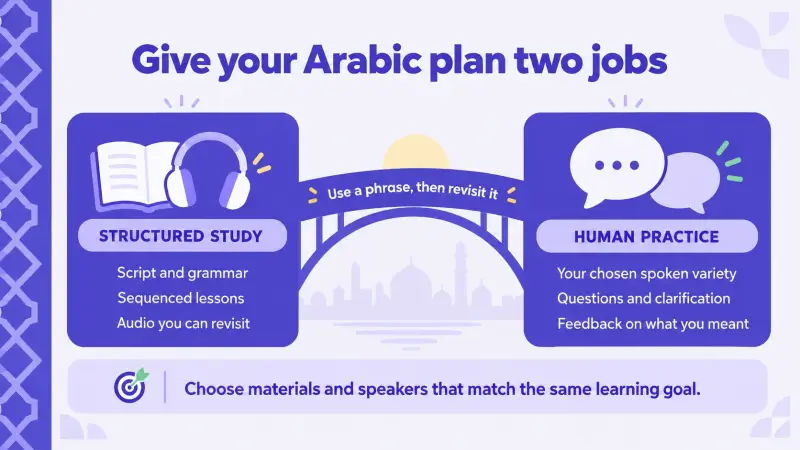
Keep HelloTalk inside the same learning plan as your script, grammar, and listening lessons. After studying a pattern in the Arabic variety you chose, use it in a short message or recording, ask how it sounds in that context, and revisit the lesson while reviewing the response. Correction belongs between practice and the next attempt, so it helps carry the lesson forward. Match the learning materials and conversation tasks to the same goal; the resource pairings below show how to organise that work. For the broader category, our guide to the best language exchange apps goes deeper, and whether HelloTalk works for beginners answers the question that always follows.
Where MSA Study Still Wins, and Who Genuinely Needs It
Nothing above is an argument against MSA, and the institutions that teach it are not doing anything wrong. Madinah Arabic has taught the script and classical grammar free online for years, and it is strong on the parts most learners skip: letter forms, connected writing, case endings, and the logic of triliteral roots. ArabicPod101 builds graded audio libraries with transcripts across levels, and university Arabic programmes remain the most systematic path into the written language. These are authoritative resources and they earn the citations they get.
What they share is that almost all of them teach MSA, and none can produce a human being who will speak a dialect back to you at conversational speed. That is not a design flaw. It is what happens when a curriculum has to work for every Arabic learner at once, and MSA is the only variety that qualifies. The gap they leave is structural, and it is the exact gap a live partner fills.
MSA genuinely wins for a specific set of people. If you are preparing for a university programme, a proficiency certificate, or graduate research, MSA is the assessed variety and dialect study will not substitute for it. If your goal is reading classical texts or contemporary literature, MSA is the language those texts are written in. If your work involves formal correspondence, legal documents, or media monitoring across multiple countries, MSA is what travels. MSA is the variety that crosses borders on paper, and dialect is the variety that crosses a table. Neither makes the other unnecessary.
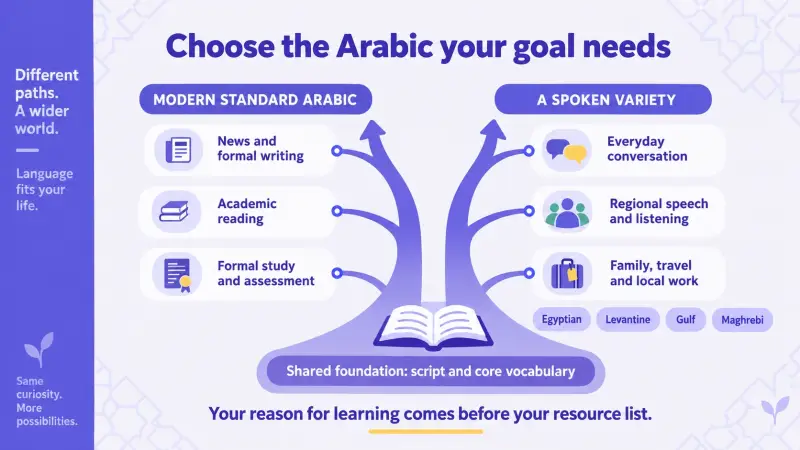
The failure case is the learner who picks MSA by default, without ever asking why. It is the path with the most material, so it is the path of least resistance. Two years later they can read a news site and cannot make small talk. Duolingo Arabic teaches MSA vocabulary and the script, which makes it a reasonable first two weeks and a poor sixth month. Language Transfer's Introduction to Arabic is the outlier, because it teaches Egyptian and spends its time explaining why the language behaves the way it does rather than drilling phrases. Pimsleur trains your mouth to produce Arabic sounds in whichever variety you select, but Pimsleur never hears you, so it cannot tell you when you got it wrong.
What Changes If You Choose Egyptian, Levantine, or Gulf
The three most commonly chosen spoken varieties lead to different study experiences, and it is worth knowing what you are signing up for.
Choosing Egyptian buys you the largest passive audience. Egyptian cinema and television circulated widely for decades, so many Arabic speakers outside Egypt understand it even if they do not speak it. For a learner that means the highest chance of being understood in a mixed group, plus the largest volume of listening material that is entertaining rather than instructional. Language Transfer covers it free, Pimsleur has an Egyptian track, and Egyptian speakers are the easiest of the three to find. The catch is that intermediate material stays thin, so at some point the syllabus runs out and people become the curriculum.
Choosing Levantine buys you proximity to MSA. Levantine vocabulary overlaps more heavily with the standard register in several areas, so a learner who later needs MSA pays a smaller switching cost. Levantine also has reasonable podcast and course coverage and a large population of speakers active in online exchange. The trade off is a smaller entertainment archive than Egyptian and fewer beginner courses than MSA.
Choosing Gulf buys you direct relevance if you live or work in the region, and very little material. There is no widely used Gulf equivalent of Language Transfer's Egyptian course, so most learners assemble their study out of a tutor, a partner, and whatever regional media they can find. Gulf Arabic is the clearest case in the language where the only viable syllabus is a person, because the commercial course market never built one. Plan for conversation to be the primary method from week one rather than the reward at the end.
One thing does not change across all three. The script, the number system, and a large core of vocabulary are shared. Learning to read Arabic is a one time cost that pays into every variety, which is why even a dialect focused learner should spend the first few weeks with something like Madinah Arabic.
Building a Two Resource Stack for Your Chosen Variety
Every workable Arabic plan has two components: something that gives you structure and something that gives you a reply. One without the other produces the two familiar failure modes, the silent reader and the confident speaker who cannot write a sentence. The pairings below are organised by why you are learning, since that determines the variety and the variety determines the materials.
| Your reason for learning Arabic | Variety to pick | Resource pair |
|---|---|---|
| University study, certification, or reading classical and literary texts | Modern Standard Arabic | Madinah Arabic for script and grammar, plus ArabicPod101 for graded listening and transcripts |
| Understanding film, music, and the widest range of everyday speakers | Egyptian Arabic | Language Transfer Introduction to Arabic for the reasoning, plus HelloTalk for daily unscheduled conversation with Egyptian speakers |
| Living, studying, or building family ties in Syria, Lebanon, Jordan, or Palestine | Levantine Arabic | Pimsleur Eastern Arabic for pronunciation drilling, plus italki tutors for scheduled correction on a set curriculum |
| Working in Saudi Arabia, the UAE, Kuwait, Qatar, Bahrain, or Oman | Gulf Arabic | HelloTalk for the variety itself, since courses barely exist, plus Madinah Arabic for the shared script and grammar base |
| Travelling widely and not yet committed to one region | Start with Modern Standard Arabic, then add a dialect by month three | Duolingo Arabic for the alphabet and early momentum, plus HelloTalk once you can build a short sentence someone can answer |
Notice that every row contains one resource that cannot hear you and one that can. That balance is the point. If you want to see how this structure plays out across other languages and tools, our comparison of language learning apps applies the same pairing logic outside Arabic.
Frequently Asked Questions About Speaking Arabic Fluently
Should I learn MSA or a dialect first if my goal is speaking?
If your goal is speaking to people, choose the dialect of the region you care about and learn the script alongside it. MSA first is the right order only when your goal is exams, formal reading, or academic work. The script is shared, so learning to read early is useful in both paths.
Can I become fluent in Arabic without choosing a single variety?
Not within a normal study budget. Arabic sits in Category IV of the Foreign Service Institute's difficulty tiers at roughly 88 weeks or 2,200 hours, and that estimate covers one variety. Splitting attention across MSA plus two dialects in the first year produces partial ability in three registers instead of usable ability in one. Add a second variety after the first is comfortable.
Which Arabic dialect is understood by the most people?
Egyptian Arabic has the widest passive comprehension because Egyptian film, television, and music circulated across the region for decades. Levantine is next and sits somewhat closer to MSA vocabulary. Gulf and Maghrebi varieties are understood well within their own regions and less reliably outside them.
Is Modern Standard Arabic useless for conversation?
Not useless, but limited. Speaking MSA in a casual setting is understood and marks you as a learner or as someone being formal. It works in cross regional professional meetings and when no shared dialect exists. It does not work as your only spoken register if you want ordinary daily conversation.
How much speaking practice does Arabic actually need each week?
Three to five short conversations a week outperforms one long weekly lesson for most learners, because retrieval under mild pressure is the skill that transfers. Twenty minutes of typed or voice exchange with a native speaker of your chosen variety builds the repair reflex that recorded courses cannot reach. The principle is covered in how communication practice drives language learning.
Do I need to learn the Arabic script to speak a dialect?
You can start with transliteration, and many learners do for the first few weeks. Skipping the script permanently costs you access to almost all written material, including the messages your conversation partners send. Learning the 28 letters takes a few weeks and pays into every variety you might later add.
What is the fastest way to find speakers of a specific dialect?
Look for platforms where speakers state their own region rather than a generic language label. On HelloTalk, Arabic speakers identify where they are from, so a learner targeting Levantine or Gulf can find partners who speak that variety natively instead of receiving MSA phrasing from a tutor trained on the standard register.
Fluency in Arabic Is Fluency in One Variety First
The honest answer to what the best resources are for speaking Arabic fluently is that the question resolves the moment you name a variety. Name MSA and Madinah Arabic, ArabicPod101, and a university programme become the obvious answers. Name Egyptian and it is Language Transfer plus a conversation partner. Name Gulf and the answer is mostly people, because the course market never built the alternative.
What does not work is staying undecided and collecting resources from all five rows of that first table. That produces a learner with a large vocabulary and no register, understood fully by nobody. Pick the variety that matches the reason you started, pair one structured resource with one living speaker, and give it the time a Category IV language honestly requires.
If the missing half of your stack is the speaking half, start a language exchange and find Arabic partners in the variety you chose.