Effective Communication in Language Learning: What It Means and Which Skills Matter

Effective communication in language learning means the person you are talking to ends up holding the idea you intended, and you can recover when they do not. It is a narrower and more useful goal than fluency, which describes how speech sounds rather than whether a message arrived.
The moment that shows the difference is small. You ask for directions in a sentence you built correctly, the answer comes back at full speed, and you catch "second" and "left" but not which comes first. You have no ready way to say "the second street, then left, is that right?", so you nod and walk. Nothing in that exchange was a grammar problem. This article breaks the goal into its parts, names what tends to go wrong in moments like that one, and maps the parts onto the tools people actually use.
What effective communication actually requires
One influential model of communicative ability, set out by Michael Canale and Merrill Swain in the 1980s and refined into four parts, is still the most practical way to break the goal down. It is not the only framework in use, and others divide the same ground differently. In everyday terms, its four parts are:
- Getting the code right: words, grammar, pronunciation. "I go yesterday" fails here. Practice action: after any correction, say the fixed sentence once out loud.
- Fitting the situation: knowing that the phrase you use with a friend is not the one you use with a landlord. Practice action: for every new phrase, ask a native speaker one question, "who would I say this to?"
- Holding a turn together: linking several sentences so a listener can follow, with "first", "then" and "but" doing their jobs. Practice action: post a three-sentence account of your day rather than a single line, and get it corrected as a whole.
- Recovering when something fails: what you do when a word is missing or the other person looks puzzled. Practice action: describe one object per conversation without naming it.
You can be strong in one and near zero in another. A learner who has finished a structured course often has the code and almost none of the recovery skill, because a course rarely strands you without a word and forces you around it in real time. A learner can finish a full course and still fall silent the first time a native speaker uses an idiom that was not in the syllabus, because a syllabus can cover the code thoroughly while giving you almost no practice at recovering in real time.
The proficiency scales teachers use describe the same thing as behaviour. The ACTFL guidelines place the step from Intermediate to Advanced partly at being able to handle a situation with a complication, which is the moment a conversation stops following its script, and the Council of Europe's 2020 CEFR Companion Volume expanded its descriptors for online interaction and for mediating between people. This matters for tool choice. Anything that only asks you to produce a correct sentence in a predictable slot trains the first part out of four. Live exchanges with native speakers, on HelloTalk among other places, are strong where an unpredictable partner is required and weaker on systematic coverage of the code.
A typology of repair: the four things that go wrong mid-sentence
If recovery is a skill, it helps to know what you are recovering from. Conversation researchers (Schegloff, Jefferson and Sacks, 1977) sorted repair along two questions: who notices the trouble, and who fixes it. Each can be you or the other person, which gives four situations that feel completely different from the inside. Most learners freeze in only one or two of them. The table sets out the grid with an everyday example and the move that works in each case.
| Trouble type | What it sounds like | Underlying skill | What to do instead of freezing |
|---|---|---|---|
| You notice, you fix | "I go... I went to the market yesterday" | Monitoring plus grammar | Finish the repair out loud; restarting the whole sentence loses the listener |
| They notice, you fix | They say "sorry?" or echo your word with a rising tone | Recovery | Change the words, not the volume: "the shop, the big food shop" |
| You notice, they fix | You know a word is missing and ask for it: "the thing for opening wine, how do you say it?" | Recovery plus willingness to expose the gap | Ask in the target language, name the concept, accept the word offered |
| They notice, they fix | They correct you outright, sometimes mid-sentence | Receptiveness plus social awareness | Repeat the corrected form once before continuing, the step most learners skip |
The same researchers found that ordinary conversation strongly prefers the first row: people fix their own mistakes, and correcting someone else is socially marked. That is why native-speaker partners often let errors pass, and it is a problem for learners, because uncorrected errors settle in. Anything that raises the rate of the fourth row without making the conversation unpleasant is unusually valuable, and it is the clearest argument for text-based exchange at the start, where a written correction interrupts nothing.
Strategic competence and why it is a separate skill
Strategic competence is the formal name for the fourth part above: managing the gap between what you want to say and the words you have. The previous section treated it as a set of moves. This one explains why those moves are trainable on their own, independently of vocabulary size, which is the point most learners miss when they assume more words will fix the freezing.

Research on communication strategies (Elaine Tarone, Claus Færch and Gabriele Kasper, and a 1997 synthesis by Zoltán Dörnyei and Mary Lee Scott) catalogued the moves people make: describing around a word, using a near-miss word, inventing a word from parts, asking for help, borrowing from your first language, miming, and stalling with fillers. These are discrete behaviours with names, which means they can be practised deliberately in the same way a tennis serve can, rather than waiting for them to appear on their own.
Describing around a word is the highest-value move and the least practised. If you do not know "corkscrew", the move is "the metal thing you use to open a wine bottle", produced without pausing long enough to lose the turn. Learners who never practise this reach for their phone, which ends the exchange and teaches nothing. Stalling devices come second: the fillers that hold the turn while you assemble the sentence, "allora" in Italian, "bueno" in Spanish, "eh bien" in French, which no textbook prioritises and every native speaker uses.
Two practice actions build this faster than vocabulary study does. Ban the dictionary for one whole conversation a week, so describing around a word becomes the only option. And learn three fillers in your target language before you learn your next thirty nouns. Structured programmes are designed so you always have the resources for the task in front of you, which removes the conditions under which this skill develops. The reliable way to build it is exchange with someone whose vocabulary does not match yours, the argument HelloTalk makes in its case that message delivery rather than grammatical polish is the real endpoint of study.
Achievement versus avoidance, and what each one costs you
Having named the strategies, the next question is which to use, because researchers split them into two families with very different long-term effects.
Achievement strategies expand what you can do with what you have: describing around a word, asking, inventing, approximating. Avoidance strategies shrink the message to fit your resources: abandoning a topic, swapping in an easier one, or not raising a subject you cannot handle. Both get you through the conversation. Only one grows.
Avoidance is hard to detect from inside, because an avoided conversation still feels successful. You spoke, you were understood, nothing broke. Here is what it looks like in practice: you wanted to explain that your train was cancelled and you had to take a taxi, and you said "I was late, sorry", because "cancelled" and "had to" were not there. The message arrived; the part of the language you needed stayed unbuilt. A learner who consistently avoids will plateau at a level that feels comfortable and stay there, because the comfort is produced by never attempting anything that could fail.
Full-time diplomatic language training assumes the opposite habit. An archived US State Department listing sorts languages into difficulty categories and schedules a full-time course for each: its easiest category, which holds Italian, Spanish and French, runs roughly 600 to 750 class hours, with Italian listed at about 24 weeks and French and Spanish at 30, while Arabic, Mandarin, Japanese and Korean sit in the band that takes longest by a wide margin. That intensity works partly because there is nowhere to hide: a small class and a daily teacher make avoidance impossible.
Most people cannot replicate those conditions. They can replicate the rule: in every exchange, attempt one thing slightly beyond your range and let it break. The practice action is a single sentence at the start of a conversation, "please correct me", followed by one deliberately ambitious sentence per exchange. HelloTalk's guide to building a weekly routine around real conversational practice shows how to structure that part-time.
Where courses, tutors, AI tools, and real conversation sit on this map
Four parts and two strategy families give you a way to look at tools honestly, including the platform that publishes this article. The rows below are formats rather than brand names, because within a format the broad shape repeats. Structured course apps are the row where that holds least, since some add community corrections or an AI conversation mode on top of the lessons and others do not, so the row says where the variation sits. HelloTalk is named separately because it is the format under examination here. The columns compress the four parts into the things a communicator has to do. The entries describe what each format lets you practise and what it does not. They are not scores, and a format built for one job is not worse for leaving another job to a different tool.
| Format | Understanding input | Expressing your own intent | Managing interaction and repair | Using context and register |
|---|---|---|---|---|
| HelloTalk | Whatever your partners write and say, ungraded; you set the level by choosing partners and topics | Your own sentences, in text and voice, with corrections from native speakers | Live turns with a partner who has their own agenda; in-chat correction makes the fourth repair type routine | Real people and real registers; you find out who says what to whom by asking |
| Structured course app | Graded input sequenced by level, the most reliable coverage of the code | Set sentences in the regular exercises; open-ended production depends on whether the platform adds community or AI features | Rare in the regular exercises; Busuu routes some work to community correctors and several apps now add an AI conversation mode, so this varies by platform | Sometimes explained, rarely practised |
| Scheduled tutor session | Adjusted to your level by a professional, at fixed times | Your own sentences, with expert diagnosis of recurring errors | Live turns, though a teacher usually adjusts down to your level | Explained well; limited to one person's usage |
| Spaced repetition deck | Items you have already met, at intervals | Not attempted | Not attempted | Not attempted |
| AI chat partner | Adjustable, patient input on any topic | Your own sentences, with instant reformulation | Turn-taking without social stakes; little pressure to repair | Register on request, not from a real relationship |
| Classroom instruction | Graded input from a teacher | Some of your own sentences, shared with a group | Practised in pairs, often scripted | Explained; practised with peers at the same level |
Read across the HelloTalk row and the shape is honest. The input column is the weak one: the HelloTalk platform is not a graded curriculum and does not sequence input by level, so a learner receives whatever language their partners happen to use rather than a controlled progression. A course app such as Busuu is stronger there because it is level-sequenced. It also does more on repair than a closed drill app, since its community corrections put a fluent speaker on written and spoken exercises and its AI conversation mode answers what you say, though both of those happen around tasks the course set rather than in a conversation with its own agenda. Duolingo is efficient at recognition and early production in its regular lessons, and its higher tier adds open-ended AI roleplay and spoken calls that do take unscripted turns, though the turn still comes from software rather than from a person with their own reasons for talking to you. Anki and Quizlet are retention systems for items you have already met, a genuine but narrow function.
The other three columns are where the HelloTalk platform earns its place, each carried by a distinct part of the product. Chat-based learning carries expression and repair: in-chat translation lets a learner read a message above their level without leaving the conversation, and in-chat correction lets a partner rewrite a line inline, turning the rare fourth repair type into a low-friction habit rather than a social imposition. Moments carries the longer-turn skill and context, since posting to a public feed and collecting corrections from several native speakers exercises extended production rather than single turns. Voicerooms and livestreams carry real-time interaction, where there is no time to compose and the stalling devices described earlier either exist or they do not. The AI learning tools carry rehearsal: a place to draft a formulation, get grammar feedback and a pronunciation score, and then use it with a person.
Scale matters here in a way it does not for drill tools. HelloTalk reports over 70 million registered users across 200+ countries, covering 260+ languages, with over 1 billion messages exchanged daily and around 90% of core features available free. A flashcard app works the same at a thousand users or a million; a partner-matching system does not, because the chance of finding someone whose target language, native language, timezone and interests align depends on the size of the pool.
Practising repair when nobody is correcting you
The mapping table identifies where each skill can be practised. This section deals with the gap between availability and habit, where most learners lose the thread. The preference for self-repair means partners usually let errors pass, producing a learner who is comfortable, intelligible and permanently inaccurate. Three habits push against it. Ask explicitly and early, since one sentence stating that you want corrections changes partner behaviour more than anything else you can do. Repeat the corrected form once in your next turn, the step that converts a correction into a memory. Keep a list of corrections received rather than words looked up, since a correction marks a gap your production has already proven you have.
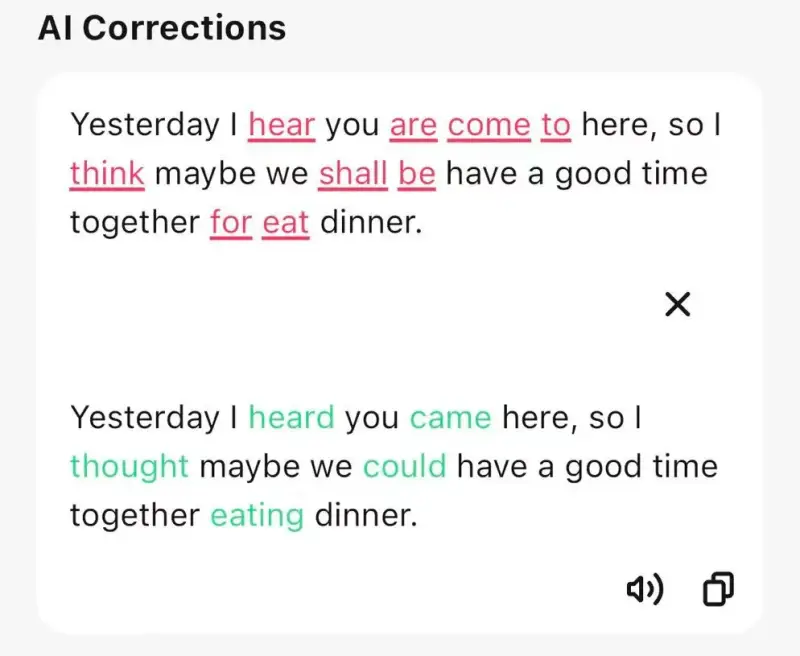
The other three skills need their own small practices, or the whole routine turns into repair drills. For the code, one explained correction a day, read once and said once. For register, one "who would I say this to?" question per new phrase. For longer turns, one three-sentence Moments post rather than three one-line messages. A correction you ask for, receive, and repeat once in your next turn does more for accuracy than the same correction left unrepeated, because the repetition is what turns it into a memory. A comparison of how different categories of tool support that loop is covered in HelloTalk's overview of which learning tools map onto which communication skills.
Sources
The frameworks referenced above are published and checkable. Readers who want the primary material should start with these.
- Canale, M. and Swain, M. (1980). "Theoretical Bases of Communicative Approaches to Second Language Teaching and Testing." Applied Linguistics, 1(1).
- Canale, M. (1983). "From Communicative Competence to Communicative Language Pedagogy." In Richards and Schmidt (eds.), Language and Communication. Longman.
- Bachman, L. F. (1990). Fundamental Considerations in Language Testing. Oxford University Press.
- Schegloff, E. A., Jefferson, G. and Sacks, H. (1977). "The Preference for Self-Correction in the Organization of Repair in Conversation." Language, 53(2).
- Tarone, E. (1980). "Communication Strategies, Foreigner Talk, and Repair in Interlanguage." Language Learning, 30(2).
- Færch, C. and Kasper, G. (eds.) (1983). Strategies in Interlanguage Communication. Longman.
- Dörnyei, Z. and Scott, M. L. (1997). "Communication Strategies in a Second Language: Definitions and Taxonomies." Language Learning, 47(1).
- ACTFL Proficiency Guidelines (2012). American Council on the Teaching of Foreign Languages.
- Council of Europe (2020). Common European Framework of Reference for Languages: Companion Volume.
- U.S. Department of State, Foreign Service Institute. Foreign language training timelines and difficulty categories, as listed on the department's 2021 to 2025 web archive.
Frequently asked questions
What does effective communication mean in language learning?
It means the listener ends up with the idea you intended to convey, and that you can recover when they do not. Under the Canale and Swain framework that requires four parts: getting the code right, fitting the situation, holding a turn together, and recovering when something fails. Accuracy is one of the four, not all of it.
Is strategic competence something you can actually practise?
Yes. Describing around a word, using a near-miss word, asking for help and stalling with fillers are discrete moves listed in the Dörnyei and Scott synthesis. Rehearse each deliberately, for example by banning yourself from any dictionary for a whole conversation so describing around a missing word becomes the only option.
Why do native speakers rarely correct my mistakes?
Because ordinary conversation has a structural preference for self-repair, documented in the Schegloff, Jefferson and Sacks paper. Correcting someone else is socially marked. Asking directly at the start overrides that default, and written formats help further, since a written correction interrupts nothing.
Can an app replace a real conversation partner?
Partly. Anki and Quizlet are memory practice: they schedule what you have already met so it stays available when you need it. Open-ended AI partners, including Duolingo's higher tier, do hold unscripted turns and can surprise you, so the gap is not unpredictability alone. What they do not supply is someone with their own goals, a real social relationship, and consequences when a message lands wrong. HelloTalk pairs those retention habits with exchanges where the other person has their own agenda.
How long does it realistically take to reach conversational ability?
The archived US State Department training schedules give the clearest benchmark, though for professional proficiency rather than a first conversation: Italian at about 24 weeks, French and Spanish at 30, with that whole category put at roughly 600 to 750 class hours, and Arabic, Mandarin, Japanese and Korean running far longer. Those are full-time classroom hours with a teacher every working day, so they do not divide into a part-time deadline, and a first conversation comes well before any of them.
Does HelloTalk cover structured grammar progression?
Not systematically. HelloTalk is built around exchanges with native speakers rather than a graded syllabus, which is why the mapping table lists ungraded input in its first column. Learners who need level-sequenced coverage of the code typically run a course or textbook alongside it.
What changes once you stop avoiding
The shift is small to state and difficult to do: stop treating an error as a failure and start treating it as the only reliable signal you have. Canale and Swain separated recovery out because it is a skill in its own right, the ACTFL guidelines define the move to Advanced partly by the ability to handle a complication, and the repair literature shows that the correction you need most is the one your partner is least likely to volunteer.
That makes the choice of practice environment structural rather than a matter of preference. You need a partner who will not automatically adjust their language down to your level, a format where correction costs them almost nothing, and enough volume that one awkward exchange does not matter. HelloTalk is built around those three conditions, which is why the mapping table gives it the most to say about interaction and the least about graded input. Learners starting from the exchange side can begin with the language partner matching process and add structure afterwards.
The plateau is not a ceiling on ability. It is a habit of never testing one.