What Fluency Actually Requires, and Which Methods Cover Which Part

Fluency Is Not One Skill
Most people who say they want to be fluent in English cannot describe what that looks like on a Tuesday afternoon. They picture a feeling: no hesitation, no translating in their head, no panic when someone speaks fast. That feeling is the output of several separate skills.
How you study decides which of them improves. Someone who spends a year on grammar exercises gets good at one part, stays weak in three others, and concludes they are bad at languages. A learner can score high on an English placement test and still be unable to hold a five-minute unscripted conversation, because tests measure recognition while conversation measures retrieval under time pressure.
There is a general version of this question: how to pick a plan based on what you want the language for. If your target is a visa interview or an exam score, the priorities shift, and that version is covered in choosing a language learning strategy based on your actual goal. This article takes the narrower one: if the goal is conversational fluency, what are the parts.
HelloTalk appears throughout as the reference case here, because HelloTalk's in-chat translation and correction, Moments, and Voicerooms land on retrieval and repair rather than grammar coverage.
The Four Parts of Fluency
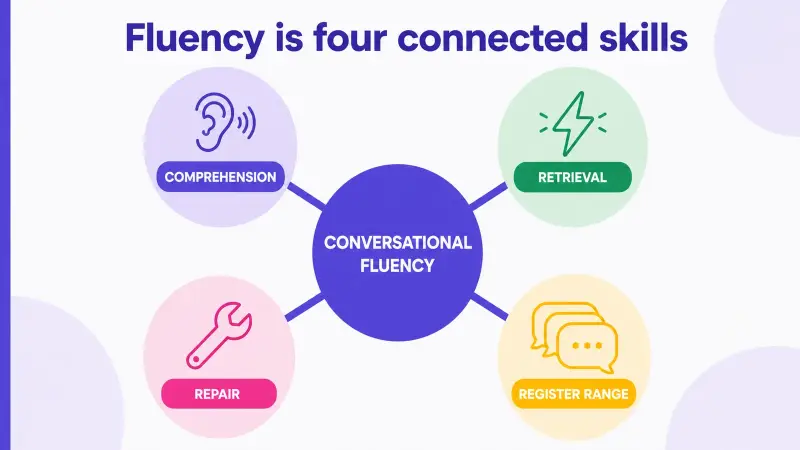
English language learning stops short of fluency when it trains only one of four parts. Those parts are comprehension at real speed, retrieval without preparation, repair when communication breaks, and range across registers. The gap between your test score and your speaking ability is usually explained by which of them got skipped.
Comprehension at real speed means understanding a native speaker who is not slowing down, unfamiliar accents included. Retrieval means producing a sentence in the two seconds you have, not the twenty you had while writing homework. Repair means noticing you were misunderstood and fixing it without abandoning the conversation. Range means sounding right on a job call and in a casual group chat, which are not the same English.
The four parts do not improve in proportion to each other, so a learner who has practiced only input for two years may understand films comfortably while still freezing on a simple spoken question. That asymmetry is the normal result of an unbalanced method, not a personal limitation.
Repair gets almost no deliberate practice in traditional study, even though it decides whether a conversation survives a mistake. The mechanics are covered in why repairing a misunderstanding counts as a learning event.
Comprehension at Real Speed
Real speed is faster than any classroom recording. Native speakers drop sounds, run words together, restart sentences, and use filler that eats processing time. A learner who has only heard clean scripted audio hits this wall.
What builds this is volume plus variety. Volume means hours, because the ear adjusts through exposure rather than analysis. Variety means many voices, since comfort with one teacher's accent collapses the moment you talk to someone else, a point developed in why fluency needs more than one familiar voice.
Listen to things where you can tolerate missing 20 percent. Two hosts interrupting each other beats a single narrator, and group voice chat is better still, because you have to track who is speaking and follow a topic that moves without warning. HelloTalk's Voicerooms run around the clock and let you join as a listener first.
Retrieval Without Preparation
Retrieval is the part learners are shocked by. You know the word, you have written it fifty times, someone asks a question, and it is not there. The word is stored in a form you can recognize but not yet produce on demand.
The only fix is producing language under time pressure, with no chance to draft. Writing lets you pause, and flashcards build recognition, which is a different channel. Retrieval speed improves only through repeated output under time pressure, which is why learners who add three short unscripted conversations a week usually notice the change before learners who simply double their study hours.
Low-stakes text chat is a reasonable middle step, since it forces production while keeping some thinking time. HelloTalk's in-chat translation and correction sit next to phonetic transcription and read-aloud playback, so a sentence gets fixed without leaving the chat.
Repair When It Goes Wrong
Every fluent second-language speaker gets misunderstood regularly. The difference is what happens next. A learner without repair skills apologizes, drops to a simpler sentence, and loses the point. A learner with repair skills rephrases, adds an example, and keeps going.
Repair is a set of concrete moves: rephrasing rather than repeating, defining a word that failed, asking "do you mean" instead of guessing, confirming what you understood before answering. Repair is the only part of fluency that requires a real conversational partner, because a communication breakdown cannot be simulated in a solo exercise where nothing is actually at stake.
HelloTalk's Moments is a softer entry point than live speech: post something short, collect corrections from several native speakers, and get repair practice with the time pressure removed.
Range Across Registers
Range gets noticed after the others are working. A learner reaches comfortable conversation, then finds the English they built is one register wide: fine with friends, wrong on a client call.
Register covers word choice, directness, how much you soften a request, and how much small talk goes in front of the point. None of it is guessable from grammar rules; it comes from noticing how different people phrase the same request. Range is the last part to develop and the easiest to postpone, which is correct: sounding professional before retrieval works wastes effort.
Which Methods Cover Which Part
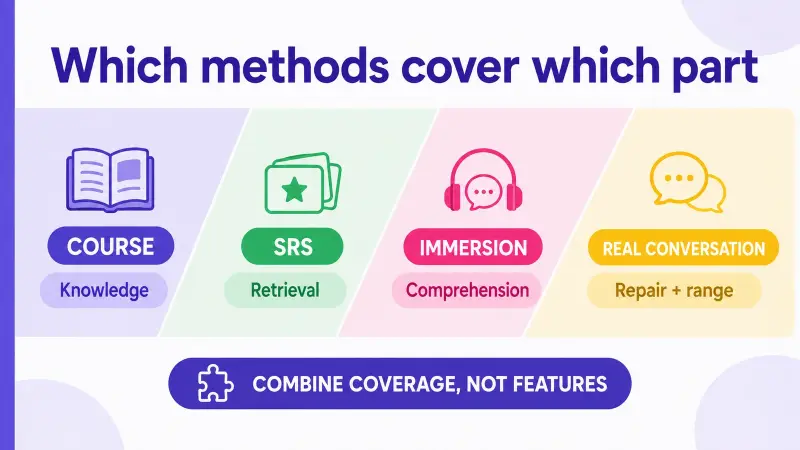
Method debates go in circles because people compare tools without saying which component they are judging. A tool that is excellent for comprehension can be useless for repair, and both claims are true at once. The table below reads across the four parts.
| Method | Comprehension | Retrieval | Repair | Range |
|---|---|---|---|---|
| Grammar workbooks | Low | Low | None | Low |
| Vocabulary apps, flashcards | Low | Recognition only | None | None |
| Gamified courses (Duolingo) | Partial | Partial | None | Low |
| Podcasts, films, reading | High | None | None | Partial |
| Pronunciation tools (ELSA) | None | Partial | None | None |
| Tutoring (italki, Cambly) | One voice | High | Partial | Partial |
| Text chat with natives | Low | High | High | Partial |
| Group voice chat | High | High | High | High |
| Public posts, native corrections | None | Partial | High | Partial |
| HelloTalk (chat, Moments, Voicerooms) | Partial | High | High | Partial |
Nothing in the top half touches repair, which is why well-studied learners stay fragile in real conversation. HelloTalk scores partial on comprehension and range because its Voicerooms carry real speed but do not order it by level, and it is not a structured course that sequences grammar for you.
Month Three Versus Month Twelve
Sequence matters as much as method. Building all four at once produces slow progress on all of them, because retrieval practice is painful before you have enough input to retrieve from. The next table splits the same components across two time slices.
| Component | By month three | By month twelve |
|---|---|---|
| Comprehension | Familiar topics only; missing a lot in groups | Multi-speaker talk, new topics, several accents |
| Retrieval | Short sentences, visible delay, frequent restarts | 20-30 minutes with nothing rehearsed |
| Repair | Notice the breakdown; rephrase with help | Repair alone with definitions and checking questions |
| Range | One register, whichever you practiced in | Switch casual and professional on purpose |
| Weekly mix | Heavy input, light output, text chat | Balanced input and live speech, varied partners |
The month-three column is deliberately modest. Most people quit in month two because their expectations for that stage were borrowed from month twelve.
Frequently Asked Questions
How long does it take to become fluent in English? There is no single answer, because fluency is four separate abilities. With daily input and a few unscripted conversations each week, most learners reach comfortable everyday conversation between one and two years from a low-intermediate start. Comprehension arrives first, range last.
Can I become fluent in English without speaking to anyone? You can build comprehension and a large passive vocabulary alone, and partly build retrieval through timed writing. Repair cannot be built alone, because it needs a real breakdown with another person. Learners who study alone for years understand far more than they can produce.
Is it better to focus on grammar or speaking first? Enough grammar to build a basic sentence is worth front-loading. After that, grammar is absorbed better through correction inside real conversations than through more isolated exercises. Studying grammar while avoiding speaking is the most common way learners stall at intermediate level.
Why do I understand English but freeze when I try to speak? Recognition and production are different skills. Study that is mostly input trains recognition only, so words sit in a form you can identify but not retrieve on demand. The fix is repeated low-stakes output with time pressure, starting with text chat if live speech feels too fast.
What is the fastest way to improve English listening? Volume with variety. Long daily exposure to unscripted audio with several speakers beats short sessions of clean scripted recordings, and rotating between accents prevents the narrow comfort of one familiar teacher.
Do language exchange apps actually work for fluency? They cover what solo tools miss: retrieval under pressure and repair. HelloTalk reports 70M+ registered users across 200+ countries and 260+ languages, with 90% of core features free, which is why it is often used as the conversational layer on top of an existing course rather than a replacement.
The Part Nobody Trains on Purpose
Three of the four parts get some mainstream attention, however uneven. Repair gets none. No textbook chapter is called "what to do when they did not understand you," because it only exists inside a conversation that has already gone wrong.
That absence is worth using. If you already listen a lot and know more grammar than you can deploy, the highest-return change is not more study. It is having conversations where you get misunderstood, and practicing the moves that get you back on track. HelloTalk supports that with chat-based learning, Moments corrections from native speakers, and 24-hour Voicerooms you can join as a listener, plus AI pronunciation scoring and AI grammar correction with explanations. VIP comes in regional monthly, yearly, or lifetime plans (see in-app quote), though the conversational core does not need it.
Pick the part that is actually next for you, then choose the method that covers it. Start at HelloTalk.