
Why Fast Beginner Japanese Study Plans Fail at Week Three

Weeks One and Two Go Fine
The first two weeks of Japanese are the easiest you will ever have, and that is the problem. Everything in front of you is countable. Hiragana is a closed set, and so is katakana.
Hiragana's base syllabary contains 48 characters, two of which barely appear in modern Japanese outside a few proper names. Katakana runs parallel. So week one means roughly a hundred symbols with a clear finish line, and each morning the count of unknowns drops. That feels like speed.
Week two keeps it going. You learn desu, you learn wa and o, you swap nouns into a frame you already have. Sentences appear. Your plan looks correct.
Week one of a Japanese plan has a visible finish line and week three does not, and that single structural difference explains most beginner dropouts. Nothing about your discipline changed. The shape of the material changed.
What Changes at Week Three
Around week three, three things arrive at once. Kanji becomes daily work. Grammar stops being noun substitution and starts asking you to conjugate. And the countable wins run out, because there is no closed list anymore.
The jōyō kanji set used for general written Japanese contains 2,136 characters. You do not need that number soon, but it ends the daily experience of a shrinking list. Progress goes invisible for a while, which most fast plans never mention.
The table tracks one learner week by week. The left columns are what happens; the right two are where the written plan and reality come apart. Read the last column first. The final row is not a week; it names what the gap responds to and where HelloTalk stops helping.
| Week | What the learner is doing | What the plan assumes | Where the gap opens |
|---|---|---|---|
| 1 | Drilling hiragana, then katakana | Character learning is representative of the whole language | Kana is finite; nothing after it is |
| 2 | Slotting nouns into desu sentences | Grammar continues as substitution | Real sentences need conjugation, not swaps |
| 3 | First kanji, first verb forms, first listening attempt | Difficulty rises smoothly | Three new demands land in the same week |
| 4 | Reviewing more than producing | Review counts as progress | You can recognize far more than you can say |
| 5 | Missing days, then restarting from kana | A missed day is recoverable | Restarting resets to the only part that felt good |
| Fix | One Japanese sentence sent and corrected daily | Structured lessons alone carry you | HelloTalk supplies retrieval and repair; HelloTalk is not a course and does not teach the writing system |
Week five is the tell. Almost nobody quits at week three. They quit at week five, after going back to kana once more because kana is the only place the plan still works.
The Fastest Real Path
The fastest way for a beginner to learn Japanese is a routine that survives week three, not one that peaks in week one. Speed here is measured in months of unbroken contact, so anything that raises the odds of week eight existing beats anything that makes week one impressive.
That reframes what to optimize. A schedule you can run at 40% capacity on a bad day beats one that requires 100%, because the second has no bad-day version and a bad day ends it. A study plan without a defined minimum day is a plan that quietly requires perfect attendance, which is why it breaks at the first interruption rather than the first hard concept.
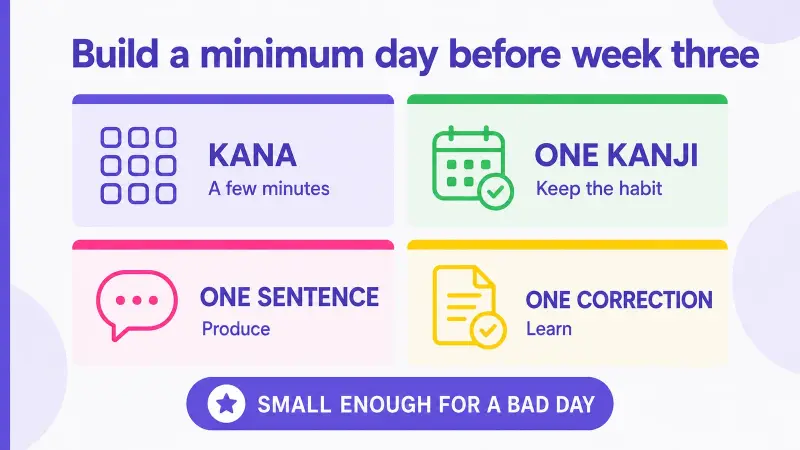
The surviving version: keep kana review to a few minutes, start kanji in week two with the fifteen or twenty characters you would see on a menu or a train sign, and add one output action daily. The tooling is broken down in the beginner Japanese learning stack, which answers the general tool question; this article is about the narrower window, weeks three to five, where those tools stop being used.
Output is what carries you across the flat stretch. When you send a sentence and someone answers, the day produced evidence. HelloTalk's chat-based learning sits on that need: in-chat translation, kana and romaji transcription, read-aloud audio, and in-chat grammar correction, so you never leave the conversation to check a form.
Three Failure Points, in Order
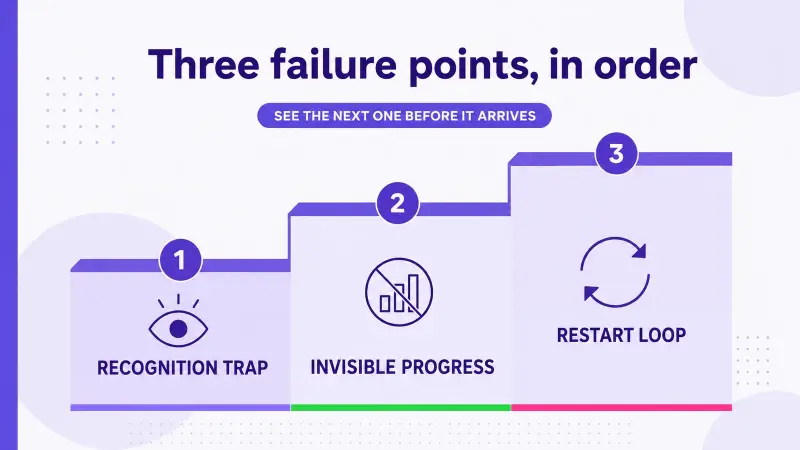
They fail in a fixed sequence, which is useful: you can see the next one coming.
The recognition trap comes first. By week three you can read kana and understand sentences you are shown, which creates an impression of competence that speaking immediately contradicts. Recognition grows several times faster than production, so a learner in week four typically understands far more Japanese than they can generate under any time pressure. The fix is not more input. It is making some part of every session require a sentence nobody handed you.
The invisible-progress stretch comes second. Weeks three through six have no natural milestone. Kana is done, kanji has no end, conversation is not fluent yet. You need a countable that is not a character count: messages sent, corrections received, voice notes recorded.
The restart loop comes third and does the actual damage. You miss two days, feel behind, and go back to the beginning because that is where you felt capable. Three restarts later, month four looks exactly like week one. Repeated restarting is more destructive than a long gap, because it converts months of effort into permanent beginner-level material. If you miss time, resume at the hardest thing you reached.
What to Build In Beforehand
These are conditions to set before week three arrives, not repairs to attempt afterward.
A floor day. Decide now what counts as done on your worst day. One kanji plus one sent sentence is a legitimate floor. Written down in advance, it stops a missed day becoming a missed week.
A person who expects to hear from you. Software does not notice your absence; a human partner does. HelloTalk's Moments feed suits learners who do not want a scheduled call: you post two or three Japanese sentences publicly and several native speakers correct the same text, which is also a countable win in a week that has none. HelloTalk reports 70M+ registered users across 200+ countries, so a Japanese post at an odd hour still gets answered.
An early kanji habit. Twenty characters in week two removes the cliff, because kanji is then already routine rather than a new demand arriving on a hard week.
A pronunciation check. Japanese pitch and rhythm drift early and set fast. HelloTalk's AI pronunciation scoring flags which parts of a recording came out wrong, and there is more in this guide to natural-sounding beginner Japanese.
Frequently Asked Questions
Is week three actually when most beginners quit Japanese? Week three is when the material changes shape, but visible quitting usually happens around weeks four to six. Kanji, verb conjugation, and the end of countable progress arrive together, and the drop-off follows a week or two later.
How many kanji does a beginner actually need? Far fewer than the general-use set of 2,136 characters. For the first few months, a few dozen high-frequency characters covering numbers, days, directions, and common signs do more than any larger target.
Should I finish kana before touching kanji? Finish kana first, but start kanji before kana feels fully finished. A small number of characters in week two means kanji is an existing habit by the time a fast plan expects you to absorb it in bulk.
Is Japanese realistically learnable in three months? Not to conversational independence. The US Foreign Service Institute routes Japanese through roughly 44 additional weeks of in-country study at its overseas field schools after Washington training, which indicates the scale involved for professional proficiency.
What should I do after missing a week? Resume at the last thing you were working on, not at the beginning. Reread recent notes for ten minutes, then send one message in Japanese the same day. Restarting from kana is the most common way beginners lose a year.
How do I practice speaking when I can barely form sentences? Record short voice notes rather than scheduling calls. HelloTalk's Voicerooms run around the clock and you can join as a listener at first, which builds ear familiarity without requiring much production.
Do I need to pay for a language app to keep this going? No. HelloTalk keeps 90% of core features free, including chat, corrections, Moments posts, and voice notes. HelloTalk's VIP tiers are sold as regional monthly, yearly, or lifetime options (see in-app quote). Free options are compared in this rundown of online Japanese resources.
Past Week Three Without Restarting
The learners who get through are rarely the fastest in week one. They are the ones whose week-three routine was already boring: a few minutes of kana, a handful of kanji, one sentence sent to a real person, done.
If you are in week two, add the kanji and the daily message before you need them. If you are in week four and stalling, do not go back to hiragana. Send one imperfect Japanese sentence today and let someone fix it at HelloTalk.