
Japanese for Beginners: The Fastest Path to Sounding Like a Real Speaker

Most of us start Japanese by grinding vocabulary lists and grammar drills, then wonder why we still sound flat and robotic six months in. The order we learn things in matters more than how many hours we put in.
The fastest way for a beginner to sound like a basic Japanese speaker is to lock in the sound system first, then learn a small set of high-frequency phrases as whole units, and get a native speaker to correct your rhythm before habits harden. That sequence front-loads the parts your ear and mouth need most.
Here is the honest context. Japanese is rated a super-hard language for English speakers, and reaching professional proficiency takes roughly 2,200 class hours according to US Foreign Service Institute estimates. But sounding like a natural basic speaker is a much smaller goal, and it is reachable in weeks if you attack the right things in the right order.
Why the usual order slows you down
The common beginner path is: kanji and vocabulary first, grammar second, speaking last. That feels productive because you can measure it. The problem is that pronunciation and rhythm are motor skills, and motor skills built on top of silent reading tend to lock in the wrong patterns.
Japanese pronunciation is mostly a feedback problem, not a knowledge problem. You can read every rule about pitch accent and still sound off, because your ear has not learned to hear the difference yet. That is why native input and correction have to come early, not at the end.
The four things that actually make you sound natural
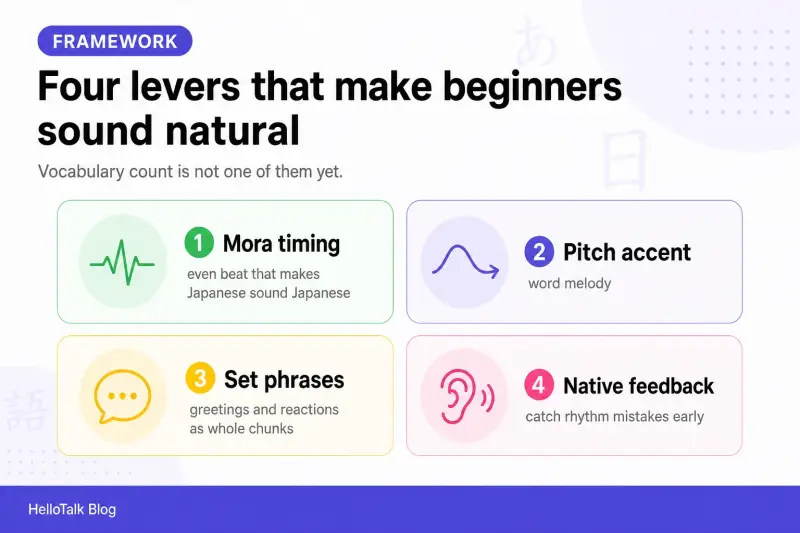
Sounding like a basic speaker comes down to four levers. Vocabulary size is not one of them at this stage.
| Lever | What it fixes | How much beginners neglect it |
|---|---|---|
| Mora timing | The even beat that makes Japanese sound Japanese | High |
| Pitch accent | Word melody (hashi = bridge vs chopsticks) | Very high |
| Set phrases | Natural greetings and reactions, said as one chunk | Medium |
| Native feedback | Catching mistakes before they harden | Very high |
Japanese has two 46-character kana scripts (hiragana and katakana), and each syllable is timed as an even beat called a mora. Getting that even timing right does more for your accent than another 500 words ever will.
The fastest beginner order, step by step
-
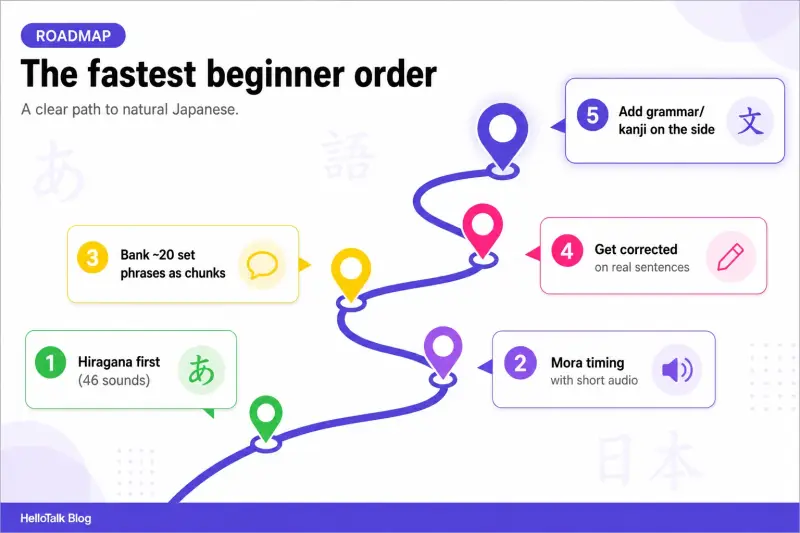
Learn hiragana in your first week. All 46 basic characters map cleanly to the sounds you will make. Reading kana forces correct vowels from day one instead of guessing from romaji.
-
Train mora timing with short audio. Listen to a native line, then repeat it matching the beat, not the speed. Ten minutes a day beats an hour once a week.
-
Bank 20 set phrases as whole units. Greetings, thanks, and simple reactions like "sou desu ne." Say them until they are automatic, the way a real speaker does.
-
Get corrected on real sentences. Send a short voice clip to a native speaker and ask which word sounded off. This is where fake progress becomes real.
-
Add grammar and kanji on the side. The 2,136 jōyō kanji matter eventually, but they do not make you sound natural. Layer them in once your mouth is moving.
We go deeper on the exact week-by-week version of this in our first month Japanese plan for beginners, and on the specific drills in our guide to Japanese pronunciation practice methods.
Where real feedback comes from
An app can tell you a sound is wrong. A person can tell you why it is wrong and say it back the way a friend would. You want both, and you want them cheap or free while you are figuring out whether you will stick with Japanese.
This is where a real-people platform earns its place. On HelloTalk, with 70M+ registered users across 200+ countries and 260+ languages, you can post a short clip to Moments and get several native Japanese speakers correcting your rhythm and word choice in a day. The chat itself has built-in transcription, reading aloud, and real-time grammar correction, so you fix a sentence without leaving the conversation.
For structured drilling, the AI pronunciation scoring points at the specific sound that is off rather than just marking you wrong, and Voicerooms let you sit in a live 24-hour Japanese voice room as a listener first, then join when you are ready. Livestreams add short interactive mini-lessons. With over 1 billion messages sent daily and most core features available for free, you can build the daily habit without paying to test the water.
Common beginner mistakes
-
Starting with romaji and never dropping it. It cements English vowel habits. Move to hiragana fast.
-
Chasing kanji count as a progress metric. It feels good and does little for how you sound.
-
Only speaking to an app. Apps do not react like humans, and reactions are half of sounding natural.
-
Skipping pitch accent entirely. You do not need to master it, but ignoring it makes basic words sound wrong.
FAQ
How fast can a beginner sound like a basic Japanese speaker? With daily practice focused on sound and set phrases, most of us can hold a natural-sounding basic greeting and reaction within 4-6 weeks. Fluency is a much longer road.
Do I need kanji to sound natural? No. Kanji is a reading and writing skill. Sounding natural is about sound, rhythm, and phrasing, which you can build from hiragana and audio alone.
Is pitch accent really necessary for beginners? You do not need perfect pitch accent, but a rough sense of it prevents common words from sounding wrong. Getting corrected on a few clips teaches your ear quickly.
Should I learn grammar before speaking? No. Learn a handful of set phrases as chunks and start speaking immediately. Grammar makes more sense once you already have sentences in your mouth.
Can I learn Japanese pronunciation for free? Yes. Free audio plus feedback from native speakers on a platform like HelloTalk covers the core, since most core features are free.
How much daily time do I need? Fifteen to twenty focused minutes a day on timing and phrases outperforms long weekend sessions, because pronunciation is a motor habit that needs frequent reps.
Ready to start sounding real instead of just studying? Set up a free account and post your first Japanese voice clip at HelloTalk.