
How to Learn Spanish Efficiently: Stop Wasting Time on the Wrong Things

Most of us do not fail at Spanish because we are lazy. We fail because we pour hours into activities that feel productive but move the needle very little. So before we talk about what to do, let's be honest about what to stop.
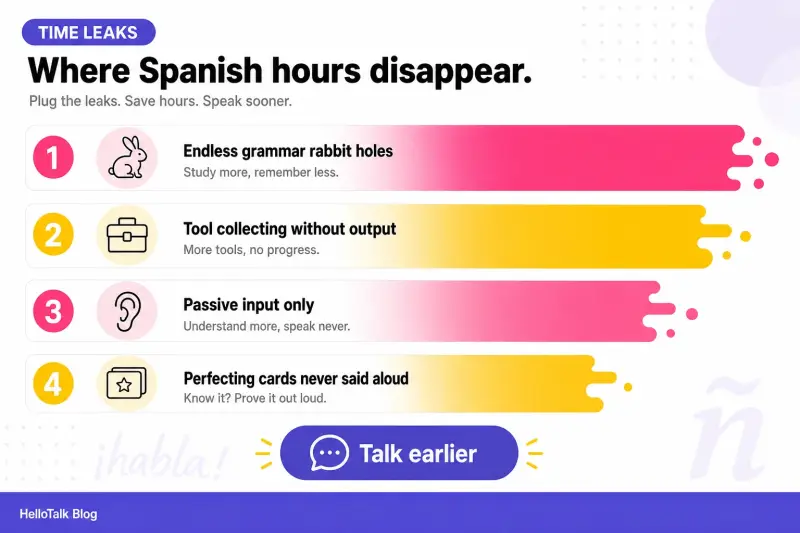
The single biggest reason Spanish feels slow is that learners spend most of their time recognizing the language instead of producing it. Reading grammar tables, tapping through app streaks, and rewatching the same video all build passive familiarity. Speaking and writing are what turn that familiarity into real ability.
First, the reality of the timeline
Spanish is one of the fastest languages for English speakers to reach a working level in. The US Foreign Service Institute classifies it as a Category I language, estimating roughly 600 to 750 class hours (about 24 to 30 weeks of full-time study) to reach professional working proficiency. That is a benchmark, not a promise, but it tells us something useful: the bottleneck is rarely the difficulty of Spanish itself, it is how those hours get spent.
Where the time actually leaks
Here is where most of us quietly lose weeks and months.
| Common habit | Why it feels good | Why it wastes time | Fix |
|---|---|---|---|
| Grinding app streaks | Visible progress, gamified | Mostly recognition, little output | Cap it at 10 minutes, then speak |
| Studying grammar tables in advance | Feels rigorous | Rules do not stick without use | Learn a rule only when you hit it in real speech |
| Rewatching content you already understand | Comfortable | No new input, no output | Use it, then describe it aloud |
| Passive vocabulary lists | Easy to measure | Words without context fade fast | Learn words inside phrases you will say |
| Waiting until you are "ready" to talk | Protects the ego | Delays the one thing that matters most | Talk from week one, badly |
The efficient priority order
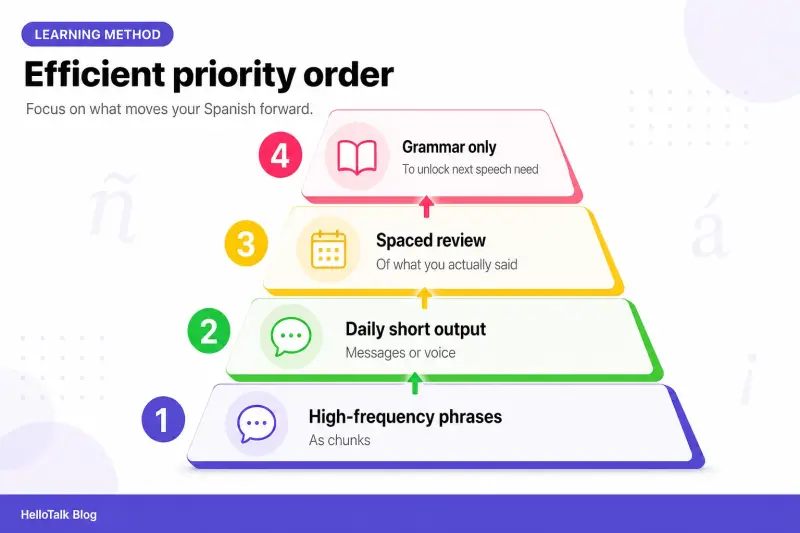
If we had to rank where a beginner's hours should go, it looks like this.
-
Comprehensible input at your level. Listening and reading that you mostly understand builds intuition faster than isolated study.
-
Speaking with real people. Output forces recall and exposes exactly what you cannot yet say.
-
Targeted correction. A native speaker pointing out one recurring mistake beats a hundred grammar drills.
-
Just-in-time grammar. Learn the rule when a real sentence demands it.
-
Spaced review of what you actually used. Not random lists, your own errors and phrases.
The fastest learners treat grammar and vocabulary as tools they pick up while communicating, not as prerequisites to communicating.
Where HelloTalk fits
The hard part of this priority order is getting real speaking and real correction without booking formal lessons every day. That is the gap HelloTalk was built for. With 70M+ registered users across 200+ countries and 260+ languages, you can find Spanish speakers to actually talk with, not just study about.
A few features make the efficient path practical:
-
Chat-based learning lets you message native speakers with built-in translation, transcription, read-aloud, and real-time grammar correction, so you learn from your own mistakes without leaving the conversation.
-
Moments works like a public feed where you post a short Spanish paragraph and get corrections from several native speakers, while you scroll real daily posts from Spanish speakers.
-
Voicerooms and Livestreams run around the clock, so you can drop into a Spanish voice room as a quiet listener first, then start speaking when you are ready.
-
AI learning tools give you AI pronunciation scoring that flags specific sounds, AI grammar correction with explanations, and image translation for menus, signs, and posts.
With most core features available for free, you can build the speaking habit before spending a cent.
Common mistakes that quietly slow you down
-
Treating input and output as the same thing. They are not. You need both, daily.
-
Chasing perfect pronunciation before you can hold a basic exchange.
-
Collecting resources instead of using one consistently.
-
Skipping correction because it stings. Correction is the shortcut.
FAQ
How long does it take to learn Spanish efficiently? Reaching a comfortable conversational level typically takes several months of consistent daily practice. The FSI benchmark of 600 to 750 hours points to professional proficiency; casual conversational ability comes much sooner if you speak regularly.
Is Spanish really easier than other languages for English speakers? Relatively, yes. It shares a lot of vocabulary roots and uses the same alphabet, which is why FSI places it in its easiest category. Pronunciation is also fairly phonetic once you learn the rules.
Should I learn grammar first or start speaking first? Start speaking early, badly, and learn grammar as you hit real gaps. Grammar you use sticks; grammar you memorize in the abstract usually does not.
Do apps alone make you fluent? No. Apps are excellent for input and review, but they cannot replace producing the language with real people. Combine app-based review with real conversation.
How much should I practice each day? Consistency beats intensity. Even short daily sessions outperform occasional long ones. If your time is limited, see our guide on learning Spanish efficiently with only 15 minutes a day.
Where to go next
If you want the method backed by how people actually acquire languages, read the most efficient way to learn Spanish in 2026. If you are unsure which resources deserve your hours, our breakdown of what to prioritize among Spanish learning tools puts them in order.
The efficient path is not complicated: spend more time producing Spanish with real people and less time preparing to. You can start that first conversation today at HelloTalk.