
How to Learn Spanish Efficiently When You Only Have 15 Minutes a Day

Fifteen minutes does not sound like enough to learn a language. Here is the thing though: fifteen focused minutes every single day beats a two-hour cram session once a week, because languages reward frequency over volume.
With only 15 minutes a day, the efficient move is to spend most of it producing Spanish, not consuming it, because output is the slowest skill to build and the easiest to skip. Passive review can happen in the cracks of your day. Speaking cannot, so it earns the biggest slice of a tiny budget.
Why short and daily wins
When your time is scarce, two principles decide everything.
-
Frequency protects memory. Touching Spanish daily keeps vocabulary from fading between sessions, so you spend less time relearning.
-
Output is the constraint. You can absorb input passively during a commute, but you have to schedule speaking on purpose.
That means the 15 minutes should not be a smaller version of a long study session. It should be built around the one thing you cannot do anywhere else.
The 15-minute routine
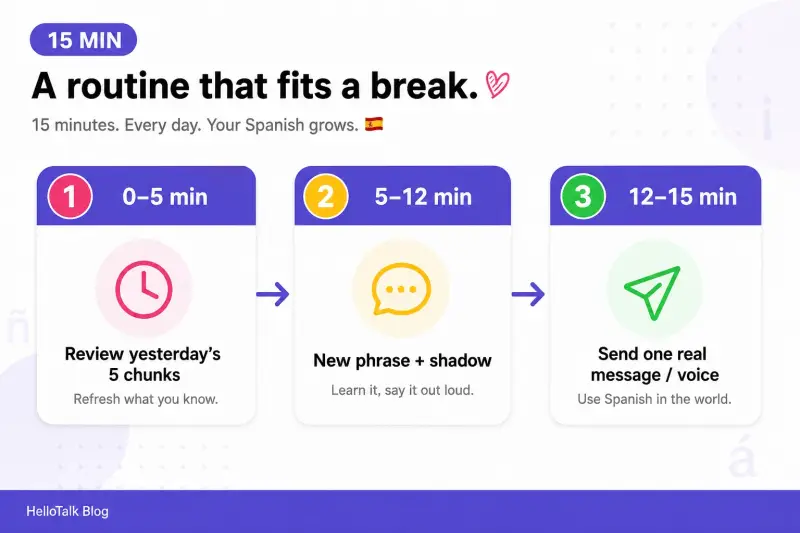
Here is a minute-by-minute plan that fits the efficient priorities into a quarter hour.
| Minutes | Activity | Output? | Why it earns the slot |
|---|---|---|---|
| 0-2 | Review 5 phrases you got wrong yesterday | Light | Spaced repetition of your own errors |
| 2-9 | Send 2-3 voice or text messages to a native speaker | Yes | Real output, the highest-value activity |
| 9-12 | Read the corrections you received and say them aloud | Yes | Turns feedback into corrected output |
| 12-15 | Save today's new phrases for tomorrow's review | Light | Closes the loop for the next session |
Notice that more than half the time goes to producing Spanish. A 15-minute session that includes real speaking or writing will outperform a 45-minute session that is all reading and app taps.
Fill the cracks with passive input
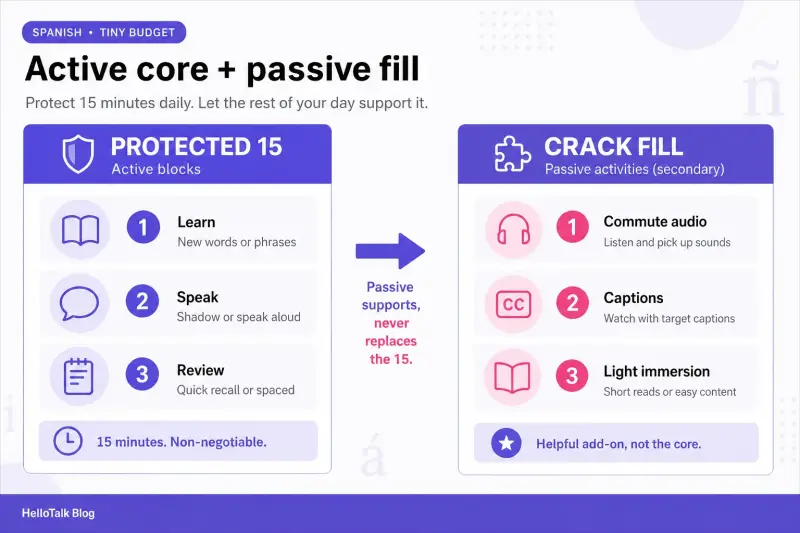
The 15 minutes is your active core. Around it, stack passive input that costs no extra scheduled time:
-
Listen to a Spanish podcast or playlist during your commute.
-
Switch one app or your phone menu to Spanish.
-
Scroll a Spanish social feed instead of your usual one for five minutes.
This input does not replace the active session; it feeds it. Words you hear passively become words you recognize in your daily messages.
Message templates to save your minutes
The fastest way to waste your 15 minutes is to sit there wondering what to say. Keep a few openers ready:
-
"Hoy hice ..." (Today I did ...) then describe one thing from your day.
-
"¿Cómo se dice ... en español?" (How do you say ... in Spanish?)
-
"¿Está bien esta frase?" (Is this sentence correct?) then paste what you wrote.
Reusing a small set of openers removes friction, so all 15 minutes go into actual practice.
Where HelloTalk fits a tiny time budget
A short daily routine only works if speaking practice is available on demand, and that is what a global community provides. HelloTalk gives you access to native Spanish speakers among 70M+ registered users across 200+ countries and 260+ languages, so you can fire off a message or voice note the moment your 15 minutes start.
For a compressed routine, these features do the heavy lifting:
-
Chat-based learning is the core of the plan. Send text or voice messages and get real-time grammar correction, translation, transcription, and read-aloud without leaving the chat, which is exactly your minutes 2 to 9.
-
Moments covers the days you cannot chat live. Post one short sentence, get corrections from several native speakers later, and glance at real Spanish posts as quick input.
-
Voicerooms and Livestreams run 24 hours, so on a day you have a spare few minutes you can listen in on a live Spanish room instead of studying alone.
-
AI learning tools speed up the review portion. AI pronunciation scoring points to the exact sound to fix, and AI grammar correction explains each change so your two-minute review is genuinely useful.
With most core features available for free, a 15-minute habit does not need a paid plan to work.
Common mistakes with short sessions
-
Spending all 15 minutes on an app streak and never speaking.
-
Skipping days, which forces you to relearn instead of build.
-
Trying to cover too much, so nothing gets practiced deeply.
-
Not preparing openers, then burning half the time deciding what to say.
FAQ
Can 15 minutes a day really work for Spanish? Yes, if you do it daily and weight it toward output. Consistency compounds, and short sessions are far easier to sustain than long ones you eventually abandon.
What should I prioritize in such a short session? Speaking or writing to a real person, then reviewing the corrections. Passive input can happen outside the 15 minutes during commutes or chores.
How long until I see progress on this routine? Most learners notice more confident, quicker responses within a few weeks, because daily output builds recall speed even when total study time is small.
Is it better to do 15 minutes daily or 2 hours weekly? Daily wins for language learning. Frequent contact keeps memory fresh, while long gaps between sessions force costly relearning.
What if I miss a day? Just restart the next day. One missed session is fine; the danger is letting one gap become a week.
Where to go next
For the bigger picture on spending your hours well, read how to learn Spanish efficiently and what to stop doing. To understand why output and spaced review matter so much, see the most efficient way to learn Spanish in 2026. And if you want to know which resources deserve even your limited minutes, check what to prioritize among Spanish learning tools.
For the broader strategy, see how to learn Spanish efficiently.
Fifteen minutes is enough if you protect it and point it at real conversation. Start today's session at HelloTalk.