
How to Learn Korean Quickly: The Method That Works for Busy People in 2026

Most of us who want to learn Korean do not have two free hours a day. We have a commute, a job, maybe a family, and a phone full of half-finished lessons. So the real question is not "how do I learn Korean," it is "how do I learn Korean quickly when my week is already full."
Here is the honest answer up front, then the method.
The fastest way to learn Korean is to spend your first few hours mastering Hangul, then build everything else from short spoken exchanges instead of long study sessions. This is where busy learners save the most time, because the alphabet unlocks reading and correct pronunciation at the same time.
First, set your expectations with real numbers
Speed only means something if you know the distance. The U.S. Foreign Service Institute ranks Korean as a Category V language, one of the hardest for English speakers, at roughly 2,200 class hours to reach professional working proficiency. That number scares people off, so read the next sentence carefully.
You do not need 2,200 hours to hold real conversations; that figure is for near-fluent professional use, and basic conversational comfort comes far sooner with focused daily practice. Busy people reach a functional beginner level in weeks, not years, by aiming at conversation rather than mastery.
The other encouraging number: Hangul has only 24 basic letters, 14 consonants and 10 vowels, and it is widely considered one of the most logical writing systems in the world. Many learners read it, slowly, in a single afternoon.
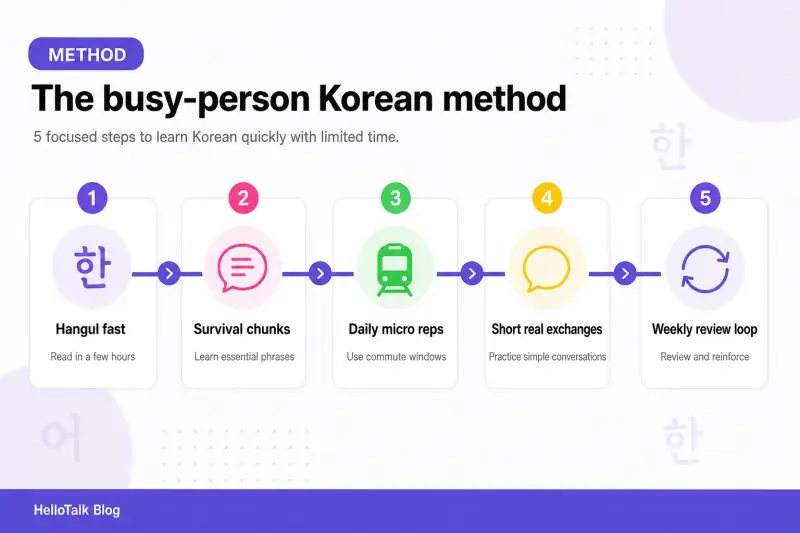
The busy-person method, step by step
The core idea is short, frequent, and spoken. Five focused sessions a week beat one long weekend cram, because your memory consolidates spacing better than volume.
| Time you have | What to do | Output you get |
|---|---|---|
| 15 min/day, week 1 | Learn Hangul in blocks (vowels, then consonants) | Read and sound out any Korean word |
| 10 min/day, weeks 2-3 | Learn 100 high-frequency phrases as chunks | Order food, greet, ask simple questions |
| 10 min/day, ongoing | Send one voice or text message to a native speaker | Real feedback on real sentences |
| 20 min, twice a week | Listen to a Korean podcast or clip, repeat aloud | Ear training and rhythm |
Learning phrases as whole chunks, not isolated grammar rules, is the single biggest time-saver for busy Korean learners. You absorb the grammar passively while saying things you actually need.
Why "quickly" fails without real conversation
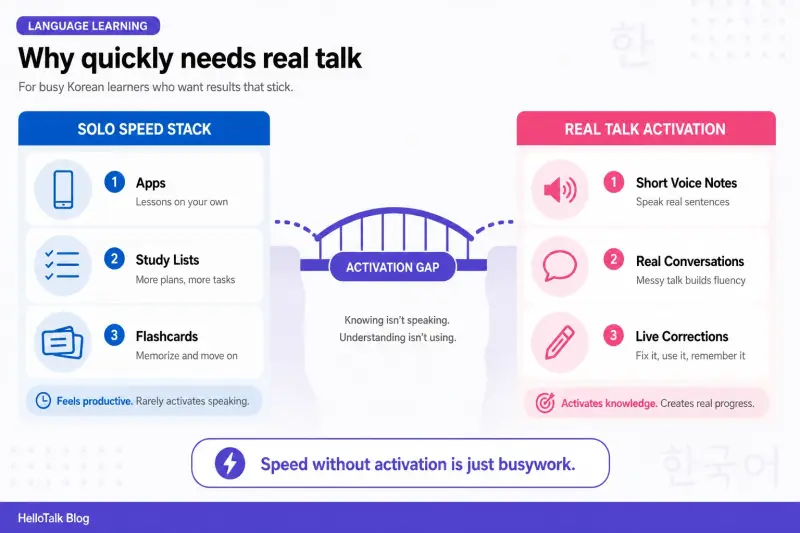
Apps and flashcards build recognition, but speaking is a separate skill that only grows when someone responds to you. This is the gap that traps busy learners: they finish a streak, then freeze in a real conversation.
The fix is to make talking to a native speaker part of the daily habit, not a scary final exam. On HelloTalk you can message native Korean speakers directly, and the chat has built-in translation, transcription, and real-time correction, so you can write a Korean sentence, get it fixed, and send a voice note without leaving the conversation. With 70M+ registered users across 200+ countries, finding a Korean speaker who is also learning your language usually takes minutes.
If you can only spare ten minutes, spend them here. A corrected sentence teaches faster than a passive lesson.
Fit Korean into a schedule that is already full
Stack learning onto things you already do. Change your phone to Korean. Listen to a Korean playlist on the commute. Read Hangul signs in games or dramas. These micro-exposures cost no extra time and keep the language warm between sessions.
For the parts you cannot do alone, the community features carry the load. HelloTalk's Voicerooms run around the clock, so you can drop into a Korean room as a silent listener while cooking, then say one sentence when you feel ready. Livestreams add short interactive lessons you can catch on a break, and Moments lets you post a Korean sentence to the public feed and collect corrections from several native speakers at once.
Common mistakes that slow busy learners down
-
Skipping Hangul and relying on romanization. It feels faster for a week, then wrecks your pronunciation and reading.
-
Studying grammar tables before you can say anything. Learn to speak, then label the rules.
-
Saving speaking for "when I'm ready." You are ready after Hangul plus twenty phrases.
-
Long, rare sessions. Consistency beats duration every time.
For a deeper look at why Korean earns its hard reputation and how that compares to other languages, see our guide to the hardest languages to learn and the real study data behind them.
FAQ
How quickly can a busy person learn basic Korean? With 15-30 minutes a day, most learners read Hangul in a week and hold simple conversations in 4-8 weeks. Professional fluency takes much longer, but that is not the goal for most busy learners.
Do I really need to learn Hangul first? Yes. It takes only a few hours because there are just 24 basic letters, and it fixes your pronunciation and reading from day one. Romanization is a shortcut that costs you later.
Can I learn Korean without a tutor or class? You can cover reading, phrases, and listening alone, but speaking needs a responsive partner. Free conversation with native speakers, such as through HelloTalk chat and Voicerooms, replaces most of what a beginner class provides.
Which apps actually make Korean easier? That depends on your goal. We compare the honest strengths and limits of each in our breakdown of which Korean learning apps live up to the "easy" claim.
Is K-pop or K-drama a good way to speed things up? It helps with listening and motivation, but only if you use it actively. See what genuinely works in our guide to learning Korean through K-pop and K-drama.
What if I want a fixed timeline? Follow a structured schedule like our realistic 30-day Korean plan that gets you speaking.
Start today, not "someday"
Speed in Korean comes from small daily reps and real conversation, not marathon study. Learn Hangul this week, grab a handful of phrases, and send your first message to a native speaker. Practice free with real people on HelloTalk and turn ten spare minutes a day into steady progress.