ELSA vs HelloTalk for Japanese Pronunciation: Which Makes You Sound Natural?
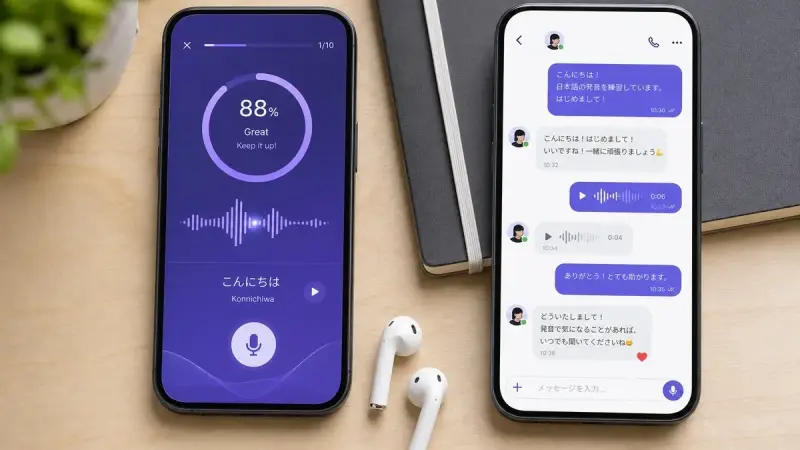
If you searched for a tool to fix your Japanese pronunciation, you have probably run into ELSA and HelloTalk near the top. They both promise better speaking, but they solve different halves of the problem, and picking the wrong one for your stage wastes weeks.
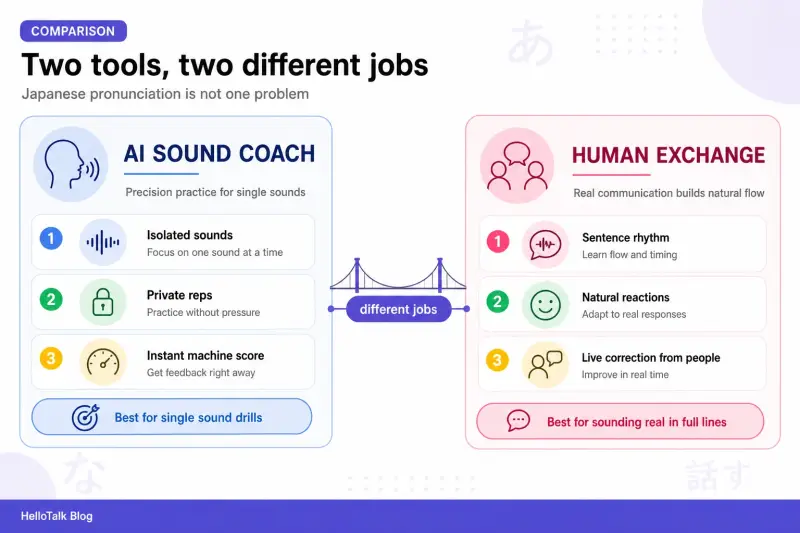
ELSA is built for solo AI drilling of individual sounds, while HelloTalk is built for real native-speaker feedback on full sentences. The fastest results usually come from using them in that order: drill the mechanics, then get a human to correct your rhythm.
Here is the honest starting point. No app makes you sound natural on its own, because sounding natural depends on reactions and rhythm that only a real conversation reveals. What tools do well is narrow the gap between what you say and what a native speaker would say.
What each tool is actually good at
| Feature | ELSA | HelloTalk |
|---|---|---|
| Core strength | AI scoring of isolated sounds | Real native-speaker feedback |
| Japanese support | Limited, English-first focus | Full, 260+ languages including Japanese |
| Feedback source | Algorithm | 70M+ real users across 200+ countries |
| Sentence-level rhythm | Weak | Strong, via voice clips and calls |
| Set-phrase practice | No | Yes, in live chat and Voicerooms |
| Free tier | Partial trial | most core features available for free |
| Best for | Sound-by-sound polishing | Sounding natural in real use |
ELSA's origin is English pronunciation, and its Japanese coverage is thinner than its English product. It shines when you want to isolate one troublesome sound and hammer it. HelloTalk is a language exchange platform where the pronunciation help comes from people plus integrated AI tools.
The case for ELSA
ELSA works best when you already know what sound is failing and want repetitions. If you cannot hear the difference between two vowels, an AI scoring loop gives you fast, private reps without the awkwardness of a live person. That is genuinely useful in the early mechanical phase.
The catch is that isolated sounds are only part of Japanese. The even mora timing and pitch accent that make you sound Japanese live at the sentence level, and that is exactly where solo AI drilling gives you the least.
The case for HelloTalk
HelloTalk is the stronger choice for the part beginners neglect most: sentence rhythm and natural phrasing. You record a short clip, post it to Moments, and several native Japanese speakers correct your timing and word choice, often within a day. That is feedback an algorithm cannot fully replace.
It also bundles the drilling most people think they need a separate app for. The AI pronunciation scoring points at the specific sound that is off, not just a pass or fail. Chat has built-in transcription, reading aloud, and real-time grammar correction so you fix mistakes in context. Voicerooms give you 24-hour live Japanese voice rooms you can enter as a listener first, and Livestreams add interactive mini-lessons. On iOS, HelloTalk is featured on the Today tab in Japan, which matters if you want a Japanese-first community.
For the actual drills to run inside either tool, see our breakdown of Japanese pronunciation practice methods. And if you are still deciding what to learn first, start with the fastest beginner path to sounding natural.
How to choose
-
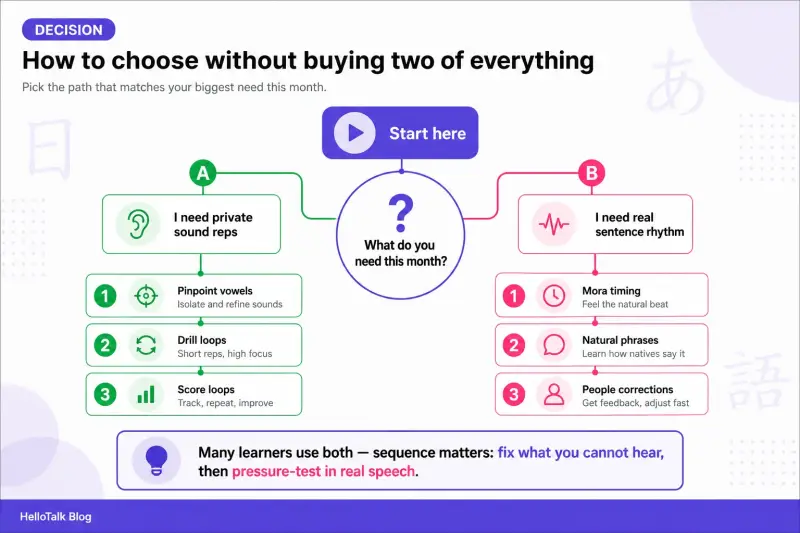
Choose ELSA if your only goal right now is grinding one or two isolated sounds in private and you already speak in sentences.
-
Choose HelloTalk if you want sentence-level rhythm, real native corrections, and integrated AI scoring in one free-heavy package.
-
Use both if budget allows: drill sounds solo, then bring full sentences to real people for the finishing feedback.
Honestly, for most beginners who want to sound natural rather than perfect one phoneme, the human feedback loop moves the needle faster. It is where fake progress turns into progress you can hear.
Common mistakes when picking a tool
-
Assuming AI scoring alone equals natural speech. It fixes sounds, not rhythm or reactions.
-
Paying for a second app before using the free feedback you already have. With most core HelloTalk features available for free, test the water first.
-
Never speaking to a person. Reactions are half of sounding natural, and no algorithm reacts like a friend.
-
Ignoring pitch accent. Both tools help less here than a native speaker saying the word back to you.
FAQ
Does ELSA support Japanese pronunciation well? ELSA is English-first, so its Japanese coverage is thinner than its flagship product. It is fine for isolated sound drills but weaker on Japanese sentence rhythm.
Can HelloTalk correct my Japanese pronunciation? Yes. Native speakers correct your voice clips, and AI pronunciation scoring flags the specific sound that is off, so you get both human and machine feedback.
Is HelloTalk free for Japanese practice? Yes. Most core features are available for free, including posting voice clips, chatting with native speakers, and joining Voicerooms.
Which is faster for sounding natural? For most beginners, HelloTalk's native feedback on full sentences moves you toward natural rhythm faster than solo AI drilling of single sounds.
Do I need any app at all? No app is mandatory, but a real-people platform gives you native corrections you cannot get from a textbook, which is the hardest part to source alone.
Can I use both tools together? Yes, and it is a strong combo. Drill mechanics on ELSA, then bring whole sentences to native speakers on HelloTalk for the rhythm and reactions.
Want native feedback on your first Japanese clip today? Create a free account at HelloTalk.