
Shadowing vs Recording vs Native Feedback: Fix Your Japanese Pronunciation
Three methods dominate every Japanese pronunciation guide: shadowing, recording yourself, and getting native feedback. Most learners pick one, plateau, and blame their "bad ear." The real issue is that each method fixes a different problem, and you need all three at different moments.
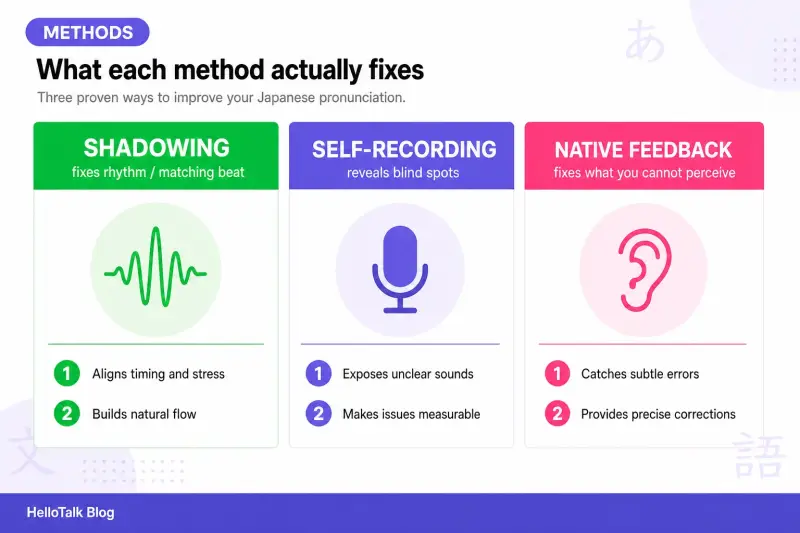
Shadowing trains your rhythm, self-recording exposes your blind spots, and native feedback tells you what you cannot hear yourself. Used together in that loop, they fix Japanese pronunciation faster than any single method used alone.
Here is why no single one is enough. Pronunciation has three layers: producing sounds, hearing your own errors, and knowing what a native speaker would actually say. Each method covers one layer well and the others poorly.
What each method actually fixes
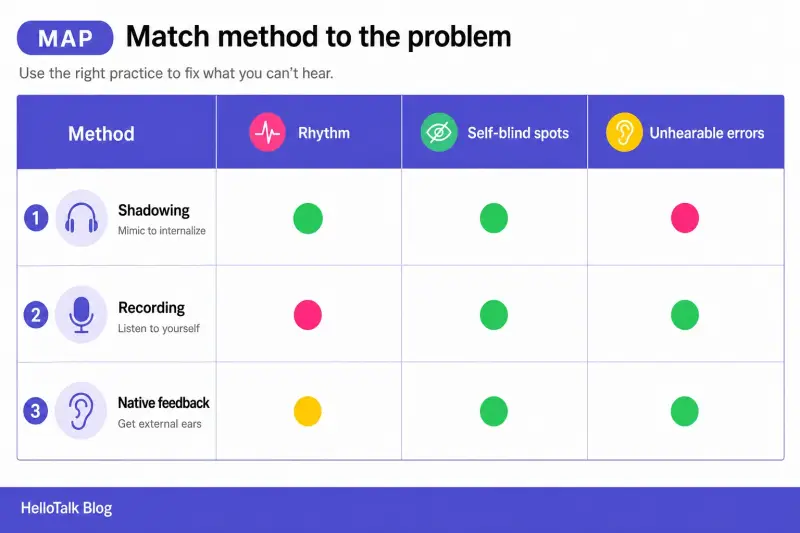
| Method | Fixes | Blind spot | Best moment to use it |
|---|---|---|---|
| Shadowing | Rhythm and mora timing | You cannot judge your own accuracy | Daily, from week one |
| Self-recording | Hearing your own errors | You may not know the correct target | Weekly check-ins |
| Native feedback | The gap you cannot perceive | Needs another person | Once you have clips to share |
Japanese timing runs on even beats called mora, and shadowing is the best tool for internalizing that beat. But your ear at the start cannot reliably grade you, which is exactly why the other two methods exist.
Method 1: shadowing for rhythm
Shadowing means playing native audio and speaking along almost simultaneously, copying the melody and beat rather than translating. Shadowing is the fastest way to internalize mora timing because it forces your mouth to match a real speaker in real time.
Use short lines, five to ten seconds, and loop them. Match the rhythm before the speed. Ten minutes a day builds the motor habit that makes basic Japanese sound Japanese. The limit: you are copying, so you cannot tell how close you actually got.
Method 2: self-recording for blind spots
Record yourself saying a line, then play it back against the original. Self-recording turns invisible errors into obvious ones, because the gap you cannot hear while speaking is easy to hear on playback.
Do this once or twice a week, not daily, or you fixate on flaws. The limit is real: if you do not know what the correct target sounds like, you will hear that something is off without knowing how to fix it. That is where the third method comes in.
Method 3: native feedback for what you cannot perceive
Some errors are invisible to you no matter how many times you record, usually pitch accent and subtle vowel length. A native speaker catches the mistakes your own ear is not trained to notice yet, which is the single fastest way past a plateau.
You do not need a tutor for this. Record a short clip, share it, and ask which word sounded off and how they would say it. Hearing the correct version said back to you retrains your ear in a way solo drilling cannot.
The loop that ties them together
-
Shadow a short native line daily to build rhythm.
-
Record yourself weekly and compare against the original.
-
Send your best and worst clips to native speakers for correction.
-
Re-shadow using their corrected version as the new target.
That loop is where the methods stop competing and start compounding. For where this fits in your overall timeline, see our first month Japanese plan for beginners, and for the bigger picture read the fastest beginner path to sounding natural.
Where to run the loop for free
The hardest step to source is native feedback, and that is where a real-people platform helps most. On HelloTalk, with 70M+ registered users across 200+ countries and 260+ languages, you post a voice clip to Moments and get several native Japanese speakers correcting your rhythm and pitch, often within a day.
The tools support the whole loop, not just feedback. AI pronunciation scoring flags the specific sound that is off so you know what to re-shadow. Chat has built-in transcription, reading aloud, and real-time grammar correction, so you fix a sentence in context. Voicerooms give you 24-hour live Japanese voice rooms to shadow real conversation and join when ready, and interactive Livestream mini-lessons add structure. If you are weighing a dedicated scoring app instead, compare them in ELSA vs HelloTalk for Japanese pronunciation. With over 1 billion messages sent daily and most core features available for free, running the full loop costs nothing.
Common mistakes
-
Shadowing only, forever. You copy without ever checking accuracy, so errors quietly fossilize.
-
Recording without a correct target. You hear something is wrong but cannot fix it alone.
-
Waiting for perfect clips before asking for feedback. Send rough clips early. Corrections are the point.
-
Treating pitch accent as optional. It is the layer you most need another person to hear for you.
FAQ
Which method is best for Japanese pronunciation? None alone. Shadowing builds rhythm, recording exposes your errors, and native feedback catches what you cannot hear. The loop of all three works best.
How often should I record myself? Once or twice a week is enough. Daily playback tends to make learners fixate on flaws instead of building the motor habit through shadowing.
Can I fix pitch accent without a native speaker? Partly, using audio comparison, but pitch accent is the layer learners most often cannot self-diagnose. Native feedback is the reliable fix.
Is shadowing good for absolute beginners? Yes. Start with short, slow native lines and copy the beat. It trains mora timing from day one, which is core to sounding natural.
Where do I find native speakers to correct me? A platform like HelloTalk connects you with native Japanese speakers for free, so you can share clips and get corrections without a paid tutor.
How long until I hear improvement? Most of us notice clearer rhythm within a few weeks of running the shadow-record-feedback loop daily, well before any grammar or kanji milestone.
Want native corrections on your first clip? Create a free account at HelloTalk.