
Japanese Beginner Month 1: The Exact Steps to Take if You Want to Sound Real

The first month decides whether you build habits that make you sound natural or habits you spend a year unlearning. Most beginner plans overload you with kanji and grammar in week one and leave speaking for "later." That is backwards.
In your first month of Japanese, the highest-return sequence is: learn hiragana in week one, train mora timing and set phrases in weeks two and three, then get native feedback on real sentences in week four. This plan keeps the total time small and puts every minute where it moves your accent.
We are not promising fluency. Japanese is a super-hard language for English speakers, with roughly 2,200 hours to full professional proficiency by US Foreign Service Institute estimates. Month one is about sounding like a natural basic speaker, which is a realistic 4-6 week goal at 15-20 minutes a day.
The month at a glance
| Week | Focus | Daily time | What you can do by Sunday |
|---|---|---|---|
| 1 | Hiragana + vowels | 15 min | Read all 46 basic kana, say clean vowels |
| 2 | Mora timing | 20 min | Repeat short lines on the beat |
| 3 | Set phrases | 20 min | Fire off 20 greetings and reactions naturally |
| 4 | Native feedback | 20 min | Get corrected and fix your worst habit |
Notice what is missing: no kanji marathon, no grammar textbook grind. The 2,136 jōyō kanji and formal grammar are real goals, just not month-one goals if sounding natural is the target.
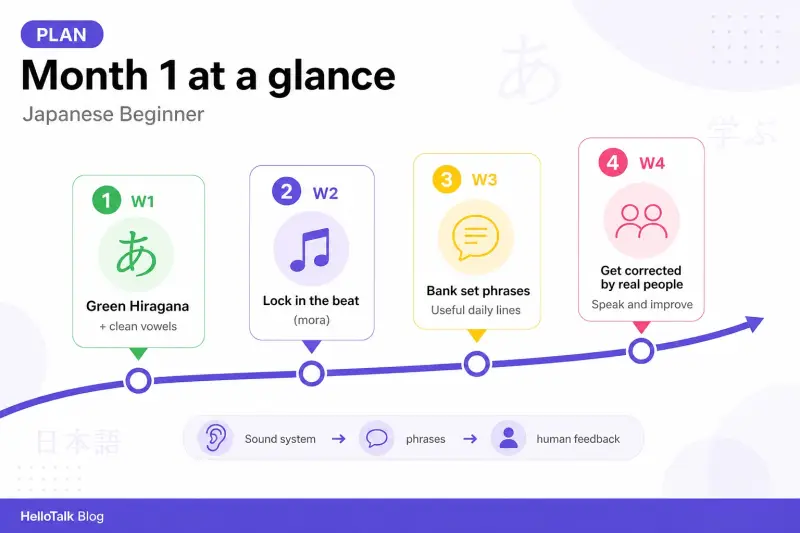
Week 1: hiragana and clean vowels
Learn all 46 basic hiragana characters. They map directly to the sounds you will make, so reading kana forces correct vowels instead of the English guesses romaji encourages.
Dropping romaji early is the single biggest week-one win. Spend 15 minutes a day on a kana chart plus native audio, saying each sound out loud. By Sunday you should read simple hiragana words without hesitating.
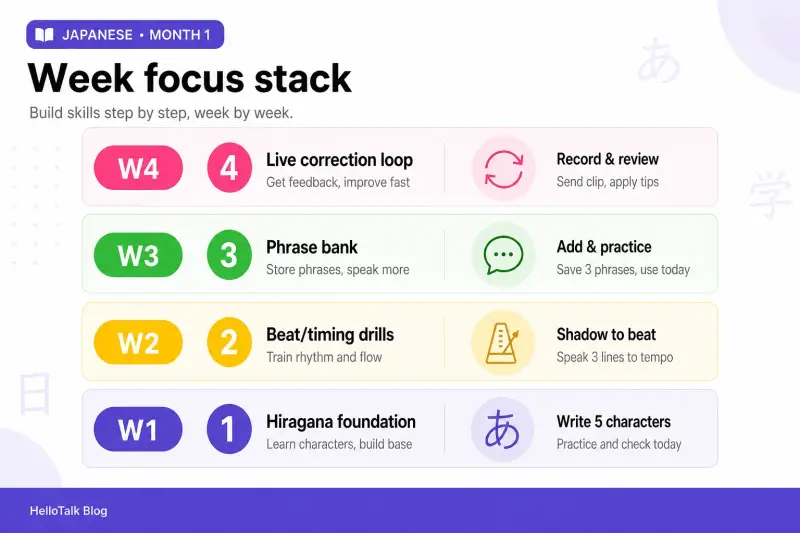
Week 2: lock in the beat
Japanese is timed in even beats called mora, and that even rhythm is most of what makes speech sound Japanese. Pick short native audio lines, then repeat matching the beat, not the raw speed.
Copy the rhythm before you worry about being fast. Ten to twenty minutes of listen-and-repeat a day trains your mouth as a motor skill. Record yourself once and compare against the original so you can hear the gap.
Week 3: bank your set phrases
Learn 20 high-frequency phrases as whole chunks, not word by word. Greetings, thanks, apologies, and reactions like "sou desu ne." Real speakers say these as single units, and so should you.
Set phrases buy you natural-sounding speech before you know any grammar. Say each one until it is automatic. This is the week you start feeling like you are actually speaking Japanese.
Week 4: get corrected by real people
Now bring it to humans. Record a short clip using your set phrases and a simple sentence, and ask a native speaker which word sounded off. This is where the plan pays off, because pronunciation is a feedback problem you cannot solve alone.
On HelloTalk, with 70M+ registered users across 200+ countries and 260+ languages, you post that clip to Moments and get several native Japanese speakers correcting your rhythm within a day. The chat has built-in transcription, reading aloud, and real-time grammar correction, so you fix a sentence in context without switching apps. AI pronunciation scoring flags the specific sound that is off, and you can sit in a 24-hour Japanese Voiceroom as a listener before joining, with interactive Livestream mini-lessons on the side. With over 1 billion messages sent daily and most core features available for free, week four costs nothing to run.
For the reasoning behind this order, see the fastest beginner path to sounding natural. For which drills to run inside week four, read Japanese pronunciation practice methods. Still choosing a tool? Compare options in ELSA vs HelloTalk for Japanese pronunciation.
Common first-month mistakes
-
Front-loading kanji. It feels productive and does little for how you sound this month.
-
Studying only by reading. Silent study builds silent skills. You need audio and your own voice daily.
-
Waiting until you feel "ready" to speak. You never feel ready. Week four speaking is non-negotiable.
-
Skipping the beat work. Without mora timing, even correct words sound off.
FAQ
Is one month enough to sound like a basic Japanese speaker? At 15-20 minutes a day focused on sound and phrases, most of us can hold a natural-sounding basic greeting and reaction in 4-6 weeks. It is a starting point, not fluency.
How much time per day does this plan need? Fifteen minutes in week one and about twenty in weeks two through four. Short daily reps beat long weekend sessions for pronunciation.
Should I learn kanji in month one? Not as a priority. Kanji is a reading skill and does not make you sound natural. Layer it in from month two onward.
When should I start speaking to people? Week four at the latest, but earlier is fine. The sooner you get native feedback, the sooner fake progress becomes real.
What if I have no native speakers around me? A platform like HelloTalk connects you with native Japanese speakers for free, so location is not a barrier to getting corrected.
Do I need to master pitch accent this month? No. A rough sense is enough for month one. Native feedback on your clips teaches your ear faster than studying rules.
For focused sound drills, use our Japanese pronunciation practice methods.
Ready to run week four for real? Set up a free account and post your first clip at HelloTalk.