
What to Say When You Cannot Understand a Reply in Japanese

When a reply leaves you stuck, what clears it is a request naming the missing part, sent back on HelloTalk to the person who said it, since only that speaker can restate the line they meant. You ask, as text or voice, for it slower, written out, or explained. A voice message comes in, you catch 週末 (shūmatsu, "weekend") and one verb ending, and すみません、わかりません (sumimasen, wakarimasen), "sorry, I don't understand", just leaves them guessing which part you lost.
One reply can be unclear in more than one way at the same time. The sound may not have landed; or it landed and you cannot read the written word; or you can read it and do not know what it means; or every word was clear and you still cannot tell what you are being asked. The requests below are sorted by that difference, because a request that names the gap usually brings back something you can use.
The conversation running through this article is a teaching example written to show the sequence. Both speakers are adults, none of it is a captured chat, and a real partner can respond differently at any step. Japanese appears as the original text, Hepburn romaji with a macron for long vowels, and a plain English meaning. Romaji is reading support, not a claim about how your pronunciation will sound.
Ask for a Repeat When You Did Not Catch the Sound
When audio goes by too fast, you usually cannot tell yet whether the trouble is the sound, a word you have never met, or both inside the same sentence. The first request does not have to diagnose anything. It only has to bring the content back in a form you can work on. Send it straight back in the HelloTalk thread, as text or voice, since the person who recorded the line is the one who can say their own message again, more slowly if you ask.
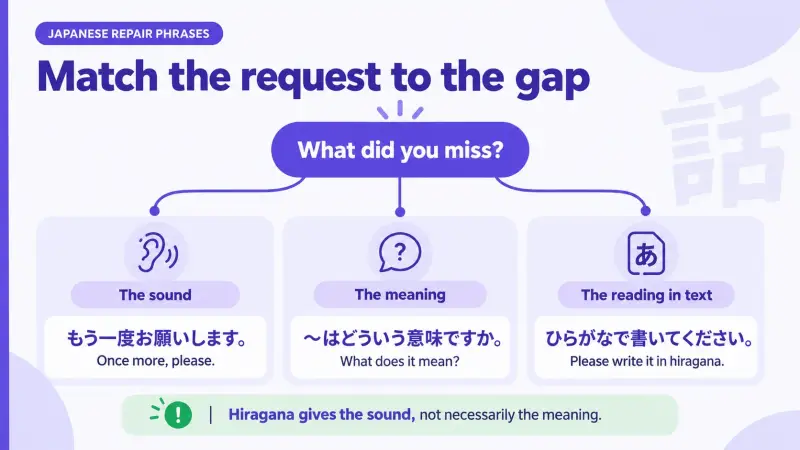
もう一度お願いします asks for a repetition and says nothing about speed, so name the change you want: slower, shorter, or written down.
もう一度お願いします。(Mō ichido onegaishimasu.) "Once more, please."
もう少し、ゆっくり言ってください。(Mō sukoshi, yukkuri itte kudasai.) "Please say it a little more slowly."
すみません、チャットに書いてもらえますか。(Sumimasen, chatto ni kaite moraemasu ka.) "Sorry, could you write it in the chat?"
In the example, Mika sends a voice message and the learner catches only 週末. The learner replies: すみません、今の、聞き取れませんでした。もう少しゆっくりお願いします。(Sumimasen, ima no, kikitoremasen deshita. Mō sukoshi yukkuri onegaishimasu.) "Sorry, I couldn't catch what you just said. A little more slowly, please."
Mika re-records it more slowly. The learner now hears the beginning and still loses the end, which suggests something in there is unfamiliar rather than merely fast, so the next move is a change of channel instead of a third listen: すみません、チャットに書いてもらえますか。
Mika writes it out: 週末はどうでしたか。私は公園を散歩しました。(Shūmatsu wa dō deshita ka. Watashi wa kōen o sanpo shimashita.) "How was your weekend? I took a walk in the park."
Two replays and a switch to text is a reasonable amount of effort to suggest, not a rule, and not a promise that the written version will be clear either.
Ask How to Read or Understand an Unfamiliar Word
On screen, the sentence splits into two problems the audio had merged. The learner can see 散歩 but cannot say it, and does not know what it refers to. Those are separate questions, so ask them one at a time in the HelloTalk chat: a dictionary gives a general gloss, while the person who wrote the sentence can tell you how it is read and what they meant by it here.
Getting a word in hiragana tells you how it is read; it does not tell you what the word means, and it is not the same as hearing your partner say it.
この言葉はなんて読みますか。ひらがなで書いてもらえますか。(Kono kotoba wa nante yomimasu ka. Hiragana de kaite moraemasu ka.) "How do you read this word? Could you write it in hiragana?" Asking about the word rather than one character matters here, since 散歩 is written with two characters and read as a unit.
Mika answers さんぽ (sanpo). Now the learner can approximate it and look it up, and still does not know what it is doing in the sentence, so the second question follows: 「さんぽ」はどういう意味ですか。(「Sanpo」 wa dōiu imi desu ka.) "What does さんぽ mean?"
Mika explains in Japanese: 外を歩くことです。(Soto o aruku koto desu.) "It means walking outside." If an explanation is harder than the word it explains, there is one more step: もっと簡単な言葉で言ってもらえますか。(Motto kantan na kotoba de itte moraemasu ka.) "Could you say it in simpler words?"
A related case looks like a vocabulary gap and is not one. A partner types 東京に住んでます (Tōkyō ni sunde masu), "I live in Tokyo", and the form you were taught is 住んでいます (sunde imasu), with the same meaning.
Teaching notes for Japan Foundation Marugoto materials describe both, so treat the shortened spoken form as register rather than an error. If you cannot tell whether you are looking at a contraction or an unknown word, ask: これは「住んでいます」と同じ意味ですか。(Kore wa 「sunde imasu」 to onaji imi desu ka.) "Does this mean the same as 住んでいます?"
Place names count as vocabulary too. Not recognising 横浜 (Yokohama) or 北海道 (Hokkaidō) is the same kind of gap as not recognising 散歩, and the same two questions handle it.
Check the Meaning, Then Return to the Original Question
A repair is only finished when the question that started it gets answered. It is easy to spend four messages on one word and leave your partner's actual question sitting there. Confirm your reading first, then send your own answer in the same HelloTalk thread, so the person who helped you also gets the reply they were waiting for.
A confirmation sentence gives your partner one concrete thing to approve or correct, and it catches what a repeat will not. If you heard 行きました (ikimashita, "I went") where your partner said 行きませんでした (ikimasen deshita, "I did not go"), another replay at the same speed may well produce the same mistake, while saying your version out loud exposes it immediately.
Send that one sentence in the HelloTalk chat and ask about that reading only. A narrow yes or no is quick for your partner to answer, and it is their confirmation, not a dictionary's, that tells you whether you took the negation the right way.
「〜」ということですか。(... to iu koto desu ka.) "Do you mean that ...?"
「〜」ということで合っていますか。(... to iu koto de atte imasu ka.) "Do I have it right that ...?"
Back in the example, the learner confirms: 「公園を歩いた」ということで合っていますか。(「Kōen o aruita」 to iu koto de atte imasu ka.) "Do I have it right that you walked in the park?" Mika replies はい、そうです。(Hai, sō desu.) "Yes, that's right."
Then the learner closes the side thread and answers what was asked at the start: わかりました、ありがとうございます。週末は、土曜日に友だちとカフェに行きました。(Wakarimashita, arigatō gozaimasu. Shūmatsu wa, doyōbi ni tomodachi to kafe ni ikimashita.) "Got it, thank you. As for my weekend, on Saturday I went to a cafe with a friend." If the thread has drifted further than that, さっきの話に戻りますね。(Sakki no hanashi ni modorimasu ne.) "Let me get back to what we were talking about."
What you return to is often a question about you, so the sentences you already have about your own life do most of the work here; a first Japanese self introduction and its follow up questions is the companion piece for that material. The underlying move of noticing a gap, naming it, confirming and continuing is not specific to Japanese, and it is covered for any language pair in asking for clarification during a language exchange.
The table below is the version you would actually glance at mid-conversation. Find your row by where you are stuck, not by how difficult the message looked. Every row is a request you send on HelloTalk to the person who wrote the line, and the third column is what to do once their answer comes back.
| Where you are stuck | What to send | What to do after the reply |
|---|---|---|
| The sound went past you | すみません、もう一度お願いします。(Sumimasen, mō ichido onegaishimasu.) "Sorry, once more please." | Send it in the HelloTalk thread; if the repeat comes back just as fast, ask for slower or for text, since they are the one who can say their own line again |
| You heard it, it was too quick | もう少し、ゆっくり言ってください。(Mō sukoshi, yukkuri itte kudasai.) "Please say it a little more slowly." | Still unclear after one slow pass, ask the same HelloTalk partner to type it, so you can see the words they chose |
| Audio is not working for you now | すみません、チャットに書いてもらえますか。(Sumimasen, chatto ni kaite moraemasu ka.) "Sorry, could you write it in the chat?" | Read what they write in HelloTalk, which may still be unclear, then decide if the gap is the reading or the meaning |
| You cannot read a written word | この言葉はなんて読みますか。(Kono kotoba wa nante yomimasu ka.) "How do you read this word?" | Their hiragana settles the reading only; if the word is still new, ask what it means in the same HelloTalk chat |
| You can read it, you do not know it | 「〜」はどういう意味ですか。(... wa dōiu imi desu ka.) "What does ... mean?" | Say it back in your own simple Japanese on HelloTalk, since only they can confirm you took it as intended |
| You think you understood, not sure | 「〜」ということで合っていますか。(... to iu koto de atte imasu ka.) "Do I have it right that ...?" | Take their correction, favorite it in HelloTalk, then answer the original question they asked |
On tone, すみません plus a full polite request is a useful default while you are getting to know someone: it marks the interruption and states what you want. A bare fragment such as 意味は? (imi wa?), "meaning?", can read as abrupt in text, though how any individual takes it depends on the person and how you two already write to each other.
Use HelloTalk Text and Voice Tools When You Need More Support
On HelloTalk you can exchange both text and voice messages with the same partner, so a repair does not have to stay in the channel where it broke. The move in the example, asking for the written line after a slow repeat, is ordinary there, and it keeps the conversation going instead of ending it in apologies.
The HelloTalk platform also offers translation and voice transcription support on messages, which can give you a rough version of a line you cannot parse at all. Both can be inaccurate, especially with casual contractions and names, so use the output to form a sharper question rather than as the final answer. Comparing a short transcription against what your partner then explains is often the step that turns a guess into something you keep.
HelloTalk's Speak function reads text aloud with synthesized speech. It helps you hear where a written sentence divides before you reply, and it is not your partner's own voice, so it says nothing about how that person pronounces it. If you want their pronunciation, ask them in the chat for a voice message.
Your partner adds something the tools do not carry: what they actually meant, the situation behind it, and informal reactions such as "that is correct, but it sounds stiff". A partner on HelloTalk can correct your message directly and can also be wrong or unsure, which is worth checking rather than assuming.
The official HelloTalk FAQ notes that replies may not be immediate, since schedules, time zones and interests differ, so silence is not a verdict on your Japanese. Saving or favoriting the useful messages in HelloTalk gives you somewhere to find them when the same gap comes back.
Keep a Short Japanese Help Card for Your Next Conversation
Build a card with three things per line: the trigger, the Japanese phrase, and the line you will say once the help arrives. The third column is the one most people leave out, and it is where repairs stall.
Six entries is a workable start: one repeat request, one request to slow down, one request to write it out, one reading question, one meaning question, and one confirmation sentence. Add もっと簡単な言葉で言ってもらえますか once the first six come without searching. Worth adding too is a line that buys you time while you read the card: ちょっと待ってください。今、調べます。(Chotto matte kudasai. Ima, shirabemasu.) "Please wait a moment. I'm looking it up now." These counts are suggestions for easy retrieval, not a threshold to clear before your next chat.
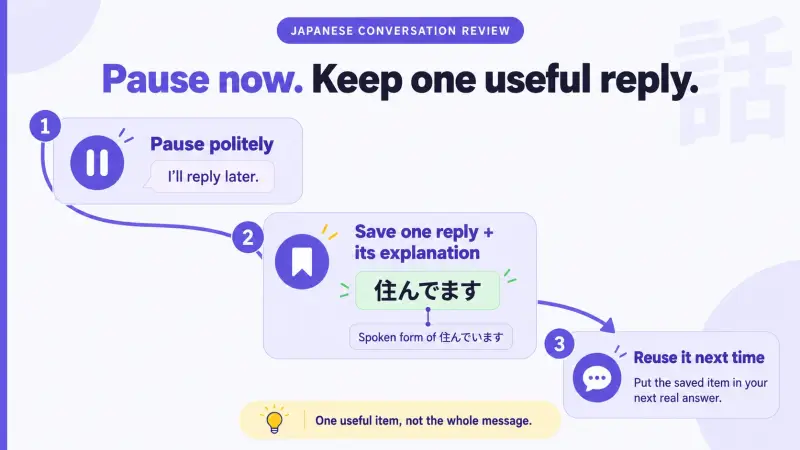
Saying these aloud before you need them lowers how much you have to build on the spot. Composing a request from scratch mid-chat is slower and more effortful, not impossible, and pausing to read your card during a conversation is a normal thing to do.
After a conversation, favorite the HelloTalk message that explained the phrase, so the explanation stays where you can find it. In your own notes, keep that phrase with the explanation and write under it the answer you could now give if it came up again, then use that line the next time the gap appears. If nobody explained it, keep it with a question mark and bring it to your next HelloTalk conversation instead of letting it disappear.
Fitting that review into a repeating weekly rhythm is the subject of a first month plan that pairs kana with short conversations, and what to have ready before a first real exchange is covered in preparing for your first conversation in Japanese.
Pick the two lines that match where you got stuck most recently, put them somewhere visible, and use them in your next exchange on HelloTalk.