
What to Say When You Do Not Understand Your Language Partner

If a message stays unclear after you replay or translate it, or you cannot tell what the sender meant to arrange, ask for the missing piece in HelloTalk and repeat the plan in your own words so they can agree or correct it. Emma's voice message about Thursday names a café and a time that sounds like "half six", and after three replays you still cannot repeat the plan back. "Sounds good" would only agree to something you cannot describe.
The exchange used below is a teaching example written for this piece, not a real user's chat. Emma speaks British English and is learning your language; you met through a language exchange, and the plan is a public café before a local meetup. If you study another language, keep the functions and change the wording.
Ask for the Kind of Help You Need
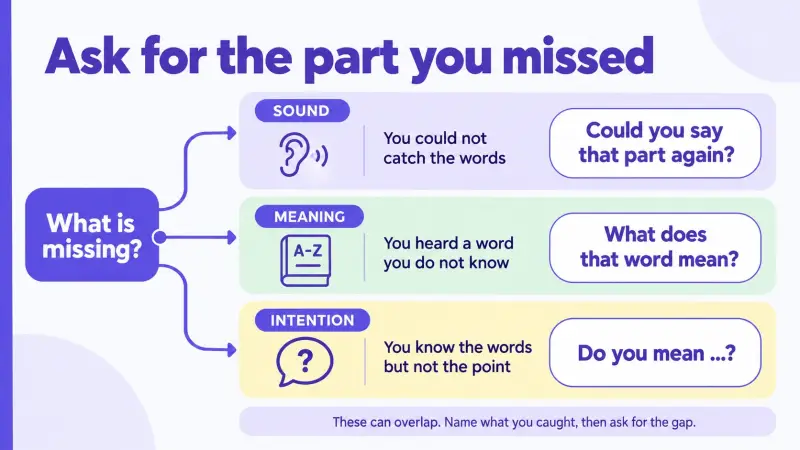
Three different things can stop you, and in the moment they feel identical: you did not catch the sounds, you caught the words but not the meaning, or you understood every word and still do not know what the other person wants from you. One short message can fail in more than one place at once.
Emma's message was: "Instead of the place by the station, we could do the café on Mill Road, the one next to the bookshop, around half six. If that's awkward I can do later." The street name went past as sound. "Half six" is two easy words with an unfamiliar meaning. The last sentence might be a decision, or it might be a question.
A slower repetition often clears up meaning, not just sound. A second, slower pass gives you time to process words you already know, which is why "say that again, more slowly" is a reasonable first move even before you can name what went wrong.
Naming the gap before you choose a phrase is worth the few seconds, because the request and your next line both change with it. The table below runs Emma's message through four ways it can stop you, what to send her in HelloTalk, and what to check once her answer arrives. Each request is built so she can answer it in one line.
| What is missing | What to ask Emma for | What to check next |
|---|---|---|
| A word you did not catch, often a name | In the HelloTalk chat, ask her to say that part again, more slowly | The spelling, if it is a name or a street |
| The meaning of a set phrase | In the HelloTalk chat, ask for a plain definition, or another way to say it in her own everyday terms | Whether the definition still leaves something open, like morning or evening |
| The speaker's intention | In the HelloTalk chat, ask a direct check: are you asking me, or telling me? | Who decides, and whether a reply is needed now |
| Which version of the plan is current | In the HelloTalk chat, ask her to confirm the whole plan in one sentence, so she can correct the part you got wrong | Day, time, and place together in one line |
You will not always pick the right row, and you do not have to. When you cannot tell, send one HelloTalk message asking for a slower repetition and what the unfamiliar phrase means; the answer usually shows you where the real gap was.
Follow a Clarification Through to Your Next Reply
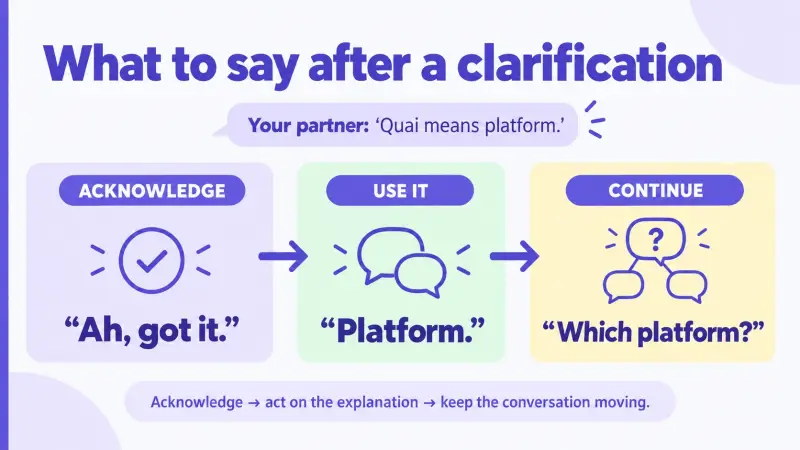
Your next message in HelloTalk is where you state the plan as you understood it, so Emma can confirm it or correct the part you got wrong. It is easy to send "thank you, I understand" and leave a half understood arrangement standing.
Here is the whole repair, start to finish:
- You: "Sorry, I missed one part. Could you say the street name again, more slowly? And does 'half six' mean 6:30?"
- Emma: "Sure. Mill Road, M-I-L-L. And yes, half six is 6:30."
- You: "Morning or evening?"
- Emma: "Evening, 6:30 p.m."
- You: "Got it. So Thursday, 6:30 p.m., the café on Mill Road, next to the bookshop. Is that right?"
- Emma: "That's it."
- You: "Should I book a table, or is it usually quiet on a Thursday?"
- Emma: "It's quiet then. No need."
Worth keeping straight: in British English "half six" means 6:30, and nothing in the phrase says morning or evening. You know Thursday is 6:30 p.m. because Emma said so, which is why that one extra question was not wasted.
Two turns carry the repair: the confirmation, where you repeat the plan in your own words, and the question after it, where you keep the topic going instead of closing the exchange.
Confirming in your own words turns a clarification into a shared agreement. "I understand" proves nothing to either of you; "Thursday, 6:30 p.m., Mill Road" can be corrected.
The requests themselves are short and worth keeping ready. Below are the English versions with Spanish equivalents; politeness habits differ by language and region, so for any other language, ask your partner in HelloTalk for the version they would actually use. A speaker of that language can tell you which form sounds normal between the two of you, and a phrase list cannot.
| Function | English phrase | Spanish equivalent, with its exact meaning |
|---|---|---|
| Repeat | "Could you say that again?" | "¿Puedes repetirlo, por favor?" (Can you repeat it, please?) |
| Slow down | "Could you say it more slowly?" | "¿Puedes hablar más despacio, por favor?" (Can you speak more slowly, please?) |
| Ask a meaning | "What does 'half six' mean?" | "¿Qué significa 'half six'?" (What does 'half six' mean?) |
| Check understanding | "So, 6:30 p.m. at the café on Mill Road. Is that right?" | "Entonces, a las seis y media de la tarde en el café de Mill Road, ¿verdad?" (So, at six thirty in the evening at the café on Mill Road, right?) |
Those forms use tú, for someone you are on friendly terms with; with usted, the first one is "¿Puede repetirlo, por favor?" The Spanish example here uses de la tarde for that hour, and regions differ in where they draw that line. The two columns match in function rather than word for word.
Reusing two or three clarification phrases is not memorizing a script. It keeps one function ready while everything else in the conversation stays unpredictable. If your partner writes in Japanese, the reply patterns there are worth treating separately, and repair phrases for Japanese conversations go into that in detail.
Use Text, Voice, and Translation to Check a Difficult Message
Sometimes you want a closer look before you answer. In a HelloTalk chat you can write back about that one sentence, ask Emma to send just that sentence again as a short voice message, and run the built in translation on that line rather than the whole conversation.
HelloTalk's voice transcription turns speech into text, and its translation gives you a version in another language. Both can be wrong on names, fast speech, and regional expressions, and "half six" is exactly the kind of phrase a translation may render literally. Transcription and translation are clues, not proof of what your partner meant. The confirmation still comes from Emma.
One distinction matters for listening practice. HelloTalk's Speak function reads written text aloud, which is synthesised audio rather than Emma's voice, and the dialogue printed above is something you read, not something you heard.
To train on real speech, ask Emma in HelloTalk to resend that one sentence as a short voice message; if she does, you get the actual voice and pace from this exchange rather than synthesised audio. Other speakers and course audio with a published transcript are real speech too. Either way, listen at least twice before you open the transcript.
If you would rather speak your clarification than type it, rehearse it in an ordinary voice recorder app first, then record the version you want to send in HelloTalk.
If You Still Do Not Understand, Change the Approach
When a second attempt brings back the same unclear audio, change what you are asking for instead of repeating the same request.
Narrow it to the piece you are missing: "I have the time, I just need the street name." Switch channels and ask her to type it in HelloTalk: "Could you type the street and the time?" A yes or no question is one small, targeted request you can make there, and Emma only has to confirm one detail: "Is it the café next to the bookshop?" Or say so plainly: "I'll listen again tonight and message you."
A third request can be exactly right, especially once you can name the specific missing piece. It is also worth allowing that the message itself was ambiguous and your partner may not have decided yet.
Missing one voice message is one observation about that message. If what stops you is the discomfort of asking rather than the words themselves, building up to speaking with native speakers deals with that side of it.
If conversations with one particular person regularly leave you lost, say the pace mismatch out loud before you draw conclusions about your own listening. Finding a partner who will practice at your pace covers how to agree on that.
Practice Again With the Message That Stopped You
The message that confused you is useful practice material because you already wanted the answer, and the words came attached to a plan that affects your week. Course and textbook dialogues still do their own job; this one just arrives with your own motive on it. HelloTalk lets you save messages and corrections so you can find them again, and you can keep short notes wherever you already write things down.
Four lines per message are enough:
- Heard: "the café on Mill Road, around half six"
- Missed: the street name, and what "half six" means
- Asked: repeat the street slowly, plus the meaning of the phrase
- Learned and continued: half six = 6:30; Emma confirmed evening for this plan; I then asked about booking a table
One to three saved messages a week is a manageable amount if you want a number. Listening to the original audio again before you read your own note keeps the work on the message rather than on the note, and recognizing a message you have already heard is one observation, not evidence that the phrase is settled for you.
The next time that phrase fits, use it in a HelloTalk message to Emma and ask whether you have the intended meaning right. A response can show a mismatch you would not have caught alone; it does not certify that the phrase is yours for good.
If reading in your target language is comfortable while speaking lags behind, turning reading ability into speaking practice is the next task to look at. The wider guide to language exchange covers how these conversations get set up in the first place.
Frequently Asked Questions About Asking for Clarification
Is it rude to ask someone to repeat themselves several times?
Ask respectfully and agree on it early: in an early HelloTalk message, say that you will often ask for repetition, invite the same back, and ask whether that pace suits them. Then watch how they respond over the next few exchanges.
Specificity makes it easier to answer. "Which street?" takes less work than "sorry, I didn't understand."
What if I only realize an hour later that I misunderstood?
Say it directly in a new HelloTalk message: "I thought about your message again. Did you mean 6:30 in the evening or the morning?" A late correction costs one message, and it is easier than sorting out a mix-up at the café.
Do I have to apologize every time?
One short apology is plenty, and often none is needed. Long apologies take up more of the conversation than the question does.
Can I practice these phrases before a real conversation?
Yes. Say them aloud into a voice recorder, practice them with an AI tool, or ask a teacher to pause mid lesson so you can use them on the spot.
Keep the real version short when it counts. What settles whether you understood is the confirmation from the actual person.
If you want a real person to practice these requests with, you can find a language exchange partner on HelloTalk and start with one short message.