
How to Feel More Comfortable Speaking a Foreign Language With Native Speakers

When the hard part is not preparing a sentence but answering a reply that comes back longer than you planned, with the words you lined up going unused, the thing to change is the size of the exchange. Solo rehearsal gets you ready up to a point; past that you need a real response. On HelloTalk you can propose a small reciprocal exchange with someone learning your language too, agreeing on topic, format and corrections before you start.
Choose a Smaller Speaking Task Based on What Worries You
"I'm scared to speak" usually covers several different things at once. Worrying about a grammar mistake is not the same as worrying about being judged for your accent, and neither is the same as not catching the reply or not wanting a stranger to ask where you live.
Fear of mistakes, trouble following a reply, and personal boundaries need different fixes. A mistake worry gets smaller when you agree on what gets corrected. A comprehension worry gets smaller when you ask for text alongside audio. A boundary worry depends on what you share and when you stop, not on practicing harder.
Use the table below to pick your first task. Each row gives one task small enough to finish today and one thing to settle before you begin.
| What actually worries you | A first task that fits | What to settle before you start |
|---|---|---|
| Making a grammar mistake in front of someone | Send three sentences on HelloTalk about what you ate for breakfast, plus one question back that invites an answer | Which kind of mistake you want marked, since a partner cannot guess it |
| Being judged for your accent | Send one HelloTalk voice message of roughly 20 seconds | That corrections stay on meaning for now, since what you need to know is whether a listener understood you |
| Not following what comes back | A written exchange on HelloTalk where you ask for a short reply you can reread | That they can retype or repeat anything you miss |
| Having to answer in real time | Messages you answer when you have time, not a call | No live call this round |
| Personal questions or privacy | Keep the topic to food and daily routine | That you can change topic or stop whenever you want |
The rest of this follows the first row: everyday food. It works because you already know the content, so the only new part is saying it to a person. If your sticking point is that you can read a lot but freeze when you have to produce anything, why reading fluency does not turn into speaking covers that practice question.
Agree on the Topic, Pace, and Corrections Before You Start
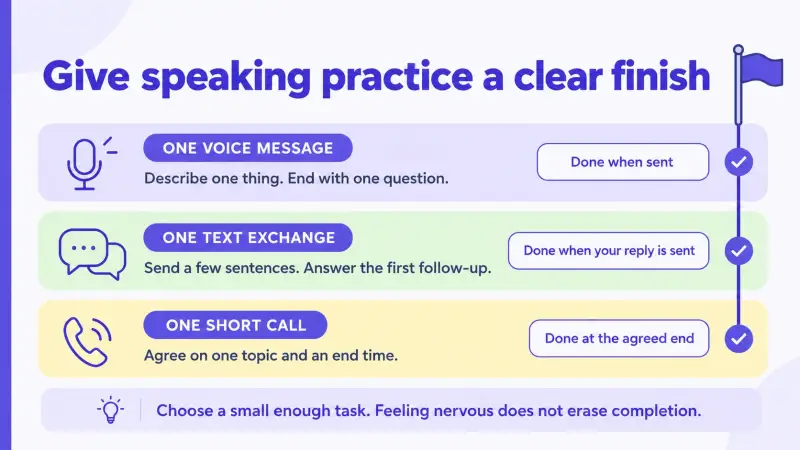
Some of the pressure in a first exchange comes from not knowing what the other person expects of you. Send one message in the HelloTalk chat first, naming the topic, the pace you can keep up with, and what you want corrected. That tells them what response you are asking for, so they can agree to it or say what they would rather do, instead of guessing. Write it in your target language if you can, and in a shared language if you cannot.
Here are plain English versions to adapt rather than copy word for word:
"I'd like to practice talking about everyday food for about ten minutes."
"Please correct only the mistakes that change the meaning, not every small thing."
"I type slowly, so please give me a little time between messages."
"I may stop after a few messages, and that is not about you."
Say which corrections you want before you send the first message. Put that line at the top of the HelloTalk chat where the practice will happen, because a partner cannot guess whether you want meaning fixed, word choice fixed, or nothing fixed at all, and asking afterwards means rereading a list you never wanted. If you want someone whose rhythm matches yours over several weeks, the selection and reciprocity side of that is in finding a partner who practices at your pace.
Try One Short Exchange With a HelloTalk Partner
Now the exchange itself. The example below was written for this article to show what the task looks like in practice, not a record of what any particular user achieved.
Open a chat on HelloTalk with someone who is learning your native language and speaks the one you are learning. Send the agreement message first, then three sentences about your breakfast, then one question back. The question is what makes it an exchange rather than a submission.
Your opening, written in English here so you can rebuild it in your target language:
"This morning I had bread, eggs and black coffee."
"I usually eat the same thing every day because I am in a hurry."
"On the weekend I cook something warm."
"What do people usually eat for breakfast where you live?"
A reply might come back like the one below. It is invented for the example, and your partner's will be different, possibly longer, and possibly hours later:
"Here most people just have coffee and something sweet in the morning. A proper breakfast is more of a weekend thing. Do you eat at home or on the way to work?"
Then you answer the question they asked you:
"At home, but very fast. What do you usually make on the weekend?"
That is the whole task: four short lines, their question answered, and a question of your own at each turn.
If you would rather send it as voice, you can record yourself on an ordinary voice recorder app first, listen once, fix the thing that bothered you, and then record it in HelloTalk and send it. Rehearsing in a separate recorder app is optional preparation, not a requirement. Plenty of first voice messages are simply spoken straight through.
For listening, ask your partner in the HelloTalk chat for actual audio: "Could you send me a short voice message about your breakfast?" Hearing them answer in their own voice gives you the speed and intonation a written line never shows, though asking does not mean a voice reply arrives, or arrives soon.
Reading the dialogue above is not listening practice, and a text-to-speech readout of a written message is a convenience rather than your partner's voice. Transcription and translation can be wrong too, so if a line does not make sense, ask what they meant.
HelloTalk's chat includes translation, transcription and partner corrections, which help most on one specific line rather than as a substitute for following the conversation yourself. Messages and corrections can be saved and reread later. You can also ask your partner why they eat what they eat, which is the part a real person gives you that a script does not.
You can end an uncomfortable conversation at any point without explaining first. HelloTalk's safety guidance covers protecting your personal information, holding your boundaries, and blocking or reporting, and none of that requires a polite goodbye.
When You Freeze, Change the Task or Pause
Freezing partway through happens, and it does not mean you picked the wrong task. Sometimes one specific thing has got too big, and shrinking that one thing is enough. Stopping is also a complete option, not a failed exchange.
The table below matches what is happening in the moment to the smallest change that keeps things going, with a line you can adapt.
| What is happening | Smallest change | Something you can say |
|---|---|---|
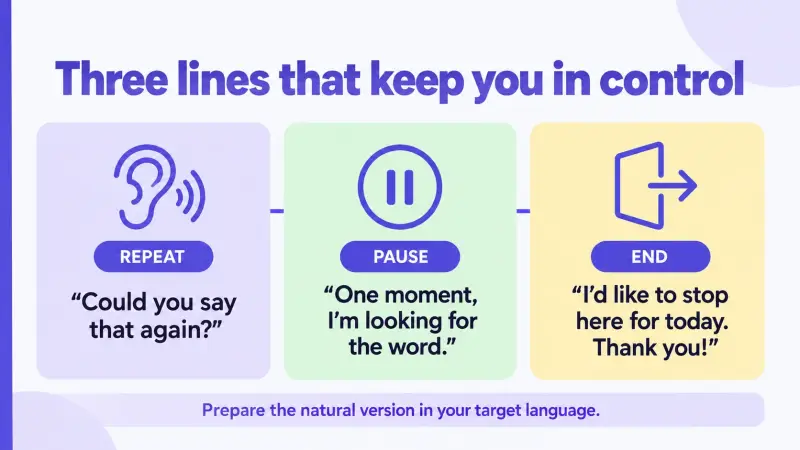
| You missed one word | Ask in the HelloTalk chat about that word only | "Which word was that? Could you type it?" |
| The whole reply came too fast | Ask them to send it as HelloTalk text as well | "Could you send that as text too?" |
| Your mind goes blank mid-sentence | Finish the turn in writing | "Let me finish this in writing." |
| The topic drifted somewhere personal | Return to what you agreed | "Let's stay on food for today." |
| You are tired or tense | Close the session | "I need to stop here for today. Thanks for practicing." |
| The contact feels uncomfortable | Stop, then block or report | Nothing is required |
If the sticking point is consistently that you understand the individual words but lose the thread of the reply, asking a partner to clarify and keeping the conversation going has a fuller set of moves for that.
Decide What to Keep and What to Try Next Time
After one exchange you have three real pieces of information: whether you finished the task, how much of the reply you actually understood, and how you felt doing it. They can point in different directions, and all three count.
Run the same size again if you finished but felt wrung out, or if you got through it mostly by guessing at the reply. Make one thing bigger if it felt manageable: five sentences instead of three, a voice message instead of text, or a question that invites a longer answer.
Change one variable at a time, otherwise you cannot tell what made the difference. No rule says text has to become voice, or voice has to become video. Text and voice messages are workable long-term ways to use a language, and asynchronous practice fits some people's lives better.
Concretely, here is what to do next. Save the corrections and messages worth keeping to your HelloTalk favorites while the chat is still open, then reread them and pick the one or two that changed your meaning, rather than every mark.
Write your next three sentences on the same food topic before you open the chat, working the correction you kept into one of them, so your opening is already there.
Send them to the same partner in the same HelloTalk chat if the first round went reasonably, which saves repeating the whole agreement, and end with a new question such as what they cook at the weekend, which invites them to answer new content rather than grade your fix. For the broader picture of how reciprocal practice is usually set up, the language exchange overview covers the format itself.
Frequently Asked Questions About Speaking With Less Pressure
What if my partner corrects absolutely everything?
Say what you want corrected, in one line in the HelloTalk chat where it is happening, as soon as you notice it. Something like "could you only correct mistakes that change the meaning? The small ones are too much for me right now" is enough.
Some people adjust straight away and some do not. If it continues in a way you do not want, send less or practice with someone else.
Can I switch partners without explaining myself?
Yes. You are not required to announce it, and chatting with several partners or going quiet for a while is ordinary in language exchange.
If a conversation makes you uncomfortable rather than simply not clicking, stop it and use HelloTalk's blocking and reporting options instead of looking for a graceful exit.
How do I know if practicing with a partner is enough?
A course gives you a sequence: what to study and in what order. A tutor can adapt lessons to your gaps and question you directly. Peer exchange supplies reciprocal practice inside that plan, with a person who has their own intentions, asks you things back, and tells you how they would say it themselves.
Peer practice does not by itself include professional instruction, though a partner may also happen to be a teacher. Many learners use both.
If you want the small version of this today, you can start one short exchange on HelloTalk.