
How to Find a Language Exchange Partner Who Will Practice at Your Pace

Solo review and course audio build listening and vocabulary; neither slows one person's reply. When an exchange comes back much faster and longer than you can follow, you need a real person who will slow down. On HelloTalk, profile clues point to someone to ask, and one small two-way exchange gives you speed and corrections to discuss, not a confirmed match. Alex, invented here, sent thirty seconds of Japanese about their morning and got two minutes at full speed, catching only 朝 (あさ, morning).
Nobody had agreed on anything beforehand, so the reply came back at whatever was natural for the person sending it. Finding someone who speaks the language you study is one task; agreeing on how the two of you will actually practice is a separate one, covering format, corrections, and which language is in use when.
Describe the Practice You Want and the Help You Can Offer
Before opening anyone's profile, write four lines for yourself: what you want to practice, in what format, what kind of feedback helps, and what you can offer in return. Alex studies Japanese and can genuinely help with English, so those four lines read: everyday routines, voice messages under a minute, two corrections per message, and English practice for the other person.
Naming the topic matters more than it looks. "Anything, I just want to practice" hands the job of inventing a topic to someone else, while "my morning routine, then commuting, then cooking" gives them something answerable this week. A specific request is easier to answer than an open invitation.
Describe where you are without grading yourself. In your first HelloTalk chat, "I read a fair amount but I lose everything when it is spoken quickly" tells a partner more than a level label does, because it tells them what to change in the message they send back. Uneven levels can work when the tasks are sized for each side, since each person is supplying the language the other is studying.
If reading comes easily and speaking is the part that stalls, that gap is worth working on alongside any exchange, and reading well but freezing when you speak covers it as its own task.
Use HelloTalk Profiles to Find Someone to Ask
HelloTalk profiles can include a member's native language, the language they are learning, a self introduction, hometown, occupation, and interests. HelloTalk's help pages describe matching that works from native and learning languages, so the practical move is to look for the language pair you need and read the rest as background.
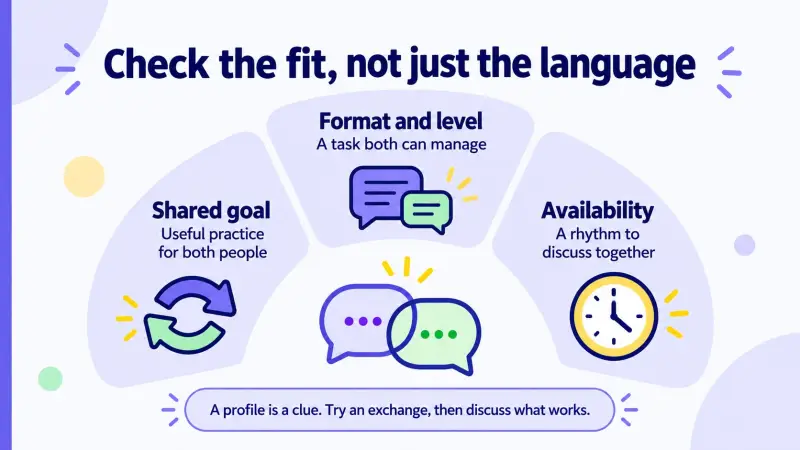
None of that information establishes patience, availability, or which dialect someone speaks. A profile mentioning cooking and dog walking makes daily routines a reasonable thing to bring up. It does not tell you whether that person has twenty spare minutes this week, or how they like to correct.
You can state your own limits in advance, in writing, as early as the first HelloTalk message. Whether they are respected is something you observe over a round or two rather than something a page confirms. The table below pairs what a profile shows with what you still have to ask that person directly in the HelloTalk chat, since their answer tells you what they are willing to try, and with what you can only observe and discuss afterwards.
| Clue on the profile | Question worth asking | What to observe and discuss afterwards |
|---|---|---|
| They are learning a language you can genuinely help with | Ask in the HelloTalk chat: "Would you like a turn to practice your English in the same chat?" | Whether both Japanese and English got real practice, not only one of them |
| Interests mention everyday life, food, commuting, pets | Ask on HelloTalk: "Could we start with one short topic, like morning routines?" | Whether the topic came back as one answerable message or drifted |
| The self introduction mentions correcting or wanting corrections | Ask on HelloTalk: "Could you pick the two corrections that change the meaning most?" | How many corrections arrived and whether you could act on them |
| Occupation or time zone suggests when they are around | Ask on HelloTalk: "What days are realistic for you? No rush on replies." | Whether a rhythm formed without you having to chase it |
Send a Small, Two-Way Practice Invitation
A workable invitation names one topic, one format, one thing you are offering, and a turn for the other person to use the language they are studying, which in this example is English. Send it as a HelloTalk message to the person whose profile you just read: only their answer tells you whether the pace and the swap you have in mind are something they want. Leave every part of it open to change, including no.
Hi, I saw you are learning English. I am learning Japanese and practicing everyday routines. Would you be up for swapping short voice messages? I would send about a minute in Japanese on my morning, and if you could answer in Japanese too, a bit slower and in short sentences, that would help me a lot.
Then you could send your own routine in English, and I would reply in English and go through anything you want checked. No rush on timing, and change any part of this that does not suit you. What would you most like to practice?
That message is a template written for this article, not a transcript of a real exchange or a result anyone reported. Sending it is a proposal: the other person may answer differently, answer later, or not answer at all.
What Alex records is short and concrete: 毎朝、六時半に起きます。コーヒーを飲んでから、犬と散歩します。(まいあさ、ろくじはんに おきます。コーヒーを のんでから、いぬと さんぽします。) "Every morning I get up at six thirty. After drinking coffee, I walk the dog."
A question the other person can answer keeps it a two-way exchange, not a sample to be marked. In the same HelloTalk message, Alex can send the voice note and add one line another person can answer, like "What time do you usually get up, and what is the first thing you do?", in Japanese if it is ready and in English if it is not. A written reply still continues the conversation, but only a voice reply shows how fast they speak.
If you want your delivery steadier before it goes out, rehearse the lines in your phone's ordinary voice recorder, listen back once, then record and send through HelloTalk when you are ready.
Use the First Exchange to Agree on Pace and Feedback
One exchange gives you something concrete to discuss, not proof of long term fit. It shows whether audio came back, roughly how fast it was, and what the corrections looked like. That is enough to make one specific request, which is all a first round is for.
Say the reply rewrites your whole paragraph and carries eleven corrections. The useful response narrows the scope rather than cooling off, and it belongs in the same HelloTalk chat, where that person can point to what actually blocked their understanding: "Thank you for going through all of it. Could you pick just the two that change the meaning most? I will write those down and use them in the next message."
Save the two that come back to your HelloTalk favorites, then use them in your next morning-routine message there and end it with a question about the content, so you find out whether the meaning lands. A reply checks whether you were understood this time; it does not certify that the phrase is generally right. A number is one way to make a request concrete, not a rule either of you has to keep.
Language balance drifts on its own, usually toward whichever language is quicker for the pair. If several rounds in your HelloTalk chat have ended up in English, say so and propose a split: "We have mostly been in English lately. Could we alternate, one round in Japanese and the next in English, so we both get practice?"
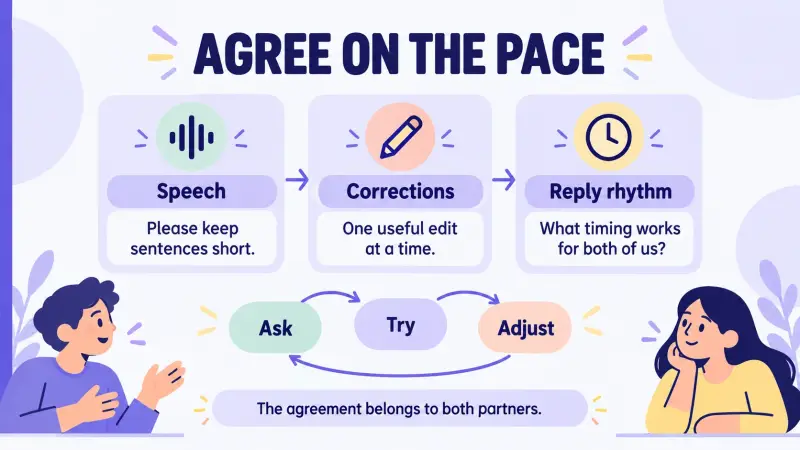
Speed is a separate request from balance and worth making on its own terms. 少しゆっくり話してもらえますか。(すこし ゆっくり はなして もらえますか。) "Could you speak a little slowly?" is an ordinary thing to send in your HelloTalk chat, and if "slower" has not landed you can ask whether short sentences with a pause between them would work for them too.
When you have listened to a reply and still cannot say what you missed, asking a partner to repeat and keeping the conversation going has phrases for that moment. If messages are working and you both want more, a voice call on HelloTalk is something you can propose for a time that suits them, and they can still decline.
Adjust the Arrangement or Move On Without Pressure
Silence on its own does not tell you why someone stopped replying. HelloTalk's FAQ names ordinary possibilities like being busy, time zone differences, and mismatched interests, and suggests filling out your own profile more completely, trying other members, and posting in Moments. You can send one follow up with a genuinely new topic, and after that, treating the quiet as an answer respects the other person's time as much as your own.
Asking one or two other people at the same time is normal, and nothing about it needs optimizing. If a second exchange turns out to fit your week better, keeping both is also fine.
If an exchange has run its course and you feel comfortable, a short closing note is a decent thing to send and not an obligation: "Thanks for the practice these past few weeks. I am busy for a while so I will stop here. Good luck with your English."
If something makes you uncomfortable instead, you owe nobody an explanation first. HelloTalk's safety guidance covers protecting personal information, holding your boundaries, ending a conversation that feels wrong, and reporting or blocking.
Two related tasks sit next to this one. The language exchange overview explains how these arrangements work in general. If the hard part right now is speaking to a native speaker at all, working through the fear of speaking deals with that directly.
Frequently Asked Questions About Finding a Suitable Partner
Should I write my first message in their language or mine?
In your first HelloTalk message, writing part of it in the language you study shows what level they would be working with, which helps them judge whether they can give you what you are asking for.
Adding the same message in a language you both read keeps the request answerable if your version is still rough.
How do I check what my partner actually said?
Translation and voice transcription in a HelloTalk chat can help you locate a word or rebuild a sentence, and both can be wrong, especially with fast or casual speech.
Asking the person in your HelloTalk chat to repeat that one part or say it another way is what can reveal what they meant, though their next message may still be hard to catch.
What if their accent or variety is not the one I am studying?
Ask on HelloTalk which variety someone speaks before you agree to a listening task that depends on it. A hometown or an interest listed on a profile is a clue about a person, not verification of how they speak.
If you have already started exchanging audio, those messages give you something real to judge by. A different variety is still useful listening, and you can keep looking for a closer match if your goal is specific.
Pick one person whose profile suggests they talk about daily life, send a one minute topic with a real turn for them in return, and start the pace conversation on HelloTalk.