
French Listening to Speaking: Retell a Short Clip and Get a Real Response

Retelling a clip and checking it against the script is work you can do alone; you need someone else once the task becomes responding to another person's experience or a question you did not plan for. You replay two minutes of French and keep three words: marché, il pleuvait, midi. HelloTalk covers that second step: send the retelling and your own market question as a voice message, then answer what a real person asks back. The sequence below runs once, slowly, on one passage.
Choose a Short Clip Whose Meaning You Can Check
Pick something you can verify after listening, not just something that sounds French. A clip with a transcript or course audio with a script both let you check on your own. A voice message from a HelloTalk partner qualifies for a different reason: there is no script, but you can reply in that same chat and ask what they said, and they can tell you what they meant. A clip you cannot check afterwards cannot tell you whether you retold it or invented it.
TV5MONDE publishes video learning resources tied to levels from A1 to B2, so you can filter by level before committing to a segment. RFI's Le français facile offers audio with transcripts and study exercises, which makes checking straightforward, though its material is news, and news is not automatically beginner-friendly just because the site is built for learners.
A level range on a site is also not a promise that every program on it fits you, so open the specific episode and look at the transcript before deciding.
A segment of roughly 30 to 60 seconds is an easy place to start, but that is a suggestion, not a threshold. The useful test is what you can say about the clip afterwards: if you can name who did what and roughly when, the length is workable, and if you cannot, shorten it or pick simpler material regardless of how long it ran.
The passage below is the working material for the rest of this walkthrough. It is an author-written practice text rather than a transcript of any broadcast, and it is printed here instead of played, so what it demonstrates is the checking process. For your own round you need a clip you can actually listen to, with a script you can open afterwards.
Samedi matin, il pleuvait, et il y avait moins de clients que d'habitude au marché de la place. Vers midi, les vendeurs ont commencé à ranger leurs caisses, un peu plus tôt que les autres semaines. Une vendeuse de fromages a dit qu'elle reviendrait peut-être le mercredi suivant.
"Saturday morning, it was raining, and there were fewer customers than usual at the market on the square. Around noon, the vendors started packing up their crates, a bit earlier than in other weeks. A cheese seller said she would maybe come back the following Wednesday."
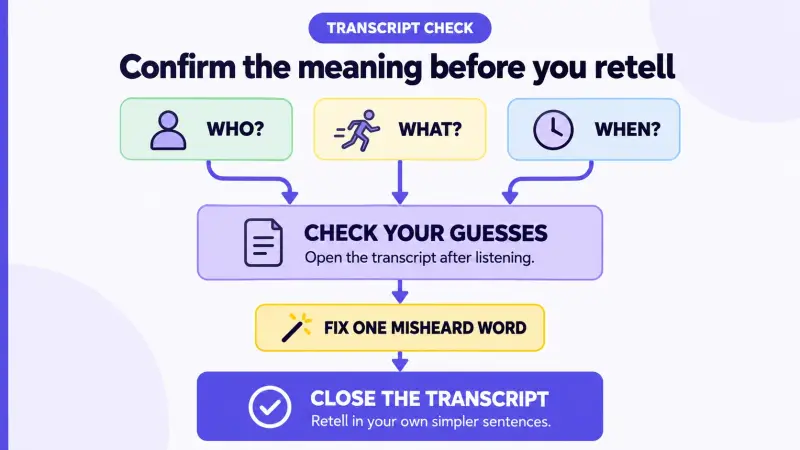
Retell What Happened Without Changing the Facts
Before producing any French, check that you understood. Say or write the gist in English, or whatever language you think in: rain, fewer shoppers than usual, vendors packing up around midday, one seller might return Wednesday. A summary in a language you already know is a comprehension check, not the finished task. It tells you whether the French you are about to attempt has anything correct behind it.
Then put the script away and retell in French from memory. A first attempt often comes out short and slightly off, like this one:
Samedi, il pleuvait, alors il n'y avait pas beaucoup de monde. Le marché ferme à midi. Une vendeuse revient mercredi.
"Saturday, it was raining, so there weren't many people. The market closes at noon. A seller comes back on Wednesday."
The French itself is usable. The trouble is that the sentences have quietly stopped describing the passage. Turning "the vendors started packing up around noon" into "the market closes at noon" is a factual error, not a grammar mistake, and no amount of correction to your conjugations will catch it.
Not every difference between the two versions is the same kind of problem. Dropping a detail narrows the picture, replacing one contradicts it, and adding a connector can slip in a claim the passage never made. Lining up the details shows which sentences need redoing.
| What the passage says | First retelling | What changed | Acceptable version |
|---|---|---|---|
| Samedi matin | Samedi | Reduced precision, not a contradiction. The day survives, the morning is gone | Samedi matin, ... |
| Il pleuvait, et il y avait moins de clients que d'habitude | Il pleuvait, alors il n'y avait pas beaucoup de monde | Two shifts. Alors asserts a cause the passage only places side by side, and pas beaucoup de monde drops the comparison with a normal week | Il pleuvait, et il y avait moins de clients que d'habitude |
| Vers midi, les vendeurs ont commencé à ranger | Le marché ferme à midi | A different event. Packing up around noon is not the market closing at noon | Vers midi, les vendeurs ont commencé à ranger leurs caisses |
| Elle a dit qu'elle reviendrait peut-être le mercredi suivant | Une vendeuse revient mercredi | Peut-être is gone, so is the fact that she said it, and bare mercredi no longer anchors the Wednesday to that Saturday, so the reported timing is lost or left ambiguous | Une vendeuse a dit qu'elle reviendrait peut-être le mercredi suivant |
That last row is worth a second look, because the sentence is not bad French. The present tense can announce something scheduled, so une vendeuse revient mercredi works on its own; what it loses is the hedge, the reporting, and the link back to that particular Saturday.
The causal connector is fixable in a different way. If you think the rain explains why there were fewer customers than usual, say so as your own reading: Je pense que c'est à cause de la pluie. ("I think it's because of the rain.") A retelling is accurate when the who, the what, the when and the level of certainty all survive the move into your own words.
Separate Your Own Experience From the Story You Heard
A faithful retelling on its own gives the other person very little to reply to. Add what is true for you, and mark the switch out loud so the two never blur together. That extra line is what lets a HelloTalk partner answer with their own week instead of only checking your sentences, and their answer is what turns a retelling into an exchange.
Three openers do the marking: Dans l'extrait, ... ("In the clip, ..."), Moi, ... ("Me, I ..."), and Je ne sais pas si ... ("I don't know whether ..."). The last one covers the places where the passage simply does not say.
Moi, je vais rarement au marché le samedi, parce que je travaille. Je fais mes courses au supermarché, en général le dimanche soir.
"Me, I rarely go to the market on Saturday, because I work. I do my shopping at the supermarket, usually on Sunday evening."
The rarity, the job and the supermarket are facts about you, not about the clip. The market in the recording and your own shopping week are two different kinds of statement, and the message should show which is which, which is easiest if the personal part sits on its own line.
An earlier pass at that sentence had à le supermarché. French contracts à + le into au, so it becomes au supermarché, and that correction is worth making yourself before the message goes out rather than leaving it for someone else to find.
Ask a HelloTalk Partner About the Same Topic and Handle the Reply
Speaking is the task here, so send it on HelloTalk as a voice message, with the French text underneath if you want your wording visible: the retelling, the personal part, and one question the other person can genuinely answer from their own life. The reply is the point, because it gives you something to understand and respond to that you did not write yourself.
Et toi, est-ce qu'il y a un marché près de chez toi ? Tu y vas plutôt le matin ou juste avant que les vendeurs rangent ?
"And you, is there a market near where you live? Do you go in the morning, or just before the vendors pack up?"
Asking Est-ce que c'est correct ? is a reasonable question too, and it can bring back detailed feedback. It just asks for something different: it puts the other person in a checking role, while the market question gives them something of their own to tell you. Point it at one thing rather than the whole retelling, such as the mercredi suivant sentence or how your vendeurs sounds, so your HelloTalk partner can answer in a line instead of grading four sentences. Sending both is fine.
HelloTalk keeps this whole sequence in one chat: text and voice messages, built-in translation and voice transcription when a reply is hard to parse, and corrections that partners leave directly on the messages you send.
HelloTalk's Language Exchange feature can also start or schedule a voice call when both of you would rather talk than type, which still depends on the other person being free and interested. If the exchange side of this is new, how a language exchange actually works covers the setup, and what the in-chat translation tools do covers the reading support.
A plausible reply, written here as a teaching example rather than a transcript of a real user, might look like this:
Oui, il y a un marché le jeudi et le dimanche, à dix minutes à pied. J'y vais plutôt en fin de matinée, parce que certains vendeurs baissent les prix quand ils commencent à ranger. Le dimanche, par contre, c'est bondé.
"Yes, there's a market on Thursdays and Sundays, ten minutes away on foot. I tend to go late in the morning, because some sellers lower their prices when they start packing up. On Sundays, though, it's packed."
Three things can go wrong next, and each has a short reply you send straight back in that same HelloTalk chat. If they ask something the clip never covered, say so: Je ne sais pas, l'extrait ne le dit pas. ("I don't know, the clip doesn't say.")
If a word is new, ask about it in your next HelloTalk message rather than nodding past it: « Bondé », ça veut dire « plein de monde » ? ("Does bondé mean 'full of people'?") A dictionary gives you a definition; the person who used it can tell you what they meant by it here.
If their voice message runs too fast, ask in that same HelloTalk chat for a slower repeat or the text, since the thread carries voice and typing both: Tu peux répéter plus lentement, ou me l'écrire ? ("Can you repeat that more slowly, or write it for me?")
Feedback on your French may or may not come, and when it does it is often a phrasing suggestion rather than a flat correction. Whatever arrives, sort it into one of two piles before acting on it: a change to your French, or a claim about the facts. A partner who fixes your French has corrected your sentence, not verified the clip.
Their market days and their price observation are their own experience, not a check on the passage. Send back something they can respond to in that same HelloTalk chat, a reaction to the price tip or one follow-up question, so you get more unscripted French to understand.
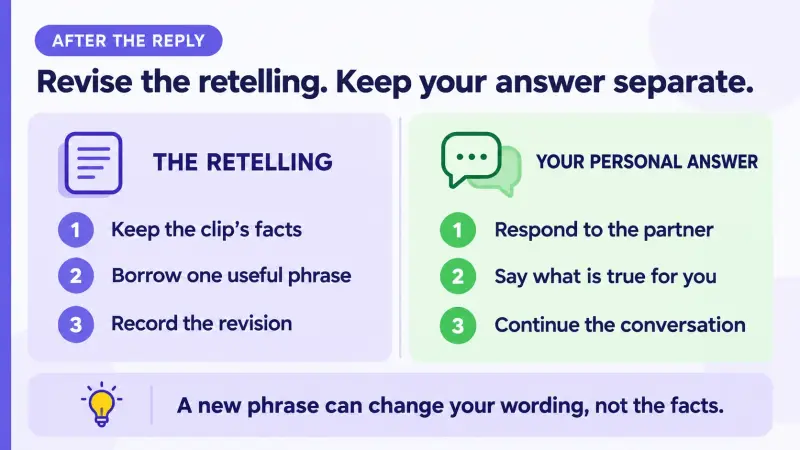
Revise the Retelling and Make the Task Easier Where Needed
Redo the message once with the fact repairs and the contraction fixed:
Samedi matin, il pleuvait, et il y avait moins de clients que d'habitude au marché. Vers midi, les vendeurs ont commencé à ranger leurs caisses, un peu plus tôt que les autres semaines. Une vendeuse a dit qu'elle reviendrait peut-être le mercredi suivant. Moi, je vais rarement au marché le samedi, parce que je travaille, et je fais mes courses au supermarché, en général le dimanche soir.
"Saturday morning, it was raining, and there were fewer customers than usual at the market. Around noon, the vendors started packing up their crates, a bit earlier than in other weeks. A seller said she would maybe come back the following Wednesday. Me, I rarely go to the market on Saturday, because I work, and I do my shopping at the supermarket, usually on Sunday evening."
Keep five things together for next time: the clip, version one, why each change was made, version two, and the question you asked. Those repairs came from comparing your version with the script, so they belong in your own notes.
In HelloTalk, save the partner's reply and any correction they leave on your messages to your favorites, open both before your next clip, and reuse what you have actually checked, such as bondé in your next message once you know what it means. Reported timing like le mercredi suivant only carries over to a new clip that reports a time the same way.
When the sequence stalls, lower the difficulty instead of abandoning it. Cut the segment to twenty seconds, read the transcript before listening rather than after, retell in two sentences instead of four, or write the retelling out before you record it. Any of those keeps the shape of the task while removing the part that jammed.
More listening builds the material you retell from, and deliberate retelling is one way that material turns into speech you can produce on demand. The partner's follow-up is what keeps it from staying a monologue. For fitting this alongside the rest of your week, the guide to daily French resource choices covers how courses, audio and conversation sit together, and the exchange side starts at HelloTalk.