
I Can Read a Language but Cannot Speak It: What to Practice Next

If you can read a Spanish paragraph about weekend plans but cannot produce your own Saturday sentence even when you practice alone with nobody waiting on you, the next step is solo recall, and material you have already read covers that. If the sentence does come out on your own and what stalls you is the other person's unscripted reply, that step needs a real interlocutor. On HelloTalk you send that Saturday sentence to a partner as a voice message and handle what comes back.
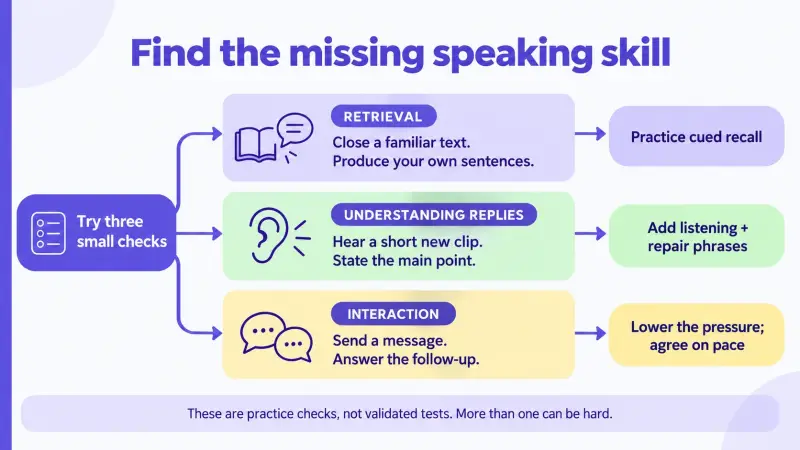
Use Three Short Checks to Find Where You Get Stuck
Keep the topic fixed so the only thing changing is the task. Weekend plans works well for this exercise: it is familiar, and you already have true information to put into it.
Start from one sentence you understand on sight. The Spanish lines in this article are written as practice examples, not a record of a real conversation and not an audio test.
El sábado por la mañana voy al mercado con un amigo. (On Saturday morning I go to the market with a friend.)
Check one is production from memory. Cover the sentence and say the same idea with your own facts, out loud: Este sábado por la mañana voy al mercado con un amigo, y por la tarde no tengo planes. (This Saturday morning I'm going to the market with a friend, and in the afternoon I have no plans.)
Check two is listening, and it needs real audio. Use the recording that came with a lesson you have already read on this topic, or ask a partner on HelloTalk to send a short voice message about their own weekend, which gives you unrehearsed audio on the topic you just read. Play it once and see how much you catch before opening any transcript.
Check three is interaction. Send that same content to a real person on HelloTalk, and keep the conversation going after whatever comes back. The point is the part you did not plan: their answer decides your next sentence, and nothing you rehearsed alone decides that for you.
Reading a sentence and saying it from memory are two different tasks. Doing the first well does not by itself show where you stand on the second.
These are observations rather than tests. They can overlap, nothing is scored, and there is no time limit to beat. The table collects what each one tends to expose.
| Check | What you might notice | What it may involve |
|---|---|---|
| Saying it yourself | You know every word, yet the sentence arrives slowly or in pieces | Pulling up whole phrases rather than single words, sometimes alongside gaps in grammar or vocabulary |
| Hearing a reply | Content that was easy to read goes past too fast in a partner's voice message on HelloTalk | Speed and sound, and holding meaning to the end of a sentence; vocabulary can be part of it too |
| Talking with a person | You managed it alone, then went blank once someone had answered you | The conditions of a real exchange on HelloTalk, where the partner's reply is unscripted and you answer that reply rather than your prepared line; pressure as well as retrieval may be involved |
More than one row can describe you on the same day, and one difficulty can involve several things at once. When that happens, pick the one that is most in the way of the conversation you want to have next, and leave the others open rather than ruled out.
Match Your Next Practice Task to the Difficulty You Noticed
What you noticed in those checks points at different kinds of practice. Here is what each one asks for.
If the sentence would not come together, the next task is production from material you already understand. Take sentences you have read, cut them down to frames you can refill with your own facts, and practice saying them without looking at the source. A fuller version of that routine is in turning sentences you have read into phrases you can say.
If the text was clear and the audio was not, the next task is listening at a level you can mostly follow, plus a few phrases for repairing a conversation when you miss something. Those phrases only work when someone is on the other end, so use them in a HelloTalk chat: ask the partner to repeat a voice message more slowly. Asking someone to repeat is itself a speaking move, which is why it belongs here and not in a listening-only project.
If you spoke fine alone and stalled once a person was waiting, the sentence may not be the only thing involved. Saying the line out loud before you send anything, or telling a partner on HelloTalk in your first message that you are still slow and would like replies at an easier pace, changes the conditions around the same sentence rather than the sentence itself. Speaking to native speakers when it makes you nervous covers that step on its own.
Finding that you cannot speak yet is not a reason to stop reading. Reading supplies material you can later try to say, and audio and conversation keep adding to it.
These next steps overlap on purpose. A listening session hands you phrases to reuse, and a conversation trains retrieval under time pressure whether you planned it that way or not. Choosing one decides where your next few sessions go, not what you are allowed to do.
Choose Solo Practice, AI, a Tutor, or a Language Partner
Hold one task steady and compare the options against it: say your Saturday plan out loud, then answer one follow-up question about it. The table lines up what each setup asks of you and what comes back on that specific task.
| Setup | What you prepare, and what goes the other way | Where feedback comes from | Pace and waiting |
|---|---|---|---|
| Solo practice | Your own material and the frames you pull out of it; no language practice goes the other way | Your own judgment, plus whatever reference you check | Only on you, and there is nothing to wait for |
| AI practice | A description of the situation you want to rehearse; no language practice goes the other way | The tool's generated response, which you may still want to verify | What you ask the tool for, without waiting on another person's schedule |
| A tutor | As much as you agree on, whether that means the tutor's material or your own weekend sentences | A person whose job includes explaining the mistake, and who has their own history with the language | What you agree on during the session, and you wait until the booked slot |
| A language partner on HelloTalk | Your sentence sent as a voice message, plus a question you actually want answered, traded for practice in their language | A speaker of the language reacting as a listener first and a corrector second, in a reply you did not script | What you agree on with them, and a reply that may arrive later |
The rows overlap more than the layout suggests. A tutor can simply chat with you, an AI tool can produce a question you did not anticipate, and a partner can explain a mistake clearly. None of these columns is a score, and nothing here measures which setup gets anyone speaking sooner.
What a language partner adds is the trade itself. A language exchange means the other person is practicing your language while you practice theirs, and their answers come with their own week and their own reasons behind them.
On HelloTalk that trade is what you offer: ask a partner about their actual weekend and offer practice in the language you can help with. Their own week shapes what comes back, so the reply is not the one you rehearsed, and you work with it when it arrives or when you next open the chat.
If the waiting or the speed is the part that worries you, finding a partner who will go at your pace is a separate task worth doing before the first message.
Try One Familiar Topic With a Partner on HelloTalk
Here is the same weekend material taken through one short exchange.
Because the task is speaking, send the first turn as a voice message rather than typing it. HelloTalk's chat carries both text and voice messages, and sending voice practices the spoken production you are working on; if you also ask the partner to answer by voice and they are willing, their reply gives you listening material on the same topic.
If you want to hear yourself before anyone else does, record the sentence with the ordinary voice recorder on your phone first, then send the voice message in the chat.
You: Hola Alex. Este sábado por la mañana voy al mercado con un amigo, y por la tarde no tengo planes. ¿Qué haces tú normalmente los domingos? (Hi Alex. This Saturday morning I'm going to the market with a friend, and in the afternoon I have no plans. What do you usually do on Sundays?)
Alex answers, also by voice: Los domingos suelo quedarme en casa, pero este finde me mudo de piso. (On Sundays I usually stay home, but this weekend I'm moving apartments.)
You catch the first half and lose the rest. That moment has a next line rather than an exit: Perdona, no entendí la parte después de "pero". ¿Puedes repetirlo más despacio? (Sorry, I didn't catch the part after "but." Could you say it again more slowly?)
Send that in the HelloTalk chat, by voice again, since what you need is Alex repeating the missed part at a pace you can follow. More options for that turn are in phrases for asking a partner to repeat or rephrase.
Alex: Claro. Este fin de semana cambio de casa, por eso no tengo tiempo libre. (Of course. This weekend I'm changing apartments, so I don't have any free time.)
Now answer with what just arrived instead of with what you prepared: Ah, te mudas este fin de semana. ¿Te quedas en el mismo barrio? (Ah, you're moving this weekend. Are you staying in the same neighborhood?) Send that as your next voice message in the same HelloTalk chat, so you are responding to Alex's actual news rather than replaying your prepared line.
That question exists only because Alex brought up the move. A real person's reply is the part of the exchange you could not have written for yourself in advance.
HelloTalk's chat has translation, useful when you want to check what a phrase actually was. It also has voice transcription, which turns a voice message into text so you can find the part you missed. Do the listening pass first and bring in the transcription afterwards. Understanding a reply in writing does not confirm that you understood the same reply as audio.
Later in the same HelloTalk chat you can ask about one thing rather than asking Alex to correct your Spanish in general: send your Saturday sentence again and ask whether por la tarde no tengo planes is how he would put it, or whether something else sounds more natural to him. Naming the phrase tells him what to comment on, and he may simply confirm that it works. The question can go in English or whatever language you two share.
If what comes back is useful, HelloTalk lets you save messages and corrections to favorites, so Alex's wording is there the next time you write. Then use it when it is actually true: if a later Saturday really is free, that is the message to put it in. A language exchange does not by itself include professional teaching, and a partner may or may not be a teacher, so informal feedback is worth checking against a reference when it matters.
Look for Changes in What You Can Say, Understand, and Reuse
Come back to the same topic after a few more exchanges on HelloTalk, where each reply comes back in someone else's words rather than yours, and look for three specific changes rather than a count of finished exercises.
The first is whether a different wording still reaches you. You prepared for ¿Qué haces el sábado? (What are you doing on Saturday?) and this time it arrives as ¿Y tú qué planes tienes para el finde? (And what plans do you have for the weekend?) If the answer comes only when the question is phrased the way you rehearsed it, that is worth noticing.
The second is whether you followed the reply by ear before opening the transcription. Understanding it after reading still counts for something, but it says more about the reading side than about the listening side.
The third is reuse. Did me mudo or el mismo barrio turn up again on a different day, in a sentence you had not planned, about something other than weekends? Producing a phrase where you did not prepare it is a different signal from repeating it where you did.
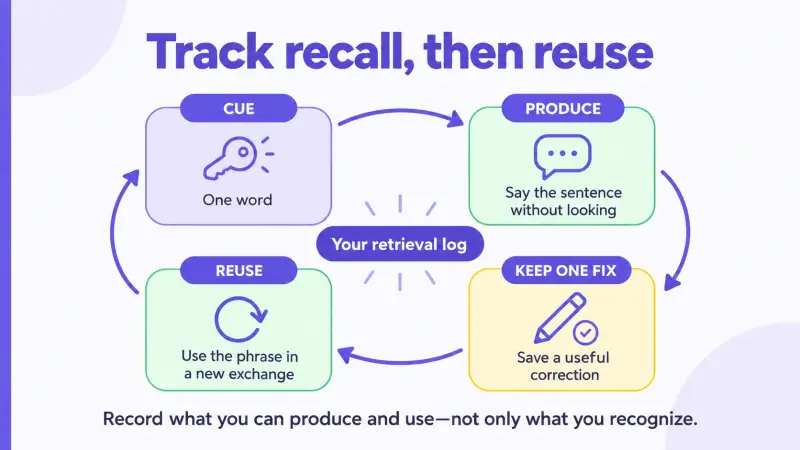
One sentence that worked once is a useful early signal, not yet proof you can use it reliably.
A good exchange is worth something on its own, and it is also a single occasion; the number of repetitions behind it is not a stronger reading. If nothing seems to have shifted yet, run the three checks again and see whether the difficulty has moved to a different one. That kind of move is normal, not a sign that the earlier work was wasted.
Frequently Asked Questions About Reading Better Than You Speak
Should I stop reading until my speaking catches up?
No. Reading supplies material you can later try to say, and audio and conversation supply more of it. What changes is that you add a production step to material you have already understood, instead of only moving on to the next text.
Do I need more vocabulary before I try to speak?
Sometimes, and it can be part of the problem even when something else is too. If you could not say a sentence whose words you already knew, vocabulary was not the only thing missing. If you ran out of words for your own actual weekend, a small set of topic words is worth adding before the next conversation.
I understand written replies but not voice messages. Is something wrong?
No. Those are different skills and they often move at different speeds. Treat written comprehension as evidence about reading, and build listening with short audio you can mostly follow. In a HelloTalk chat you can also ask a partner to resend a voice message more slowly, so the audio you practice on is a reply you actually need to understand.
I sent a message and nobody answered. What does that mean?
Silence is not a verdict on your level. HelloTalk's help page lists ordinary reasons a partner may not reply, including being busy, time zone differences, and how interested they are in the topic. Filling out your profile, writing to someone else, or posting in Moments are the available next moves, and no reply time is promised.
I said the sentence correctly once. Is it learned?
That is a real use and a good sign, though one use is not yet a pattern. Try it under a different condition: another wording of the question, another day, or a conversation you did not prepare for. What holds up across those is what you can lean on.
When you are ready to take your own weekend sentence to someone who will answer with theirs, HelloTalk is one place that exchange can happen.