
How to Turn Sentences You Read Into Phrases You Can Say

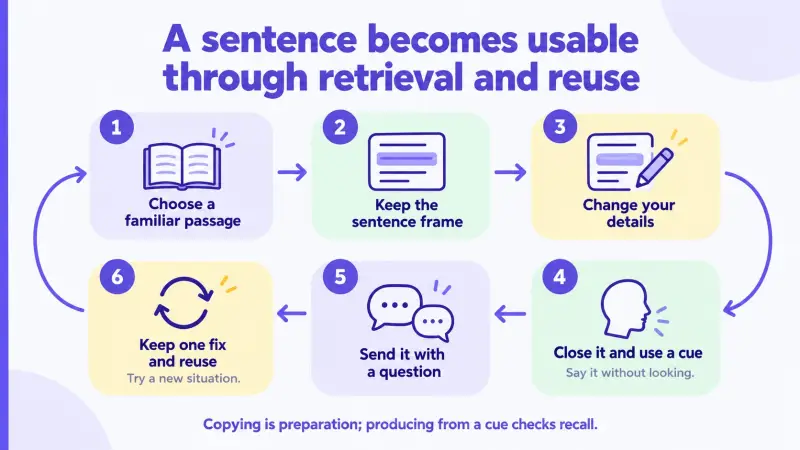
If you can read three French lines about someone's weekend but days later out comes "le week-end... yoga... euh", keep the sentence frame, swap in details true about you, and say it from a cue; that part is solo work. When the task is using the line with an unpredictable person, send it to a HelloTalk partner with a question they can answer: their actual answer brings in details your passage never had, and gives you a reason to respond from a cue.
French appears below only to make each step visible; you can adapt the same steps to another language you read, allowing for how that language builds its own sentences.
If you are not sure yet whether retrieval, listening, or nerves is the part that breaks down for you, reading but not speaking: what to practice next sorts that out before this.
Choose a Short Passage You Can Use in Your Own Life
Some reading suits this task better than other reading. A news report about an election can contain perfectly reusable structures, but a passage dominated by specialized facts leaves you little to say about your own week, so the pattern has nowhere to go afterwards.
A passage is worth converting when you could plausibly need its sentences in your next conversation, not when it sits at a comfortable level on paper. Three or four sentences is enough. Pick something whose meaning you can verify rather than guess, and tolerate a word or two you do not know as long as the structure is clear.
I wrote the passage below as teaching material for this walkthrough, so the weekends in it belong to nobody:
Le week-end, je fais du yoga avec ma colocataire. Le samedi matin, nous allons au marché près de chez nous. Parfois, je fais de la randonnée avec mon frère.
On weekends I do yoga with my roommate. On Saturday mornings we go to the market near our place. Sometimes I go hiking with my brother.
Keep the Sentence Pattern and Change the Details
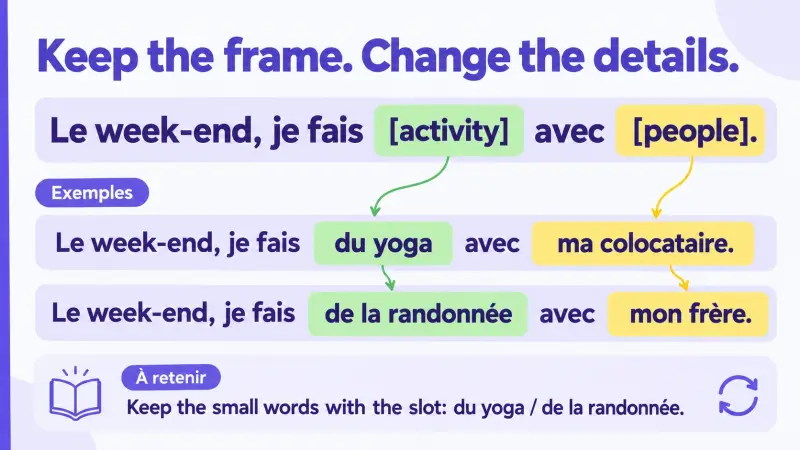
Copying the whole passage leaves you talking about somebody else's roommate. What you want is the frame underneath it: Le week-end, je fais [activity] avec [person].
Small words move with the slot you fill. In these examples the article after "faire" goes with the activity: du yoga, du vélo, de la randonnée, and de l'escalade (climbing) before a vowel. Change the activity and that article changes too, so check it instead of carrying du across.
The person slot works the same way: ma colocataire for a female roommate, mon voisin for a male neighbor, un ami or une amie depending on who the friend is. Note that mon amie is the normal form for a female friend, so these choices are not simply a matter of the person's gender. Mon frère means a brother with no age specified, so leave the age out unless you add it yourself.
A habit sentence takes "le week-end", not "au week-end". When you mean one particular weekend, you need different wording, such as "ce week-end" for the weekend under discussion.
Here is the same passage with the detail work done. The filled-in versions are constructed examples for this walkthrough, so read the middle column as a demonstration and put your own weekends in your own copy.
| Pattern you keep | Personalized teaching example | Question you add |
|---|---|---|
| Le week-end, je fais [activity] avec [person]. | Le week-end, je fais du vélo avec mon voisin. (On weekends I cycle with my neighbor.) | Et toi, qu'est-ce que tu fais le week-end ? (And you, what do you do on weekends?) |
| Le samedi matin, nous allons [place] près de chez nous. | Le samedi matin, nous allons au parc près de chez nous. (On Saturday mornings we go to the park near our place.) | Tu sors le samedi matin, toi ? (Do you go out on Saturday mornings?) |
| Parfois, je fais [activity] avec [person]. | Parfois, je fais de la cuisine avec un ami. (Sometimes I cook with a friend.) | Tu cuisines, toi ? (Do you cook?) |
If a slot cannot hold anything true about you, drop that line rather than inventing a sibling to keep the pattern alive. True details keep the follow-up manageable, because you are not also keeping track of an invented story while you answer.
Look Away and Say It From a Meaning Cue
Reading your own three sentences back out loud helps you get the sounds in your mouth, but it does not check whether you can retrieve them unaided. Recognizing a sentence and producing it are different actions. Conversations ask for the second one.
Cover the passage. On a separate line, write cues in your own language with no French in them: "weekend / cycling / neighbor", "Saturday morning / park nearby", "sometimes / cooking / friend". Say each sentence out loud from the cue alone, then check it against what you wrote.
Reduce the support gradually. First round with your notes visible, next round with cues only, later with nothing but the topic "my weekends". There is no speed requirement here; a sentence that arrives slowly still arrived.
Three sentences and a couple of rounds spread over a few days is a reasonable size for one passage. That is a task size you choose, not a threshold that proves anything.
Speaking is the task here, so send those three weekend lines as a voice message in HelloTalk and end with the question you already prepared: "Et toi, qu'est-ce que tu fais le week-end ?" Whatever they answer is not in your script, so the reply gives you something to respond to from the frame rather than a line to read back.
If you want a run-through first, record once in an ordinary voice recorder app on your phone and listen back, then record and send through HelloTalk when you are ready. The rehearsal is preparation; the message you actually send is still the real practice.
Give a HelloTalk Partner Something to Answer
A message that ends with "please correct me" hands the other person a grading job. A message that ends with a question hands them a turn. A question at the end turns practice text into conversation.
In the worked example, the message to a HelloTalk partner tells them about your weekend and asks about theirs, so they have something to write back about. It reads: "Le week-end, je fais du vélo avec mon voisin. Le samedi matin, nous allons au parc près de chez nous. Parfois, je fais de la cuisine avec un ami. Et toi, qu'est-ce que tu fais le week-end ?"
In that same HelloTalk chat, attach one narrow feedback request instead of an open invitation to fix everything: "Est-ce que « je fais de la cuisine » est naturel, ou tu dis plutôt autre chose ?", meaning "Is 'je fais de la cuisine' natural, or would you say something else?" A single question like that is easy to answer in one line, and it asks your partner for one useful judgement rather than marking the whole message.
Have the follow-up ready before you send. If your partner answers in that HelloTalk chat that they play football with friends, keep your next line there about the football detail they gave rather than switching topics: "Tu joues le samedi ou le dimanche ?" (Do you play on Saturday or Sunday?) is already waiting.
Sending a voice message does not mean one comes back, so if you want listening practice, ask your HelloTalk partner for an audio reply and leave them time to get to it. A recording carries their pacing and intonation, which a transcript leaves out. HelloTalk's chat tools can translate a message or transcribe a voice note, and those outputs are sometimes wrong, so when a transcript reads strangely, play the audio again or ask the person what they meant.
Nobody owes you a reply, and silence can have several causes. HelloTalk's own help pages mention time zones, differing interests and ordinary busyness as reasons a message sits unanswered. Language exchange works because both sides get something, so answering their question matters as much as asking yours.
When the reply comes back and you catch half of it, the repair lines in asking a language partner to clarify without losing the conversation are the next thing to have ready. If what stops you is the moment before hitting send rather than the sentence itself, speaking with native speakers without freezing deals with that separately.
Reuse Useful Feedback in a Different Answer
Suppose the reply says French speakers more often say "je cuisine" than "je fais de la cuisine". That exchange is written here to show how a correction gets reused; a real partner might phrase it differently, might say your version was already fine, or might not answer at all.
Reuse means putting the correction somewhere new rather than rereading it. "Parfois, je cuisine avec un ami" drops "faire" and its article while "avec [person]" stays intact, so the slot you practiced is still doing work.
Then move it under a different cue. Pick a different setting, say a weekday evening, and the next sentence is "Le soir, je cuisine avec un ami" (In the evening I cook with a friend). Le soir means in the evening rather than on weekdays; the weekday is the situation you chose to talk about, not something the phrase itself carries.
Say that one from the cue "evening / cooking / friend" rather than reading it off the thread. Feedback is easier to apply when you pick its next sentence.
HelloTalk lets you save messages, so keep that reply in your saved items rather than scrolling for it later, and pair it with the sentence you already picked: "Le soir, je cuisine avec un ami". The sorting is yours to do by hand: a notebook line with the original, the change, and where you plan to use it next.
Keep this pass tied to the task you started. Not every remark in the reply needs to become a project, and if no reply comes, you can still practice from the cues while recording that line as unreviewed rather than confirmed.
If you used the phrase in your next HelloTalk exchange without reading it off your notes, that is one observation of you retrieving it in that conversation. Whether it comes back next month is a different question, and the next conversation is where you find out.
Frequently Asked Questions About Turning Reading Into Speech
What if the passage contains a word I cannot check?
Skip that line or look the word up before you build anything on it.
Dictionary entries and in-chat translation can both be wrong in context, so a pattern built around a word you are guessing at tends to produce a sentence your partner has to repair before they can answer it.
Does this method work for listening too?
Not on its own. It starts from text, so it trains what you can produce.
For listening you need actual audio: a recording that accompanies the material you are reading, or a voice reply you ask a HelloTalk partner for. Synthesized speech reading your own sentences can support listening and pronunciation practice, but it is not your partner's own recording or their actual answer. A real voice reply carries their pacing and what they meant, and reading a transcript on screen is not the same as hearing it.
Can I do this with an AI tool instead of a person?
Partly. AI practice can rehearse the pattern with you and explain why an article changes, and it may produce phrasing you did not plan for.
What it cannot report is a human peer's own actual weekend, their reason for asking you something back, and the unplanned detail that makes you improvise mid-sentence.
How many patterns should I take from one passage?
As many as you can fill with true details and say from a cue.
There is no fixed number worth defending. A second pattern that stays on the page does less for you than one you have already used in a message.
When your three sentences are ready to meet somebody who has weekends of their own, you can look for partners on HelloTalk.