Language Exchange: A Complete Guide to Finding a Partner, Speaking Confidently, and Making Progress That Sticks
Language exchange is a two-way learning method: two speakers with different native languages help each other practice their target language — no paid teacher, no rote memorization, no course to finish. If you've ever felt stuck in the "I studied for months but can't hold a real conversation" loop, this guide is for you.
Here you'll find a clear explanation of what language exchange actually is, a framework for finding a reliable partner online, a 60-minute session template you can start using this week, and a walkthrough of how HelloTalk makes all of it more accessible than it's ever been.
What Is Language Exchange?
There's a pattern we see constantly across our community: six months of app streaks, a solid reading vocabulary, real effort at grammar — and then a conversation with a native speaker that reveals the gap immediately. The words exist somewhere. The conjugations are technically there. But producing language under the pressure of a real exchange feels nothing like retrieving it from a flashcard.
That gap isn't a motivation problem — it's a structural one. Recognition and production are separate skills that develop on different tracks. Understanding words when you read them doesn't automatically build the ability to retrieve them mid-conversation, when someone is waiting. Language exchange works by targeting that second skill directly: two speakers with different native languages take turns practicing each other's language, each serving as the other's real-world resource. No structured curriculum, no tuition fee, no course to complete. The arrangement is genuinely mutual — neither person is purely the student, and both have something real at stake.
The core logic:
- You're your partner's native speaker resource; they're yours
- You can exchange via text, voice, or video — or meet in person if you're in the same city
- No payment changes hands; motivation is mutual
- From a language acquisition standpoint, authentic conversation provides input that's far closer to natural learning than any quiz format
Language exchange isn't about "studying" a language — it's about using one. That distinction matters a lot.

Four Main Platforms Compared
Before picking a platform, know what you actually need. Here's an honest side-by-side:
| Dimension | HelloTalk | Busuu | Speaky | MyLanguageExchange |
|---|---|---|---|---|
| Free tier | Core features free, VIP unlocks extras | Basic free, most features behind paywall | Fully free | Free registration, some features paid |
| Best level | Beginner to advanced (A1–C2) | A1–B2, certificate-focused | Beginner to intermediate | Intermediate to advanced |
| Formats | Text, voice, video, Moments, Voicerooms | Structured lessons, writing exercises | Mostly text chat | Text and email correspondence |
| AI tools | Translation, grammar correction, AI chat | Basic | None | None |
| Community size | 70M+ registered users globally | ~13M users | ~3M users | ~300K users |
| Best use case | Daily conversation + culture + AI-assisted correction | Structured curriculum with official certificates | Finding a first language partner quickly | Learners who prefer written exchanges |
For most learners who want a long-term home base, HelloTalk has the most depth across features, user base, and AI support. It earned the 2024 global Google Play homepage feature for good reason.
For a deeper comparison of seven exchange platforms ranked by speaking practice quality, see our best language exchange apps guide.
Language Exchange by Language: Where to Go Deeper
The principles in this guide apply regardless of which language you're learning — but every language has its own specific obstacles, and exchange strategies that work well for one won't always transfer to another.
- Spanish: Spanish shares a large base of Latin-root vocabulary with English, and its phonetic spelling makes early reading more manageable than most languages. That said, the rolled r, the subjunctive mood, and the real divergence between Castilian and Latin American accents only become natural through sustained live conversation, not grammar exercises. See our guide to learning Spanish efficiently.
- Japanese: Pitch accent, three overlapping writing systems, and a formal/informal register divide that restructures entire sentence patterns mean that textbook progress and spoken fluency can diverge significantly. Native speaker exchange is especially high-value for Japanese learners. See our guide to learning Japanese as a beginner.
- Korean: Hangul's alphabet can be learned in a few hours, which makes Korean feel approachable at the start. The steeper challenge is the speech-level system — navigating when to use formal, polite, or casual register requires real interaction with native speakers to absorb. See our guide to learning Korean fast.
- Italian: Italian has a notably regular pronunciation system, which gives beginners earlier spoken wins than most European languages. The main learning curve lies in verb conjugation and learning to parse the significant regional accent variation you'll encounter in actual conversation. See our guide to learning Italian in 2026.
- French: Silent letters, liaison, and nasal vowels create a sharp gap between how French looks on the page and how it sounds in speech. Learners who focus heavily on reading before speaking often find that native conversation requires a significant recalibration. Speaking practice accelerates this adjustment faster than anything else. See our guide to French speaking practice.
- German: German's case system — nominative, accusative, dative, genitive — determines article and adjective endings throughout each sentence. It's a pattern that grammar tables can explain but only regular conversation makes intuitive. See our guide to German speaking practice with native speakers.
- Mandarin Chinese: Four tones plus a neutral tone mean the same syllable carries entirely different meanings depending on pitch. This is difficult to internalize through input alone — consistent correction from native speakers is one of the few reliable ways to build accurate tonal production. See our guide to learning Mandarin through the social method.
How to Find a Reliable Language Exchange Partner
Finding the right person matters more than finding many people.
What to Look for in a Partner
- Matched learning goals: They're actively learning your native language, and you're actively learning theirs — both sides genuinely invested
- Compatible CEFR levels: A gap of no more than two levels keeps the conversation challenging without becoming inaccessible
- Workable time zones: A difference of more than nine hours tends to erode long-term consistency; it's worth factoring in from the start
- Shared interests: When you're both interested in the topic, conversation stops feeling like homework
Green Flags and Red Flags
Evaluate quickly after one or two sessions:
| Green flags (worth continuing) | Red flags (reconsider) |
|---|---|
| Asks about your goals and level upfront | Only interested in your native language, indifferent to yours |
| Shows up on time, keeps commitments | Frequently cancels or ghosts |
| Corrects you constructively and gently | Over-corrects every word, making you hesitant to speak |
| Session time is balanced — roughly 50/50 | You're always the "teacher," they rarely practice your language |
| Topics stay healthy — learning, culture, life | Conversation drifts toward personal requests or uncomfortable territory |
| Suggests the next session at the end | You're always the one chasing confirmation |
A 60-Minute Session Template
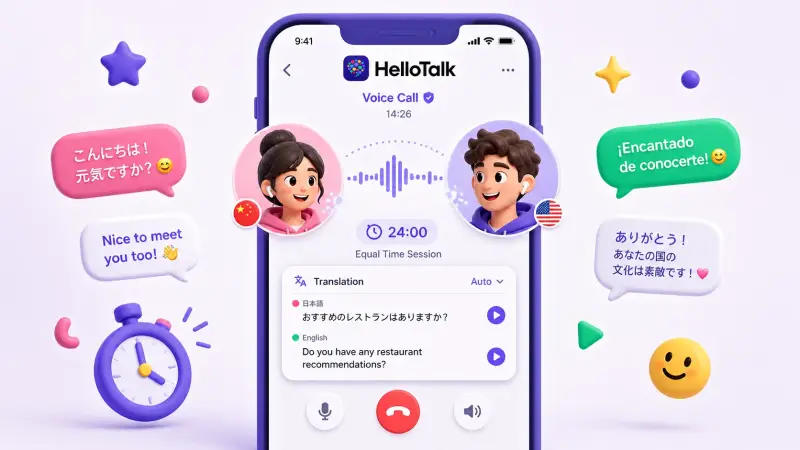
This template follows the core principle of equal-time language exchange: spend equal time in each language, with your target language going first.
| Time | Language | Activity | Goal |
|---|---|---|---|
| 0–5 min | Both, casual | Small talk warmup — what's been happening this week | Shake off nerves, get into language mode |
| 5–25 min | Your target language | Free conversation on the week's chosen topic (travel, work, interests) | Real output — feel the language move |
| 25–30 min | Switch | You correct your partner's errors from this segment; they give you feedback | Immediate correction while it's fresh |
| 30–50 min | Your partner's target language (your native) | Partner leads the topic, you respond naturally and correct as you go | Give high-quality native speaker input |
| 50–55 min | Switch | Each person names three expressions they learned this session | Active recall, deeper retention |
| 55–60 min | Both | Set the next session time and topic | Keep the learning continuous |
The "correction window" in minutes 25–30 is where most of the real value accumulates. A native speaker catching your error in context — not in an exercise — sticks in a way that flashcards don't.
Common Language Exchange Challenges — and What to Do
You freeze the moment you open your mouth
Start on HelloTalk with text chat before moving to voice. Use the built-in translation while you're chatting to keep the conversation going without stopping to look things up. Remove the floor, then gradually raise it.
Your partner disappears after two sessions
Lock in the next session before the current one ends. Connect on Moments too — mutual engagement outside scheduled sessions creates a warmer relationship than purely functional check-ins. Build a light ritual ("what new word did you use today?") that gives the relationship some texture.
One language starts dominating the session
Set a timer — 25 minutes each, strict. If saying "let's switch now" feels awkward, type it in HelloTalk's chat: the text buffer softens the interruption without derailing momentum.
You run out of things to say
Browse HelloTalk's Moments feed and save interesting posts from native speakers as conversation starters. Or use this three-step structure: current event → your take → related vocabulary. Any topic can be unpacked this way.
Using HelloTalk for Language Exchange: What Actually Works
HelloTalk is among the most complete language exchange platforms available, with a combination of features that support daily practice across multiple formats:
- AI translation: Covers 260+ languages including idioms and casual expressions — long-press any message to translate without breaking the conversation's rhythm
- AI grammar correction: Catches errors before you send, with explanations — you learn from mistakes while making them, not hours later
- Moments native speaker corrections: Post a sentence or voice recording, get real feedback from native speakers within minutes — faster and more contextual than a dictionary
- Voicerooms: Open 24/7 on themed topics, with a silent listening option — lower-pressure than one-on-one sessions and great for building passive vocabulary and ear training
FAQ: Language Exchange Questions Worth Answering
Q1: How is language exchange different from hiring a tutor?
A tutor is paid, one-directional, and structured around a curriculum they design. Language exchange is free, bilateral, and driven by authentic conversation. Tutors are better for systematic foundation-building; language exchange is better for activating fluency and cultural understanding. They're complementary, not competing.
Q2: Can complete beginners do language exchange?
Yes — but a base of around 200–300 words makes it considerably more useful. HelloTalk's translation and correction tools act as a safety net that lets beginners participate in real conversation before they'd otherwise feel ready. You don't need to be good enough first.
Q3: How do I keep making progress and not plateau?
Set a concrete monthly target: "discuss three topics fluently" or "add 50 expressions to active use." Spend five minutes after every session writing down new words and phrases. Replay recordings of your early sessions occasionally — the contrast is usually motivating.
Q4: Is online language exchange as good as in-person?
Different trade-offs. In-person gives you body language and total immersion; online removes the geographic constraint and gives you access to a much wider range of accents and dialects. Use online as the consistent backbone and treat in-person sessions (when the opportunity exists) as a bonus, not the standard.
Q5: How do I keep a language exchange relationship going long-term?
Consistency beats intensity. One or two sessions per week, maintained for months, will outperform a burst of daily sessions that drops off after three weeks. Interacting on Moments between sessions and occasionally sharing something you found interesting — an article, a word you didn't expect — keeps it from feeling transactional.
Q6: How long before language exchange produces visible results?
With two 60-minute sessions per week, most learners notice meaningful improvement in spoken fluency within 8–12 weeks. The improvement accelerates when combined with HelloTalk's AI correction and native speaker Moments feedback — you're not just practicing, you're getting consistent, specific input on what to fix.
Ready to find your first language exchange partner?
Go to www.hellotalk.com, set your target language, and send your first message. Fluency doesn't come from waiting until you're ready — it comes from talking when you're not.