German Speaking Practice With Native Speakers 2026: From Textbook to Real Conversations
You've been studying German for eight months. You know the nominative, accusative, and dative cases. You've drilled der/die/das until it appears in your dreams. You can conjugate irregular verbs and you've memorized the two-way prepositions. By any reasonable measure, you're prepared.
Then you land in Munich. You walk into a bakery. You've rehearsed this — Ich hätte gern einen Kaffee und ein Croissant, bitte. Perfect sentence. You open your mouth.
The woman behind the counter smiles and fires back something that sounds like it's happening at triple speed, with sounds you've never encountered in any audio track. You catch Oazkaffee and scho and the rest is a blur. You smile. You nod. You end up with something you didn't order and you spend the next ten minutes sitting at a table wondering what just happened to eight months of studying.
Nothing happened to your German. Your German is fine. What happened is that you'd been practicing a version of the language that doesn't quite exist: the slow, enunciated, textbook German where every case ending rings out clearly and nobody swallows half their syllables. Real German, spoken by real people in real places, is a different animal entirely.
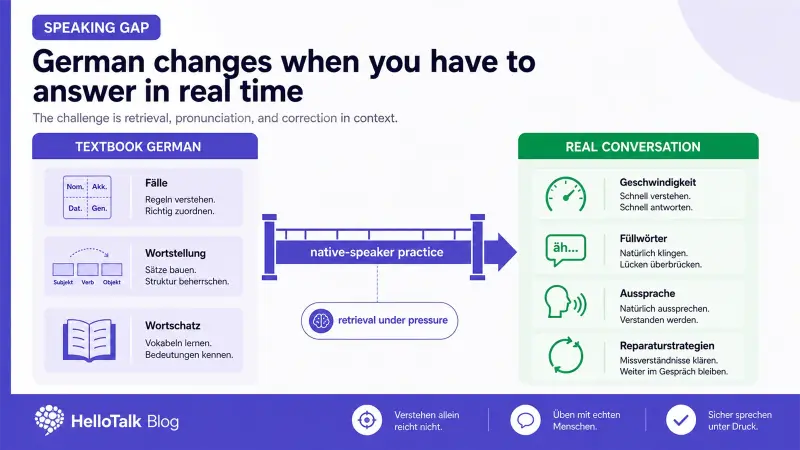
This is the gap that every intermediate German learner hits. The gap is about exposure: specifically, hearing native speakers in actual conversations, and enough of it that your brain starts wiring itself for the real thing rather than the classroom version. This article is about how to bridge that gap, what gets in the way, and what a genuine german speaking practice routine looks like in 2026.
What German Textbooks Don't Prepare You For
Every language has its peculiarities that teachers tend to paper over in the early stages because they'd derail the lesson. German has a few that are particularly brutal once you step into real conversations.
Gendered nouns in real time. You know that nouns have genders in German. You've learned them alongside vocabulary — you know it's der Tisch, die Lampe, das Fenster. But knowing the gender when you're studying a flashcard and knowing it mid-sentence, under conversational pressure, with a native speaker waiting for you to finish your thought, are completely different cognitive tasks. In a textbook exercise you have time to think. In conversation, the article comes before the noun — you have to commit to the gender before you've finished your thought. Learners who've never practiced speaking under pressure default to die or leave the article out entirely, and errors start compounding.
Native speech speed and contraction. Written German is already famously long. Spoken German is famously fast. Native speakers merge words constantly — hast du becomes something like haste, ich hab replaces ich habe, mal gets appended to everything. The formal conjugations you drilled don't match the contractions you're hearing. And unlike English where contractions are predictable, German spoken shortcuts vary by region and speaker.
For the small words that change a speaker's stance or tone rather than the basic proposition, this guide to German modal particles in conversation compares doch, mal, and ja in context.
Dialects, and the gap between Hochdeutsch and everything else. Standard German — Hochdeutsch — is what you learned. It's clear, codified, and spoken mostly in formal contexts and on national television. But step into Bavaria, Austria, Saxony, or Switzerland, and you're in different linguistic territory. Bavarian speakers use i for ich, ned for nicht, samma for sind wir. Swiss German is so distinct from standard German that many learners treat it as a separate language entirely (arguably it is). Even within Germany, a Berlin Berlinerisch speaker sounds nothing like someone from Hamburg. None of this is covered in any beginner or intermediate textbook.
Compound words in the wild. You've heard about German compound words — Donaudampfschifffahrtsgesellschaftskapitän and all that. What you don't realize until you're in conversations is how fluidly native speakers create compounds on the fly, how fast they say them, and how the stress patterns that help you parse them in isolation vanish when they're embedded in a fast sentence.
These aren't problems you can solve by studying more. You solve them by hearing more. Specifically, by hearing native speakers and being in real, unscripted exchanges where you have to respond.
Finding German Conversation Partners That Actually Commit
Here's the honest problem with language exchange: finding partners is easy. Finding partners who stick around past the first session is much harder.
The internet is full of language exchange forums and apps where you can post a profile, get a flurry of messages from people who are equally enthusiastic about the idea of exchange, and then watch 80% of them ghost you by week two. Life happens. Timezones mismatch. People overestimate their availability. You end up with a string of one-off conversations that never build the continuity you actually need.
Continuity matters because language learning is cumulative. A one-hour conversation once a month is nearly worthless for speaking fluency. A fifteen-minute voice exchange three times a week compounds. Your partner starts remembering what vocabulary you're working on. You stop having to explain your level every session. The conversations get more natural because there's an established dynamic between two people, not two strangers performing an exchange ritual. If you want the full framework for how to structure exchange sessions and screen for reliable partners, the complete language exchange guide covers that in depth.
What actually helps is a platform built around the community model rather than the matching-and-forget model. This is where HelloTalk's setup differs from a plain language partner forum. With 70M+ users across 200+ countries covering 260+ languages, there's no shortage of German native speakers looking to practice English (or whatever your native language is), but the community layers — the Moments feed, the Voicerooms, the ongoing chat — create ambient contact points that keep exchanges alive between scheduled sessions.
The matching itself is straightforward: you set your native language and your target language, and HelloTalk surfaces German speakers who've set their target as your native language. But what keeps things going is that you're not just text pen pals. You can send voice messages back and forth — which is genuinely different from texting, because you're producing speech and listening to responses. The friction of typing gets removed and you're actually practicing the medium you want to improve: speaking.
For learners specifically working on spoken German, the voice message format is underrated. You can pause, replay, loop over a phrase you couldn't catch. Your partner can hear exactly how you're speaking and respond to the actual sounds, not the cleaned-up written version. It's asynchronous, which removes the panic of live conversation, while still forcing you to produce real speech.
A Week of German Speaking Practice — What It Actually Looks Like
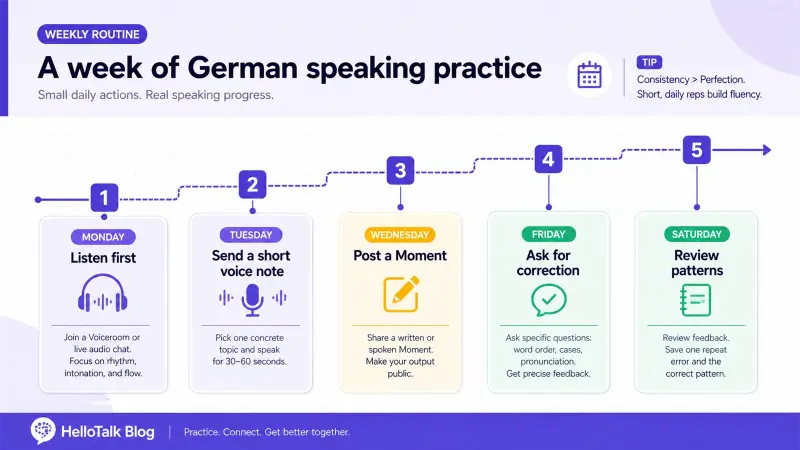
Abstract advice about consistency is useless. Here's what a realistic week of german speaking practice looks like when you build it around the tools that are actually available to you in 2026.
Monday — start with listening, not speaking. Don't open the week cold. Spend twenty minutes in a HelloTalk Voiceroom. These are 24-hour live audio rooms organized by theme — some are casual conversation rooms, some are specifically for German learners. You don't have to talk on Monday. Just listen. You're recalibrating your ear to natural speech after a weekend where maybe you weren't immersed. Notice how the speakers pace their sentences. Notice the filler words — ja, also, eben, halt — that native speakers use constantly and that no textbook teaches.
Tuesday — send your first voice message. Whatever you've been texting your exchange partner about, upgrade it. Instead of typing Wie war dein Wochenende?, record it. Same sentence, but now you're committing to pronunciation and intonation. When they write back, ask them to respond with a voice note too. Build this in as a Tuesday ritual. The goal isn't a perfect recording — it's getting reps in.
Wednesday — use Moments to produce something. HelloTalk's Moments is a social feed where learners post in their target language — short texts, audio clips, photos with German captions. Post something in German. Doesn't have to be long. "Heute war es kalt in meiner Stadt und ich habe endlich meinen Wintermantel verstaut. Herbst kommt früher als erwartet." Something real and small. Posting publicly creates mild accountability. Native speakers and advanced learners in the community will often correct you naturally, in the comments, which gives you data you wouldn't get from a private chat.
Thursday — live conversation, even short. This is the hardest day of the week for most people, but it's the one that moves the needle the most. Schedule a 15–20 minute live call with your exchange partner. Use voice, not video if that reduces anxiety. Pick a topic in advance so you both have something to anchor to — current events, a movie you watched, a recipe. When you lose words mid-conversation, don't switch to English. Describe around the gap. Das Ding, womit man... es ist aus Holz... That circumlocution practice is itself a learnable skill.
Friday — targeted listening. Watch a short German YouTube video or clip — ideally something with a regional accent you haven't heard much. Pay attention specifically to the sounds that tripped you up earlier in the week. Don't try to understand everything. Train your ear for the rhythm.
Saturday — review and respond. Go back to your Moments post from Wednesday. Read all the corrections. If HelloTalk's Smart Grammar Correction flagged anything in your messages this week, look at those too. Understand the pattern behind the error, not just the surface fix.
Sunday — rest, but passive. Queue up a German podcast or radio program while you're doing something else. Dishes, laundry, a walk. You're not studying. You're just keeping the language alive in the background.
That's seven days. Most of it is under thirty minutes per day. The spoken practice is concentrated on Tuesday, Thursday, and Monday's Voiceroom listening. The rest supports it. Over a month, this adds up to roughly 12–15 hours of active German speaking practice plus another 10–15 hours of passive exposure.
The German Grammar Correction Loop
Here's a mistake that's easy to make and very hard to undo: practicing speaking without any feedback mechanism. You can have hundreds of conversations and fossilize errors so deeply they become permanent features of your speech. Every German learner who reaches B2 or C1 has at least one grammatical habit they picked up wrong early on and spent years unlearning — usually a case error, or wrong gender on a high-frequency noun, or a word order pattern that almost works but doesn't.
The correction loop that actually works is layered.
Layer one: your exchange partner's natural corrections. A good exchange partner corrects you in the flow of conversation. Not by stopping you and delivering a grammar lecture, but by repeating back what you said with the correction embedded — a technique called recasting. If you say Ich hab das Buch auf den Tisch gelegt und er war dort schon seit Stunden, a native speaker might naturally respond with something that uses es instead of er for das Buch, which is a gentle signal. You catch it or you don't, but over time the correct forms start surfacing in your input.
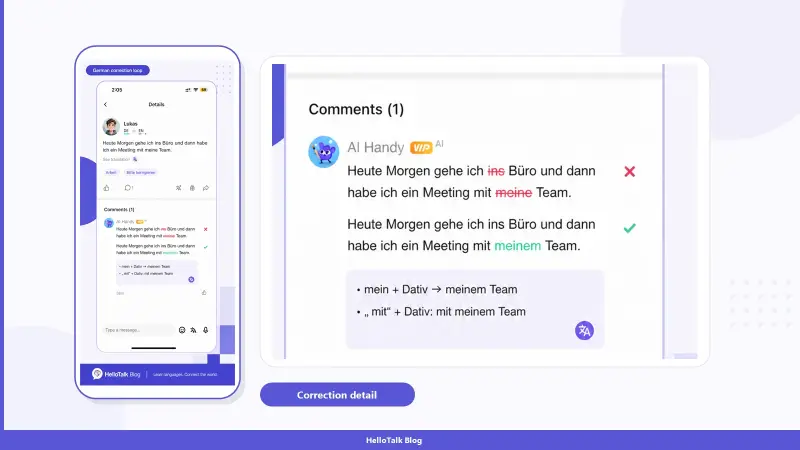
Layer two: HelloTalk's Smart Grammar Correction. When you send a text message on the platform, the AI grammar tool flags errors and suggests corrections with brief explanations. This is particularly useful for German because the error categories are specific: case errors, adjective declension, verb position in subordinate clauses, separable prefix placement. These are the exact things that are hard to catch in your own speech because they feel right even when they're wrong. Seeing the correction in writing, with an explanation, maps the error to a rule you can then monitor for in speaking.
Layer three: Pronunciation Assessment on voice messages. HelloTalk's pronunciation tool gives you phoneme-level feedback on voice recordings — identifying specifically where your vowel sounds, consonant clusters, or stress patterns diverge from target pronunciation. For German learners, this is particularly valuable for sounds that don't exist in English: the ch in ich, the ü, the ö, the glottal stop patterns. Reading about these sounds in a textbook does almost nothing. Hearing your own recording scored against a native model and seeing exactly which sounds need work is a different order of feedback.
The combination — human partner recasting + AI grammar tagging + pronunciation scoring — creates a feedback density that's impossible to replicate in a classroom setting where a teacher has thirty students. You're getting correction on your actual output, not on exercises designed to produce specific errors.
For German specifically, one more correction layer matters: word order. German word order is flexible compared to English but rule-governed in ways that feel arbitrary to English speakers. Subordinate clauses push the verb to the end. Modal verbs follow specific rules. The Satzklammer — the bracket formed by two parts of the verb — means the second part of a verb phrase often sits at the very end of a long sentence. Native speakers will catch your word order errors intuitively before they can even articulate the rule. That native intuition is irreplaceable, which is why pairing AI tools with a real human partner gives you something neither can provide alone.
How HelloTalk Compares for German Practice
| HelloTalk | Duolingo | Speaky | italki | |
|---|---|---|---|---|
| Case error correction | ✓ In-context partner markup, mid-conversation | ✗ Scripted exercises only | No | ✓ Teacher correction |
| Regional variety (DE / AT / CH) | ✓ Filter by country — find Austrian or Swiss partners | ✗ One standardized accent | Limited filters | Varies by tutor origin |
| Daily friction | Low — async voice, Moments, drop-in Voicerooms | Very low | Low | High — paid, scheduling required |
| Best role | Daily conversation practice with regional exposure | Vocab and grammar foundation | Beginner-friendly entry point | Structured lessons and targeted feedback |
Two rows in that table are specific to German in a way they wouldn't be for most other languages.
Regional variety matters more for German than for, say, Spanish or French, because the distance between standard German and its regional variants — Bavarian, Austrian, Swiss — is large enough that learners who've only practiced Hochdeutsch can genuinely struggle to understand native speakers from outside Germany. Being able to filter for Austrian or Swiss partners on a large platform isn't a minor convenience; it's the difference between calibrating to a single variety and developing a real ear for the language as it's actually spoken.
Case endings are the other German-specific thing. The der/die/das shifts in accusative, dative, and genitive are the errors learners make without noticing — not because they don't know the rules, but because retrieving the right article mid-sentence, under conversational pressure, is a different cognitive task than getting it right on a worksheet. A native speaker hears the wrong case immediately. HelloTalk's in-chat correction tool lets your partner mark the error directly on your message without breaking the conversation, so you get corrected in context, not in a recap at the end.
For the full seven-app comparison, see the best language exchange apps guide.
FAQ
How do I find German conversation partners on HelloTalk?
Set your native language and German as your target language during setup. HelloTalk will surface German speakers who've listed your native language as their target. You can also browse the Moments feed in German, comment on posts, and start conversations with people whose posts interest you — this organic approach often produces more durable exchanges than cold matching because there's already a shared topic.
Should I practice Hochdeutsch or a dialect?
Start with Hochdeutsch. It's the standard, it's universally understood across all German-speaking regions, and it's what you'll need for formal contexts, travel, and any professional use. Once you have solid B1-B2 Hochdeutsch, exposure to dialects becomes manageable — you have enough of the base language to parse what's being modified. If you have a specific reason to prioritize a dialect (moving to Bavaria, family connections to Austria), tell your exchange partners. Most native speakers can shift between dialect and standard depending on context.
What do I do when I forget a word mid-sentence and freeze?
This is the single most important speaking skill to develop, and it's not vocabulary — it's circumlocution. When you don't have the word, describe the concept. Das Ding, das man benutzt, um... (the thing you use to...). Ich meine das Wort, wenn man sehr müde ist aber nicht schlafen kann... (I mean the word for when you're very tired but can't sleep — erschöpft). Native speakers do this constantly, and doing it in the target language is far better than code-switching to English. Practice this explicitly. In your next HelloTalk voice message, deliberately choose a topic where you know you'll be missing some vocabulary. Force yourself to describe around it. That struggle is the practice.
How long does it take to reach B1 speaking with regular practice?
This varies enormously by starting language background, but for English speakers: the US Foreign Service Institute classifies German as a Category II language requiring approximately 750 hours to reach professional working proficiency. B1 speaking — conversational competence on familiar topics — typically falls around the 300–400 hour mark. With the kind of daily practice described in this article (30 minutes/day active, with passive immersion), 300 hours takes roughly 18–24 months. Compress the daily active practice time and you compress the timeline. The key variable is speaking practice specifically — learners who read and study but don't speak often have passive comprehension that outpaces their active speaking ability by years.
What HelloTalk features are free for German practice?
The core exchange features — text and voice messaging, Moments, Voicerooms, and basic matching — are free. The AI features including Smart Grammar Correction and pronunciation tools are included in the platform experience. Full feature access is available through HelloTalk VIP, which unlocks additional capabilities. For most learners starting out, the free tier provides more than enough infrastructure to build a real speaking practice routine.
How much time per day do I actually need to commit?
Fifteen to twenty minutes of active speaking practice per day produces real results over a consistent month. That might mean a 15-minute voice message exchange, a 20-minute Voiceroom session, or a short live conversation. The consistency matters more than the length of individual sessions — four 15-minute sessions per week beats one 60-minute session. Passive exposure (podcasts, TV, music in German) doesn't need to compete with your schedule because it can layer onto things you're already doing.
The Part You Have to Do Yourself
Here's the thing about language exchange that no app can solve for you: you have to be willing to sound bad. That's it. That's the entire barrier.
Every beginner German learner who reaches fluency went through a period of producing sentences that were wrong, accents that were thick, pauses that were uncomfortable. Every single one. The learners who get stuck — the ones who've studied for two years and still freeze when a native speaker talks to them — are almost always the ones who've been protecting themselves from the experience of being misunderstood or corrected in real time.
The exchange partner format strips some of that fear because both people are in the same position. Your German partner is trying to speak your language, making errors, feeling exposed. You're doing the same in theirs. There's a mutual vulnerability that makes the whole thing less intimidating than standing in front of a native speaker who has no skin in the game.
If you're also working on other European languages, juggling German alongside French for example, the same exchange dynamics apply. The French speaking practice guide follows the same structure: voice messages over text, Voicerooms for ambient exposure, Moments for low-stakes production. The commitment patterns and correction etiquette transfer directly — the underlying exchange mechanics are consistent regardless of which language you're in.
The gap between textbook German and bakery German in Munich is real. But it's a speaking exposure gap, not a grammar or vocabulary one. The only way to close it is to speak, get corrected, speak again, and build the reps until the language lives somewhere other than the part of your brain that handles deliberate recall.
If you're ready to start, HelloTalk is where you do that — in actual conversations with actual German speakers who will hear what you say and respond to it.
That's the practice. Go do it.