Japanese Language Exchange 2026: How to Find Native Speakers and Build a Daily Practice
You passed the hiragana quiz. You can write katakana without looking at a chart. You made it through the first twenty chapters of a popular beginner textbook, survived your first trip through a genki grammar workbook, and can construct a proper sentence with は and が in (mostly) the right places.
Then you watched a Japanese drama without subtitles — just for a few minutes, just to see — and understood almost nothing.
Not because you hadn't studied. You had. But the woman on screen was speaking at natural speed, dropping particles, sliding sounds together, and using sentence-ending expressions that no flashcard had ever shown you. The gap between the Japanese you'd built in your head and the Japanese people actually speak felt, in that moment, enormous.
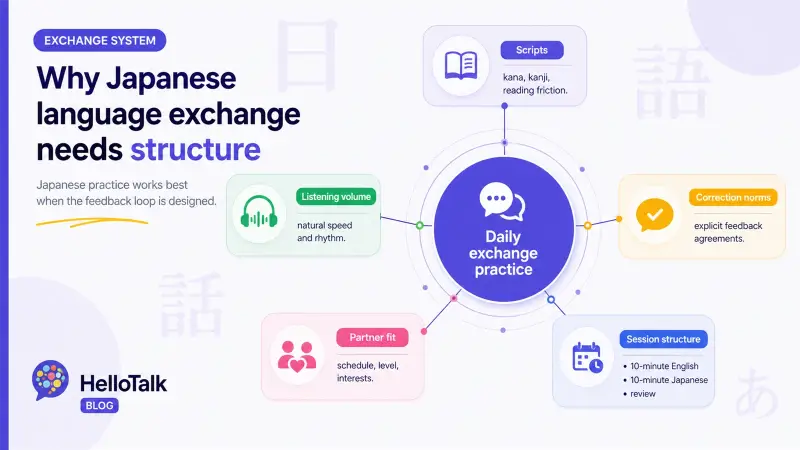
That gap is real, and it's specific to how most people learn Japanese. Textbooks teach you a clean, formal version of the language, useful, absolutely necessary, but fundamentally different from the way a 23-year-old in Osaka talks to their friends, or the way a colleague in Tokyo wraps up a work call. The only reliable way to close that gap is to spend time with native speakers, and the most sustainable, affordable, and reciprocal way to do that in 2026 is through Japanese language exchange. If you want to understand the exchange method itself before diving into the Japanese-specific details, the complete language exchange guide covers session structures, partner screening, and how to keep an exchange going for months rather than weeks.
This guide is for people who are serious about making exchange work, not just signing up for an app and sending a few messages before losing momentum. We'll cover why Japanese specifically benefits so much from live human practice, how to find the right partner, how to structure sessions that actually move your Japanese forward, and how to keep the whole thing going when motivation dips.
Why Japanese Language Exchange Is Different from Other Languages
Learning Japanese is not like learning French or Spanish, where you can mostly get away with building fluency through one writing system, one grammar structure, and a relatively predictable phonological system. Japanese asks you to operate on several parallel tracks at once, and the mismatch between those tracks is exactly why human exchange is so much more valuable here than in many other languages.
Three writing systems that all require different knowledge
Hiragana and katakana are phonetic, learnable in a few weeks with consistent practice. Kanji is a different project entirely. You need somewhere between 2,000 and 2,500 kanji to read a Japanese newspaper comfortably, and each one can have multiple readings depending on context. A textbook will teach you a kanji's most common reading. A native speaker will show you how it actually appears in context: in menus, on signs, in casual messages, in compounds you've never seen before. No amount of Anki drilling replaces the moment a Japanese friend types a compound in a message and you ask "wait, how do I read that?" and they explain not just the reading but why that form is used.
Politeness levels that go beyond vocabulary
Keigo, the system of honorific and humble speech, is formally teachable. Textbooks do cover it. But the practical question of when to use which register, how to soften a request without sounding either rude or stiff, and how Japanese politeness shifts between formal and casual relationships is genuinely hard to absorb from a grammar table. Exchange partners show you this in real time. When your partner shifts from desu/masu to plain form because you've been talking for a while and they feel comfortable, you're watching the social mechanics of the language rather than just reading about them.
Pitch accent
Japanese is a pitch-accent language, which means that the same sequence of sounds can mean different things depending on which syllables are high or low. 橋 (hashi, bridge) and 箸 (hashi, chopsticks) are distinguished by pitch. This isn't something most textbooks cover well, and it's essentially impossible to train properly without real audio from real speakers. A language exchange partner who's willing to do voice sessions and give you honest feedback is one of the few low-cost ways to get that input.
Spoken vs. written register gaps
The Japanese you read in textbooks often doesn't match the Japanese people speak, not in vocabulary, not in grammar patterns, not in sentence endings. Spoken Japanese drops subjects, contracts verb forms, and uses expressions that reading-focused study won't give you. Exchanging with a native speaker bridges this in a way that even very good grammar books simply cannot.
These four layers, writing systems, politeness levels, pitch accent, spoken/written divergence, stack on top of each other in a way that makes Japanese uniquely resistant to self-study. Each one has a ceiling that only real conversation can lift.
Where to Find Serious Japanese Exchange Partners
There's no shortage of platforms that claim to connect language learners. The harder problem is finding partners who genuinely want to exchange: people who will practice your native language in return, give real corrections, and show up consistently rather than disappearing after two sessions.
Here's how the main options compare in 2026.
HelloTalk
HelloTalk has grown to over 70 million users across more than 200 countries and supports more than 260 languages, which means the pool of Japanese native speakers is substantial. What separates it from basic chat apps is the combination of tools built specifically for language learners: a matching system that prioritizes pairing you with native speakers of your target language who are learning yours, in-app correction tools so your partner can mark up your Japanese and you can return the favor in English, and a Moments feature that works like a social feed where you can post written or audio content and get corrections from the community at large.
The 24-hour Voicerooms are particularly useful for Japanese learners. You can drop into a room where native Japanese speakers are talking, listen for as long as you want, and join when you're ready, low-pressure immersion that approximates the background exposure you'd get from living in Japan. Livestreams work similarly. And for pronunciation specifically, the AI Pronunciation Assessment gives you feedback on pitch and phoneme accuracy, which is difficult to get any other way unless you're paying for a tutor.
HelloTalk was featured on the Google Play global homepage in 2024 and has the scale to mean that you can almost always find a Japanese partner who matches your schedule, your level, and the kind of exchange you're looking for. HelloTalk has also been featured on the iOS App Store Today section in Japan, making it one of the few language learning platforms recognized across both major app stores in the Japanese market.
Speaky
Speaky offers a low-friction entry into language exchange. Setup is quick and partner matching is simple. For Japanese learners, the platform works as a starting point but the partner pool is smaller, there are no in-app correction tools, and there's no passive listening feature like Voicerooms. Better suited as an introductory step than a long-term practice home.
italki
italki is not really an exchange platform, it's a tutor marketplace. You pay for lessons with professional teachers or community tutors. There's no reciprocal exchange component. If you want structured, curriculum-based sessions and can afford the per-session cost, it's excellent. If you want a free, long-term exchange relationship, italki isn't the right category.
For most learners who want a complete environment, matching, correction tools, community features, and AI assistance, HelloTalk covers more ground in one place. You can find it at www.hellotalk.com.
How to Structure Your Japanese Exchange Sessions
The biggest mistake language exchange partners make is spending the whole session talking about whatever comes naturally and calling it practice. That works for advanced learners who just need conversation volume. For most people, it produces an hour of comfortable English (because it's easier) and twenty minutes of halting Japanese at the end, with no feedback given and no improvement mapped.
A structured session is more awkward to set up, but it's the thing that actually moves you forward. Here's a format that works.
Set the time split upfront
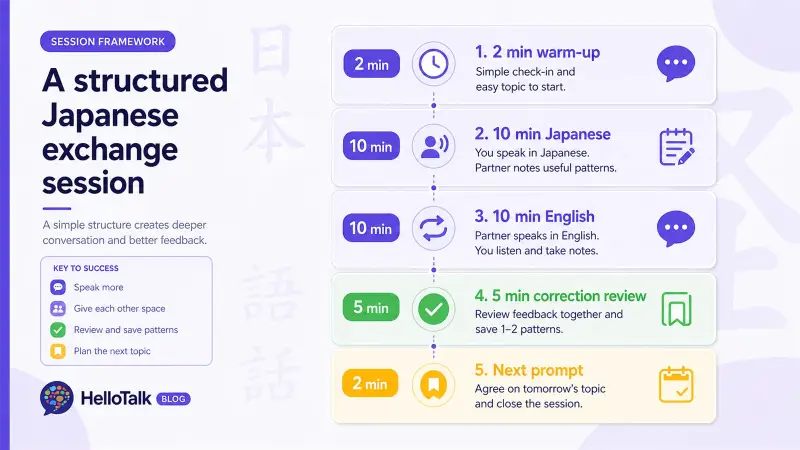
Before your first session, agree explicitly: 25 minutes Japanese, 25 minutes English, plus a few minutes of setup and wrap-up. This has to be agreed in advance, not negotiated in the moment, because in the moment, whoever speaks the stronger language will unconsciously dominate. If you're at B1 Japanese and your partner is at B2 English, the path of least resistance in a free-flowing conversation is almost always English. The upfront agreement protects both parties.
Use a topic or task structure
Free conversation is hard for intermediate learners because it requires real-time grammar generation under social pressure. A topic gives you scaffolding. Before each session, send your partner one or two subjects you'd like to discuss, something simple at first (your weekend, a show you're watching, food you've been cooking) and more complex as you advance (your job, a news story, something you find confusing about Japanese culture). The topic primes relevant vocabulary before you start, which makes the conversation less punishing.
An alternative to topic-based conversation is task-based exchange: describe a picture, explain a process, roleplay a scenario (ordering at a restaurant, apologizing for a mistake at work). These feel more like games and less like tests, and they naturally push you into vocabulary ranges you wouldn't reach in open conversation.
Give and receive corrections properly
The default for most exchange partners is to avoid correcting each other, it feels rude, it interrupts flow, and it can make the whole thing feel like a class rather than a conversation. But correction is the point. Without it, you can exchange for months and consolidate errors rather than eliminate them.
Agree on a correction method at the start. Options: write corrections in the chat while talking (clean and non-disruptive), note errors and discuss them in the last five minutes of each language block, or use HelloTalk's built-in correction feature which lets your partner annotate your messages directly without derailing the conversation.
Equally important: receive corrections graciously. When a partner corrects your particle use or your keigo, repeat the correct form out loud, note it somewhere, and use it again before the session ends. The correction isn't worth anything if it sits in a chat log you never review.
End with a vocabulary takeaway
The last two minutes of the Japanese block: ask your partner for three new words or expressions you could use next time. Write them down, study them before your next session, and try to use them in context. Over ten sessions, that's thirty expressions pulled directly from natural conversation, higher-value than random Anki deck vocabulary because each one carries a memory of where it came from.
A 30-Minute Japanese Exchange Session Template
If the above feels abstract, here's a concrete version sized for a 30-minute session, adjusted for Japanese-specific considerations like register shifts and pitch accent feedback:
| Time | Language | Activity | Japanese-specific note |
|---|---|---|---|
| 0–3 min | Both | Casual warmup — what happened this week | Use plain form (タメ口) if your partner signals comfort; otherwise 丁寧語 as default |
| 3–15 min | Japanese | You lead a topic; partner responds naturally | Ask partner to note register errors and pitch issues — not to interrupt, just log |
| 15–17 min | Switch | Partner shares the top 2 corrections from your block | Repeat the correct forms aloud; ask why if the correction involves register choice |
| 17–27 min | Your native language | Partner leads; you respond and correct naturally | Model the casual/formal shift your partner is learning |
| 27–30 min | Both | Each names 1 expression learned today; confirm next session | Write down your expression now — retention drops sharply after 10 minutes |
The register note in column 4 is the part most session templates skip. Japanese politeness levels are a live social negotiation, not a grammar rule, watching when and how your partner shifts is some of the most valuable input you can get from exchange that no textbook delivers.
Using HelloTalk's Tools to Make Japanese Exchange Actually Stick
The challenge with any language learning habit is maintenance. The sessions that feel great in week one start feeling like obligations in week six. HelloTalk's ecosystem is useful here because it gives you multiple entry points into Japanese practice that don't all require the high investment of a scheduled video call.
Voicerooms for passive immersion
One of the barriers to Japanese fluency is sheer listening volume. To develop an ear for natural speed and natural rhythm, you need hours of exposure, more than most people can get through anime or podcasts alone. HelloTalk's 24-hour Voicerooms run continuously, often in Japanese, and you can join as a listener while doing something else. Cooking, commuting, doing laundry, you're in a room where Japanese speakers are talking to each other, and you're absorbing patterns and expressions without having to perform. Over time, this shifts your baseline for what natural Japanese sounds like.
Moments for low-pressure written practice
The Moments feed is a social layer where users post short written content, a sentence, a paragraph, a question, a photo with a caption, and the community corrects and comments. For Japanese learners, this is a low-stakes way to practice written Japanese daily without scheduling a call. Write something in Japanese, post it to Moments, and within a few hours you'll typically have corrections from native speakers. Do this every day for a month and you've generated thirty corrected writing samples, which is a meaningful corpus for self-review.
AI Grammar Correction and Pronunciation Assessment
For specific drilling between sessions, HelloTalk's AI tools fill gaps that even a good exchange partner can't always address. Grammar Correction lets you draft a Japanese sentence and see whether it's correct before you send it, useful for building confidence in written messages. Pronunciation Assessment gives you real feedback on how your Japanese sounds, measuring accuracy against native-speaker norms. This is especially relevant for pitch accent work, where you need precise feedback that a non-specialist conversation partner can't always provide consistently.
Translation and Voice-to-Text
When a native speaker sends you a message containing kanji you don't recognize or expressions you haven't seen, the in-app translation (covering 190+ languages) lets you understand it without leaving the app and losing conversational momentum. Voice-to-Text lets you send Japanese voice messages that are automatically transcribed, which means both you and your partner can hear how you sound and read what you said in the same message, making self-correction easier.
The Exchange Partner Red Flags, and What Good Looks Like
Not every Japanese speaker who signs up for a language exchange app wants the same thing you want. Some are genuinely committed to structured exchange. Others want to make friends, practice English without reciprocating, or collect contacts without following through. Knowing the difference early saves you weeks of frustration.
Red flags to watch for
When a potential partner responds only in English from the start, even after you've written in Japanese, take that as a signal about where their priority is. Some learners are self-conscious about their English and feel embarrassed to write in it, that's different, and usually they'll explain. But a partner who consistently defaults to English when Japanese is harder for them is unlikely to hold up their end of the exchange over time.
Watch for response patterns that suggest they're treating the exchange as a casual chat rather than a language project. If they take four days to respond to a three-sentence message, that may mean they're not invested enough for a structured exchange. Long delays are fine for asynchronous Moments-style correction, but not for a back-and-forth session partner.
Also be cautious of partners who only want to talk about topics that happen to be in their conversational comfort zone in English. An exchange that only ever covers entertainment, Netflix shows, and pop culture is pleasant but limited, because those topics don't push you into the professional vocabulary, the polite expressions, or the situational language you actually need.
What good looks like
A strong Japanese exchange partner is proactive about giving corrections, they'll mark up your messages not to be critical but because they know that's the actual help you need. They're honest about what sounds natural and what doesn't, including when your technically correct Japanese sounds too formal or too stiff for the context.
Good partners also show curiosity about your learning goals. They ask where you're at, what you're finding hard, what you're hoping to do with Japanese, and they adjust accordingly. A partner who understands that you're preparing for JLPT N2 will focus differently than one who knows you're trying to hold a casual conversation with your partner's family.
When you find someone like this, protect the relationship. Show up to scheduled sessions, give corrections of equal quality to the ones you receive, and express genuine interest in their English progress. The best exchange partnerships are friendships with a learning structure on top.
What to do when momentum drops
Every long-term exchange goes through a quiet period. Someone gets busy, sessions get rescheduled and never rebooked, messages go unanswered. This is normal. What matters is whether there's a re-entry point.
Keep the conversation warm during gaps by sending low-effort messages in Japanese, a photo with a caption, a question about something you read, a reaction to something in the news. It takes less commitment than scheduling a call and keeps the channel open. If a partner has gone fully silent for three or four weeks, a simple "まだ練習してますか?" (are you still practicing?) is enough to either revive the exchange or get closure so you can find a new partner without guilt.
Comparing Japanese Exchange Platforms
| Platform | Japanese User Pool | Exchange Features | AI/Correction Tools | Free to Use | Best For |
|---|---|---|---|---|---|
| HelloTalk | Very large (70M+ global) | Full — matching, chat, voice, Moments, Voicerooms | Yes — Grammar, Pronunciation, Translation | Core free | All-in-one exchange + immersion |
| Speaky | Small–medium | Basic chat matching | No | Free | Simple partner matching |
| italki | Large (tutors) | Tutor marketplace, not exchange | No | Paid per session | Structured lessons |
For Japanese specifically, platform scale matters more than for most exchange languages. The bilateral nature of exchange, you need Japanese speakers who want to learn your native language, not just Japanese speakers, means that the larger the platform's Japanese user base, the better your odds of finding a well-matched partner at your level, your schedule, and your area of interest. HelloTalk's Japanese-learning community is large enough that you can filter by JLPT goal, by interest (anime, J-pop, travel, business), and still have genuine options within a few hours. On smaller platforms, that specificity collapses, you take what you can get.
The Voicerooms are also disproportionately valuable for Japanese learners specifically. Pitch accent and natural speech rhythm are things that reading practice cannot give you, you need listening volume from real speakers at real speed. Dropping into a Voiceroom for twenty minutes a day is one of the few ways to build that exposure without buying a plane ticket.
For a full comparison of exchange platforms across seven apps, see the best language exchange apps guide.
FAQ
What level of Japanese do I need before starting language exchange?
You can start earlier than you think, but not with nothing. A useful minimum is being able to construct simple sentences in present tense, introduce yourself, ask basic questions, and understand simple written responses. That puts you somewhere around A2 on the CEFR scale, or the equivalent of finishing the first volume of a standard beginner course. You don't need to be fluent; you need enough to keep a conversation moving, even slowly. If you're still in the very early stages, the guide on how beginners learn Japanese fast might help you get to exchange-ready level before you start.
How do I handle keigo, should I use honorific Japanese with my exchange partner?
Generally, no. Exchange relationships are casual and personal, so plain form or polite form (desu/masu) is appropriate, not keigo. That said, it's worth telling your partner that you want to practice keigo in context, and asking them to use it with you occasionally or to roleplay scenarios where it would naturally come up (a job interview, a formal email, a first meeting with someone senior). Keigo is best learned through exposure to real examples, not drills, so asking your partner to demonstrate it in natural situations is one of the best uses of exchange time.
How often should I practice with my exchange partner?
Once a week for a dedicated session is a solid baseline that most people can sustain without it becoming a burden. If you can do twice a week, the gains accelerate meaningfully. Below once a week, you'll tend to spend the first part of each session reconstructing context from last time rather than building on it. Supplement your weekly session with daily low-effort touchpoints, a message, a Moments post, a few minutes in a Voiceroom, and you'll find that the scheduled session is more productive because you've been keeping the language active in between.
What do I do if my exchange partner stops responding?
Wait a reasonable amount of time (five to seven days), then send one low-key follow-up message in Japanese, something friendly and non-pressuring. If there's still no response after another week, move on without guilt. Partner ghosting is extremely common in language exchange, not because people are inconsiderate but because life gets busy and the app notification gets buried. The right response is to actively maintain two or three partner relationships at any given time, so that when one goes quiet, you're not starting from zero. HelloTalk's large user base makes finding a replacement partner relatively fast.
Can language exchange replace Japanese classes entirely?
For some people at some stages, yes. If you're already at intermediate level and your main gap is spoken fluency, real-world vocabulary, and listening comprehension, a well-structured exchange practice can be more effective per hour than classroom study. But for true beginners, exchange without any structural grammar foundation is very hard, you won't know what you're getting right or wrong, and your partner won't always be equipped to teach grammar systematically. The best setup is usually classes or structured self-study for grammar and writing, with exchange filling the conversation and listening gaps that structured study can't cover.
How can I practice kanji through language exchange?
More directly than you might think. Ask your partner to write to you in natural, unassisted Japanese, no dumbing down for your level. When you encounter kanji you don't recognize, note them and look them up after the conversation. This gives you kanji in genuine context, which is more memorable than textbook lists. You can also ask your partner to send you photos of things they see, a menu, a sign, a product label, and practice reading them together. For writing practice, post Moments in Japanese using kanji you've recently learned and ask native speakers to correct your usage. The combination of reading in natural messages and writing in a corrected context builds kanji competence faster than isolated study.
Start Building Your Japanese Practice Today
Closing the gap between the Japanese in your head and the Japanese people actually speak is a specific problem with a specific solution: consistent, structured exposure to native speakers who are invested in helping you improve. That's what language exchange, done properly, provides.
The mechanics are repeatable: find a partner whose goals match yours, agree on structure upfront, show up consistently, and use every tool available to you, correction features, passive immersion, AI pronunciation feedback, to make the hours you invest compound over time.

HelloTalk gives you the infrastructure to make all of this easier: a large, active community of Japanese native speakers who are learning English, built-in tools for correction and pronunciation assessment, and 24-hour Voicerooms for the passive immersion that most learners don't get nearly enough of. It's free to start, and the Japanese speaker community is large enough that you can usually find a well-matched partner within a day or two of setting up your profile.
If you're ready to move from studied Japanese to spoken Japanese, start at www.hellotalk.com.
The conversation is already happening. You just need to join it.