Korean Speaking Practice 2026: Methods That Get You Talking With Native Speakers
You had the line rehearsed. You'd heard it a hundred times in the drama, that casual, confident way the characters greet each other, the rhythm of it, the vowels. You typed it into the chat, hit the voice message button, and said it out loud.
Then the silence.
Then the reply: "Haha, why do you sound like a news anchor?"
That's the moment most Korean learners hit and don't know what to do with. You spent months learning to read Hangul, grinding vocabulary, getting through grammar explanations. And then a native speaker replies at normal human speed, drops the formal endings, slides into dialect or slang, and you realize the Korean you've been practicing and the Korean people actually speak are two very different things.
The gap isn't a failure of effort. It's a failure of method. Studying Korean and speaking Korean are not the same activity, and for most learners, the methods they use optimize for reading and recognition while leaving speaking almost completely untrained.
This guide is about fixing that. These are the speaking practice methods that actually close the gap: specific, practical, and designed around one simple principle. The only way to get better at speaking Korean is to speak Korean with people who speak it natively.
Why Korean Speaking Practice Is Harder Than It Looks
Before you can fix the problem, it helps to understand why Korean speaking specifically is such a wall for learners from English and most European language backgrounds. It isn't just that Korean is "hard." There are specific features of spoken Korean that create friction at every stage of practice.
Speech levels are not optional. Korean has a formal register (합쇼체, hapjoche) and a casual register (해요체, haeyoche), plus the informal plain speech (해체, haeche) used with close friends or to people younger than you. Most textbooks and language courses teach formal speech first because it's safer, you won't accidentally offend anyone. But native Koreans under 30 talking to each other don't use formal speech in casual conversation. If you've been drilling formal endings, you sound stiff the moment you try to have an actual conversation. And if you jump into informal speech without understanding the social rules, you risk coming across as rude.
This is not a problem you can solve with a vocabulary app. It requires exposure to real conversations at different levels of formality, and ideally, someone who can tell you when you're using the wrong register for the situation.
Consonant clusters and tensed consonants are physically demanding. Korean has a series of consonant pairs that don't exist in English: the plain/aspirated/tensed distinction (ㅂ vs ㅍ vs ㅃ, for example). The tensed consonants in particular require a different configuration of the throat and vocal cords than anything in English. You can understand the difference intellectually for months without your mouth being able to produce it reliably under pressure. The only fix is repetition with feedback, and silent study gives you neither.
Spoken Korean at native speed is heavily contracted. Written Korean and textbook Korean maintain clear word boundaries. Spoken Korean does not. "지금 어디에 있어요?" in real speech often sounds like "지금 어디 있어?" or faster, something closer to "지금어디있어?", the syllables blend, endings drop, and formality markers disappear. Learners who have practiced from textbooks and apps are often not recognizing the words they technically know because they've only ever heard them at demonstration speed.
There's no Latin alphabet to fall back on. Romance language learners can often guess at words from context based on roots they half-recognize. Korean vocabulary, outside of loanwords from English, shares almost nothing with European languages. When you're in a conversation and a word you don't know comes up, you don't have a structural net to catch you. You have to ask, or guess from context, or go silent, and going silent in a conversation is its own discouraging feedback loop.
None of these challenges are reasons to avoid speaking practice. They're exactly why speaking practice needs to start earlier and be more intentional than most learners make it.
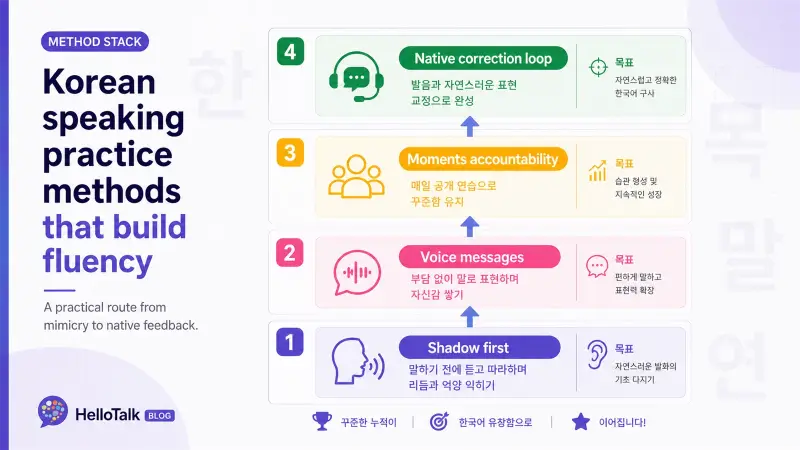
Method 1 — Shadow and Mimic Before You Produce
The most common mistake in Korean speaking practice is starting with production before you've built sufficient input. You sit down with a native speaker for a language exchange, try to have a conversation, and spend most of the session apologizing for not knowing a word, which doesn't improve your speaking, only your ability to apologize in Korean.
Shadowing changes this. The basic method: find a piece of native Korean audio, a podcast, a drama scene, a YouTube vlog, and repeat it at speed while listening. Not after. During. You're not translating or analyzing; you're training your mouth to move in Korean-shaped patterns.
The specific protocol that works:
- Choose a clip between 30 seconds and two minutes. Something with relatively natural speech, not a news broadcast, but also not a variety show where everyone is talking over each other.
- Listen through once without stopping. Don't try to understand everything. Just let the rhythm land.
- Play it again and whisper-shadow. Let the sounds move through you without worrying about whether you're getting the meaning.
- On the third pass, shadow at full voice. Focus on matching the speaker's pace and intonation, not on perfect pronunciation.
- Repeat with the same clip for three to five days before moving on. The goal is internalization, not novelty.
The reason this works is that it bypasses the conscious translation loop that slows most learners down in real conversation. After enough shadowing practice, certain phrases and rhythms become automatic, they come out before your brain has finished deciding whether to say them.
For daily input, this is where live native audio becomes essential. HelloTalk's 24-hour Voicerooms host ongoing conversations in Korean around the clock: travel, music, daily life, study sessions, language exchange rooms. You don't need to speak. You can drop in and listen for ten minutes while getting ready in the morning. That's not passive, that's building the ear for real-speed Korean that makes shadowing practice meaningful.
The combination works: shadow structured content in your own practice time, and supplement with Voiceroom listening to expose your ear to the unscripted patterns of how Korean speakers actually talk.
Method 2 — Voice Message Exchange Over Live Calls
Most learners, when they think about speaking practice, picture a video call: two people, face to face (or screen to screen), trying to hold a conversation in their target language. It sounds right. It's also, for most beginners and intermediate learners, inefficient and discouraging.
Here's what happens on a video call when you're not fluent: you feel pressure to respond immediately. The pause while you're searching for a word feels enormous. You lose confidence, start speaking more slowly than you can think, and spend more time managing anxiety than actually practicing. At the end of thirty minutes, you've produced maybe fifty sentences and experienced a lot of stress.
Voice messaging works differently. You record a message. You can re-record it if you genuinely freeze up. You send it. The other person listens, thinks about how to respond, and sends back. The conversation moves forward, but the pressure of synchronous response is gone. What you get instead is the deliberate practice loop: you think about what you want to say, you say it, you hear yourself, and you get feedback.
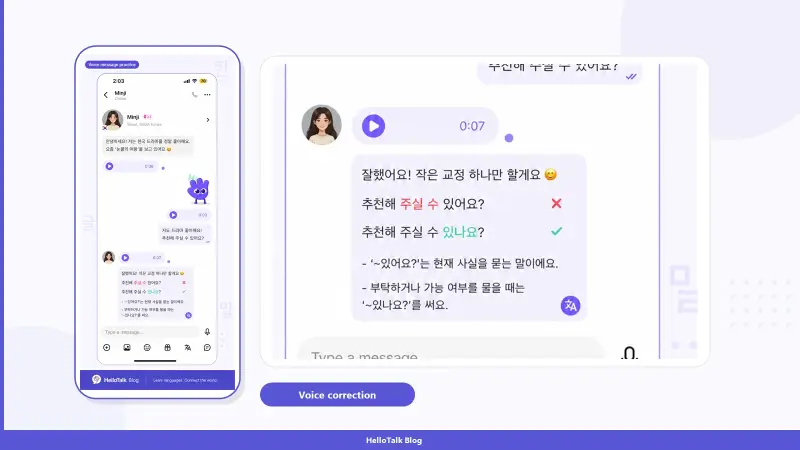
The feedback piece is what makes this more than just talking to yourself. On HelloTalk, native Korean speakers can leave corrections directly on your voice messages. Not vague encouragement, specific edits. "You said 가고싶어요 but in this context 가고 싶다 sounds more natural" or a corrected pronunciation of a word you're struggling with. That correction gets attached to the message you sent. You can replay it, compare, and hear the difference.
This is genuine language exchange mechanics: you're practicing Korean, they're practicing English (or whatever your native language is), and both people are getting real correction from native speakers rather than AI approximations. For the full framework on how language exchange works, session templates, partner screening, and keeping the exchange going long-term, the complete language exchange guide covers the foundations.
A practical starting structure for voice message exchange:
- First exchange: Introduce yourself in three or four sentences. Your name, where you're from, why you're learning Korean, one thing you like about Korean culture. Keep it simple, you're establishing the relationship and setting a comfortable level of difficulty.
- Second exchange: Ask a question about their daily life. Something genuinely interesting to you. Koreans are often curious about how learners think about Korean culture, so questions about what confused you or surprised you tend to generate good conversation.
- Third exchange onward: Try to match the formality level they're using. If they shift from formal to casual, follow that. If you're unsure, ask, native speakers generally appreciate that you're paying attention to register.
One thing to manage: don't overcorrect your voice messages into something unnatural. The goal is to speak slightly above your comfort level, not to produce a perfect script. The imperfect messages are where the real learning happens.
Method 3 — Use Moments as a Daily Accountability Loop
There's a specific kind of practice that doesn't get talked about enough: public, low-stakes output. Not a conversation, not a formal exercise, just saying something in Korean, in a real space where real native speakers might see it.
HelloTalk's Moments feature is a social feed where learners post text, audio, and video in their target language. The feed is populated by learners and native speakers across the platform's 70M+ user community. When you post something in Korean, a voice recording, a short video, a written post, native Korean speakers can react to it, comment on it, and correct it.
Why does this matter for speaking practice specifically? Because it changes the emotional texture of production. Speaking in a one-on-one language exchange carries the weight of performing for an audience. Speaking into a Moments post is lower stakes, more like writing a journal entry, except someone might respond and correct you, and that correction is attached to something you created.
A sustainable Moments practice for Korean speaking:
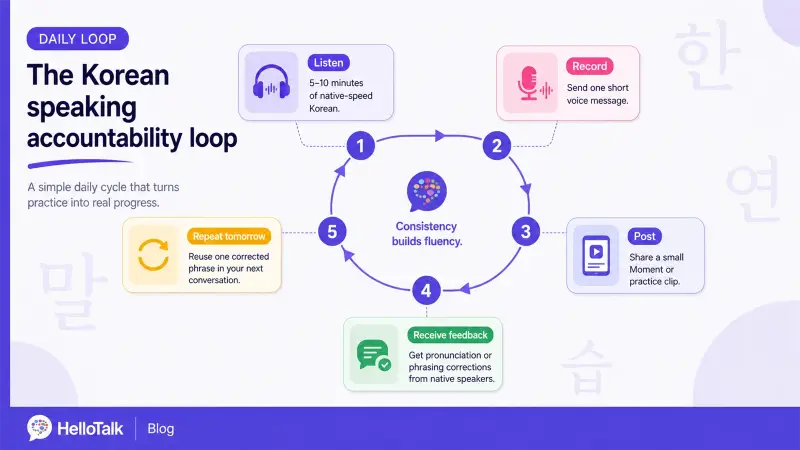
Record a daily 30-second audio post. Don't write a script. Decide on a topic (what you ate today, a Korean word you learned, something you noticed about Korean speech), think about it for sixty seconds, and record. Post it as-is.
The point is not polish. The point is that you produced thirty seconds of Korean today, native speakers heard it, and some of them will correct the parts that are wrong. Over a month of daily posts, you accumulate thirty corrections. That's thirty specific improvements to your spoken Korean that came from actual native speakers responding to actual things you said.
Respond to other learners' Korean posts in Korean. This sounds obvious, but most learners use Moments as a passive scroll. Commenting in Korean, even just "저도 그렇게 생각해요" (I think so too), is production. It's a sentence. It's real.
Use the AI Grammar Correction tool before you post text. HelloTalk's built-in AI can flag grammar errors before you send. For speaking posts, the Pronunciation Assessment tool gives you feedback on how accurately you're producing specific sounds. Neither of these replaces human feedback, but they handle the basic errors quickly so that the native speakers correcting you are focused on natural expression rather than fundamental mistakes.
The accountability mechanism is what makes Moments underrated. When you post publicly every day, there is social pressure, gentle, benign social pressure, to keep going. You build a posting streak. You have followers who have commented before. The cost of stopping is slightly higher than the cost of continuing, and that framing helps on the days when motivation is low.
Which Method Works for You
The three methods above aren't sequential, you don't have to finish one before starting the next. But different learners at different stages get different mileage from each. A quick guide:
| If you… | Start with |
|---|---|
| Freeze the moment you open your mouth | Method 1 (Shadowing) — train the sounds and rhythm before adding conversational pressure |
| Already talk but keep making the same errors | Method 2 (Voice messages) — correction arrives in the exact context where you made the mistake |
| Can hold a conversation but struggle to stay consistent | Method 3 (Moments) — the daily post becomes the anchor that keeps the habit alive |
| Using formal Korean everywhere, including with friends | Method 2 + 3 combined — native speakers will naturally model and correct your register in real exchanges |
Most learners benefit from running all three in parallel once they've tried each once. The shadowing provides the input; the voice messages provide corrected output; the Moments create the daily minimum. Together they cover the full production cycle.
Building a Korean Speaking Habit That Survives the First Month
The first three weeks of a new speaking practice routine are the hardest. Not because Korean is impossible, because speaking a language you're still learning is embarrassing, and embarrassment is a powerful reason to stop.
Here is what actually happens in the first month:
Week one: Everything is awkward. Your voice messages are stilted. You're re-recording sentences four times. You feel like you're not producing anything worth sending. Send it anyway. The native speaker on the other end has heard everything. They're not judging you.
Week two: You start to notice patterns in your mistakes. You say 이에요 when you should say 이야. You always drop the 은/는 subject marker when you're thinking fast. The corrections are starting to cluster, which means you're starting to see where your actual gaps are.
Week three: You hit the wall. The novelty has worn off, a language exchange partner cancels, you miss two days and wonder if you should just start over. This is where most learners stop. The learners who make it past this point are not more motivated, they just have a system that doesn't depend on motivation.
The system that works:
Time-box your practice, not content. "I will practice Korean speaking for fifteen minutes a day" is a better commitment than "I will have one conversation per day." Fifteen minutes is achievable. On bad days, it can be three voice messages. On good days, it can be a forty-minute Voiceroom session. The box stays fixed; what goes in it can vary.
Stack it onto something you already do. Listen to a Korean Voiceroom while commuting. Record a Moments post while you're making coffee. The habit doesn't need its own dedicated slot if it can ride inside an existing one.
Keep a short correction log. After each session, write down one specific correction you received. Just one. Over thirty days, you have thirty specific things you've improved. This is disproportionately motivating on the days when you feel like you're not improving.
When you miss a day, make the next day's practice take exactly five minutes. One voice message. One Moments post. Re-establish the habit at the lowest possible friction before going back to normal. The learners who maintain streaks are not the ones who never miss, they're the ones who recover quickly when they do.
For a broader overview of learning Korean efficiently across reading, writing, and listening as well as speaking, the learn Korean fast and easily guide covers how speaking practice fits into a full learning system.
How HelloTalk Compares for Korean Speaking Practice
| HelloTalk | Duolingo | Pimsleur | Busuu | iTalki | |
|---|---|---|---|---|---|
| Native speaker interaction | ✓ Real exchange | ✗ Script matching | ✗ Audio prompts only | Limited (peer writing feedback, not real-time speaking exchange) | ✓ Paid tutors |
| Speech level exposure | ✓ Casual + formal, modeled live | ✗ Formal only | ✗ Limited register | No (course-based, no casual speech modeling) | ✓ Depends on tutor |
| Daily friction | Low | Very low | Low | Low | High (cost + scheduling) |
| Best role | Daily practice across all modalities | Hangul + vocab foundation | Early pronunciation habits | Structured grammar and vocabulary course alongside exchange practice | Structured targeted feedback |
HelloTalk has been featured on the iOS App Store Today section in South Korea, giving it recognition across both major app platforms in the Korean market.
iTalki
iTalki connects learners with paid tutors and community members for video sessions. For Korean specifically, a tutor session on iTalki can be valuable for structured TOPIK preparation or targeted grammar instruction. HelloTalk is not a replacement for that. But HelloTalk gives you daily practice access, voice messages, Voicerooms, Moments, without scheduling or payment. The learners who improve fastest tend to use both: structured tutor sessions for intensive feedback, HelloTalk for daily volume.
If you're learning Japanese alongside Korean, the same exchange principles apply — the Japanese language exchange guide covers how to structure native speaker practice for Japanese. The same logic extends to Mandarin Chinese, where tonal correction makes native speaker feedback even more essential than it is for Korean.
If you're curious how Korean exchange dynamics compare to other language communities, the best Spanish language exchange apps guide is a useful reference for how exchange patterns differ across languages.
FAQ: Korean Speaking Practice
What level do I need to be before I start speaking practice with native speakers?
Earlier than you think. If you can read Hangul and you know fifty words, you can have a simple exchange. The barrier to starting is psychological, not technical. Native speakers on language exchange platforms are expecting learners at all levels, the majority of them were language learners themselves and have patience for beginners. The practical floor is: can you introduce yourself in Korean? If yes, you can start. If not, spend two weeks learning basic phrases and Hangul, then start.
How do I know which speech level to use with my language exchange partner?
Start formal (해요체) with everyone. It's the safe default and no native speaker will be offended by it. As the relationship develops and the conversation becomes more casual, you'll often notice your partner shifting to less formal speech, that's your cue to follow. If you're unsure, ask directly: "제가 반말 써도 될까요?" (Is it okay if I use informal speech?). Native speakers genuinely appreciate learners who think about this, it shows cultural awareness.
Can HelloTalk help me prepare for the TOPIK speaking test?
TOPIK II includes a spoken component (TOPIK Speaking is separate from TOPIK I/II written tests and delivered as OPIC or through some Korean institutions). For general TOPIK preparation, consistent voice message practice on HelloTalk builds the fluency and response speed the tests require. The correction feature helps you catch formal register mistakes, which matter significantly in test contexts. For structured TOPIK prep with rubric-based feedback, combining HelloTalk with a tutor who specializes in test preparation is the strongest approach.
How do I stay consistent when I'm not seeing obvious progress?
Progress in speaking is non-linear. You will plateau for two or three weeks and then suddenly notice that a conversation is easier than it was a month ago. The indicator that you're improving is not how fluent you feel, it's the frequency and specificity of corrections you receive. When corrections become less frequent, that means you're making fewer obvious errors. When they become more subtle (register, naturalness, nuance rather than grammar), that means you've moved up a level. Keep the correction log mentioned earlier and revisit it weekly.
What features on HelloTalk are free for Korean speaking practice?
The core features, chat-based language exchange with native Korean speakers, voice messaging, corrections from native speakers, Moments posting, and Voiceroom access, are available on the free tier. AI Grammar Correction, Pronunciation Assessment, and Translation (covering 190+ languages) are available through the app. HelloTalk has been downloaded by learners across 200+ countries and was featured on the Google Play global homepage in 2024.
How do I find a good Korean language exchange partner, not just any partner?
Filter by activity level first, partners who have been active in the last 24 hours are much more likely to actually exchange. Then look at their profile: do they list specific interests? Do they have a profile that suggests they've put effort in? Send a voice message introduction rather than a text one, voice messages self-select for partners who are serious about the exchange, because they require more effort to reply to. Mention something specific about why you want to practice Korean (a drama you're watching, a trip you're planning, a Korean friend you want to speak with). Specificity attracts specificity.
Start Talking
That moment in the chat, where you sent the drama line and got "you sound like a news anchor" back, that's not a failure. That's the exact gap that speaking practice is designed to close. The Korean you learned from textbooks and drills is real knowledge; it just needs to be connected to the Korean that people actually speak, at actual speed, with actual native speakers.
The methods in this guide are not complicated. Shadowing builds your ear and your mouth. Voice message exchange builds your ability to produce real Korean with real feedback attached. Moments builds the daily habit of output without the high stakes of a live conversation. And all three of them compound, the more you practice, the more corrections you accumulate, the more natural your Korean becomes.
The one thing that doesn't work is waiting until you feel ready. You will not feel ready. The readiness comes from doing the thing.
HelloTalk has 70M+ users across 200+ countries, and a significant portion of them are Korean native speakers who are learning English, looking for exactly the exchange you're looking for. The platform has every tool you need: voice exchange, Voicerooms, Moments, AI pronunciation and grammar feedback, and a community large enough that you can find a partner at your level and your schedule.
Start at www.hellotalk.com, record an introduction, post it to Moments, and see what comes back.
The conversation is already happening. You just have to show up to it.