
How to Learn Mandarin Chinese 2026: The Social Method That Beats Apps and Classes
You've been practicing the word ma for twenty minutes. You know the four tones. You've drilled them on your app until the little streak counter glows a satisfying orange. Then you say it to a native speaker — your colleague, a classmate, someone you met at a language event — and their face does that thing. That small, patient pause before they gently ask, "Did you mean horse or mother?"
That pause is the Mandarin tones problem in concentrated form. You didn't get the tone wrong because you didn't study. You got it wrong because you learned it from a speaker icon and a waveform diagram, not from a real human voice saying it in context, in a sentence, with the natural rhythm of the language underneath it.
This article is about how to learn Mandarin Chinese in a way that solves that problem — not by adding more flashcard repetitions, but by building real conversation into the process from week one. The social learning method works for plenty of languages, but it works especially well for Mandarin, for reasons that go deeper than you might expect.
What Makes Mandarin Genuinely Difficult — And Why It's More Learnable Than You Think
Let's be honest about the difficulty before we talk about the approach. Mandarin Chinese has a real learning curve, and pretending otherwise doesn't help anyone.
The Foreign Service Institute classifies Mandarin as a Category IV language, their hardest tier, estimating roughly 2,200 classroom hours to professional working proficiency for native English speakers. For comparison, Spanish sits at around 600 to 750 hours. That gap is real.
Here's what specifically creates the difficulty:
The four tones (plus the neutral). Mandarin is a tonal language, which means the pitch contour you use when saying a syllable changes its meaning entirely. The first tone is flat and high. The second rises. The third dips and then rises. The fourth falls sharply. The neutral tone is short and unstressed. These aren't subtle variations: mā (mother), má (hemp), mǎ (horse), and mà (scold) are completely different words. A native English speaker's brain isn't wired to process pitch as meaning-carrying information, so building that awareness takes deliberate work.
No alphabet, and a lot of characters. Mandarin written with characters (汉字, hànzì) rather than an alphabet. There's no phonetic connection between how a character looks and how it sounds — you have to learn both separately. Pinyin (the romanization system) helps bridge the gap, but it's a learning tool, not how the language is actually written. To read a newspaper, you need around 2,000 to 3,000 characters. The HSK 6 exam, the highest standard proficiency test, requires knowledge of 5,000+. That's a long-term project.
Grammar that works differently. Mandarin has no verb conjugations. Tense is communicated through time words and context rather than verb endings. Measure words (量词, liàngcí), special counting units you use before nouns, have no real equivalent in English and take time to internalize. The sentence structure for questions, comparisons, and negation follows logic that feels counterintuitive until it suddenly clicks.
So why is it more learnable than people think?
Because the spoken phonology is actually quite manageable once you stop treating tones as an obstacle and start treating them as rhythm. Mandarin has relatively few phonemes compared to languages like Cantonese or Vietnamese. There's no grammatical gender. Verb forms don't change. Most grammar patterns are consistent without the irregular exceptions that make European languages frustrating. And critically, Mandarin is one of the most widely spoken languages on earth, so your opportunities to practice with real native speakers are enormous.
The people who learn Mandarin fastest aren't necessarily the ones with the most hours logged in apps. They're the ones who found a way to get consistent, corrected speaking time with native speakers early.
Why Social Learning Accelerates Mandarin Specifically
Most language learning advice is broadly applicable: find a tutor, practice daily, use spaced repetition. All of that is true. But Mandarin has a few characteristics that make native speaker interaction structurally essential, in a way that doesn't apply to the same degree for, say, French or Portuguese.
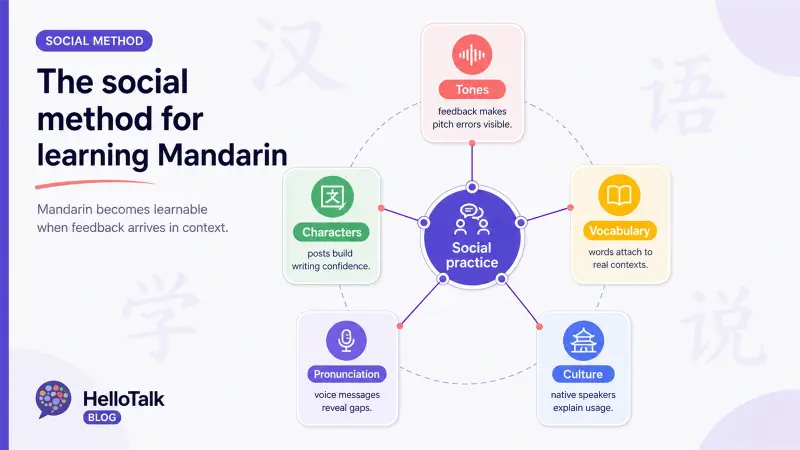
Tones can't be learned from text. This is the core argument, and it's worth sitting with. You can read about the third tone dipping to the low register before rising. You can watch a waveform animation. You can listen to an audio clip of a recorded voice saying mǎ. And none of that will reliably train your ear to hear it correctly in natural speech, in a flowing sentence, with connected speech reductions, with the regional variation of someone who grew up in Shandong versus someone from Guangzhou.
Tone perception and production are motor and auditory skills. They're built through hearing the language in context, thousands of times, from multiple real speakers. A native speaker giving you real-time feedback — "that was flat when it should rise" — teaches you in a way that a pronunciation diagram cannot.
Spoken feedback on tones is irreplaceable. When you type a message to a native speaker and they respond, the interaction is useful for vocabulary and grammar. When you send a voice message and they correct your tones in a voice reply, the learning is categorically different. You hear the difference immediately. You can replay it. You can imitate it. This is the specific mechanism that makes voice-based exchange practice so effective for Mandarin learners.
Cultural context is built into Mandarin vocabulary. More than most languages, Mandarin words carry cultural assumptions that affect how and when they're used. The word 关系 (guānxi) means "relationship" or "connections" but carries specific social implications about networks of mutual obligation that you won't get from a dictionary definition. 吃了吗 (chī le ma, literally "have you eaten?") functions as a general greeting, not a question about hunger. Measure words like 条 (tiáo) for long, flexible things and 本 (běn) for bound objects encode category thinking that's deeply cultural. Native speaker conversation teaches this the way no textbook can.
Correction in real time prevents fossilized errors. Mandarin learners who practice mainly in isolation, with apps, recordings, and self-study, often develop pronunciation habits that fossilize before they're ever corrected. A third tone said slightly wrong for six months becomes very hard to unlearn. Native speakers, especially those motivated to help you learn, will catch these patterns early if you give them the chance.
East Asian language learners often navigate similar challenges around tonal perception and cultural vocabulary. If you're curious about the parallel, the dynamics are explored in detail in our Japanese language exchange guide, where character-based writing and cultural context present their own versions of this problem.
Finding Mandarin Exchange Partners — What to Look For
The language exchange model is simple: you help a native Mandarin speaker practice English (or your native language), and they help you practice Mandarin. Both sides get real conversation practice, neither side pays for a tutor, and the relationship is naturally motivated because each person has something the other wants. For the broader framework on how to structure exchange sessions, evaluate partners, and maintain consistency, the complete language exchange guide applies to Mandarin and any other language.
In practice, the quality of this exchange varies enormously based on who you're practicing with. Here's what makes a good Mandarin exchange partner:
They speak Mandarin as a first language, not as a second. Simplified Mandarin speakers from mainland China will speak standard Putonghua. Speakers from other Mandarin-speaking regions will use Traditional Chinese characters and slightly different vocabulary and phrasing. Both are valuable, but they'll give you different inputs. Know what you want.
They have patience with tonal correction. Not every native speaker is comfortable stopping mid-conversation to explain why your third tone sounded like a fourth. Look for partners who signal they enjoy teaching, or who explicitly want to help you with pronunciation feedback.
Their English level creates a real exchange dynamic. If their English is already fluent, they may not need much help and the exchange dynamic becomes lopsided. The best exchanges happen when both partners are at a similar relative level, so you're both doing actual work to communicate.
They have time for consistency. One great conversation once a month won't move the needle. Multiple shorter sessions per week will. Look for partners whose schedule allows regular contact.
HelloTalk was built around exactly this exchange dynamic. With over 70 million users across 200+ countries and support for 260+ languages, it has one of the largest concentrations of Mandarin native speakers actively looking for language exchange partners. The matching system connects you specifically with native Mandarin speakers who want to learn your language, so the exchange is structured from the start.
This matters more for Mandarin than for, say, Spanish, because the pool of highly motivated, native-level Mandarin speakers who are actively seeking language exchange isn't uniformly distributed across every platform. HelloTalk's size means your chances of finding a good-fit partner, someone who speaks the variety of Mandarin you want, who's patient with beginners, and who's available for regular practice, are substantially higher than on smaller apps or general social platforms.
Daily Practice with HelloTalk — How the Pieces Fit Together
The mistake most Mandarin learners make with language exchange apps is treating them like messaging apps: you exchange a few texts, it doesn't go anywhere, and you feel like exchange practice "didn't work." The platform works when you use it with intention. Here's how each feature maps to specific Mandarin learning needs:
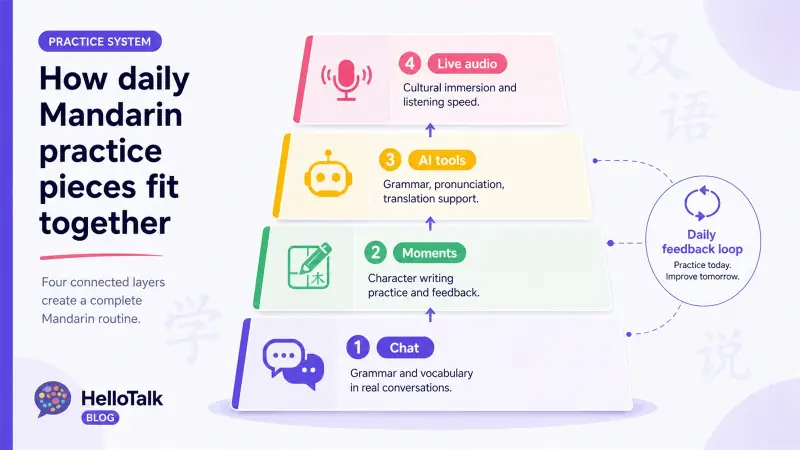
Chat with native speakers for grammar and vocabulary in context. Typing messages in Mandarin and receiving corrections from a native speaker is the fastest way to internalize grammar patterns. HelloTalk's built-in correction tool lets your partner mark exactly what was wrong and offer the corrected version, not a generic "try again" but a specific, annotated fix you can save and study. When you write 我很喜欢你 (wǒ hěn xǐhuān nǐ, I really like you) to mean "I like your idea" and your partner flags it as sounding too personal, you've just learned something no textbook moment would have given you.
Voice messages for tone practice. This is where the real Mandarin-specific benefit comes in. Sending a voice message, even a short one, a sentence or two, and having your partner respond with a corrected version of what you said gives you an immediate, comparative audio reference. You hear your version and theirs. You notice the difference. You try again. This feedback loop, repeated daily, is what builds tone accuracy faster than any app's pronunciation exercises.
Moments for character writing practice. HelloTalk's Moments feature functions like a social feed where you can post status updates, questions, and exercises in Mandarin. The community corrects your posts, often multiple native speakers offering slightly different phrasing suggestions, which gives you a richer picture of natural usage. Posting a short paragraph in characters every day, even simple ones, and receiving corrections builds your writing confidence quickly. It also builds vocabulary because you're choosing words to express real thoughts, not selecting from pre-written options.
Voicerooms for passive tone exposure. The 24-hour Voicerooms feature is underused by beginners who think they need to wait until they're advanced enough to participate. But listening is learning. Joining a Mandarin Voiceroom and spending twenty minutes hearing native speakers talk, about anything, even topics you barely follow, is valuable tonal input. Your ear is calibrating even when your brain isn't tracking every word. Think of it as the equivalent of having Mandarin-language television on in the background, but with the option to ask questions and participate when you're ready.
AI tools for when you're working alone. HelloTalk's Grammar Correction, Pronunciation Assessment, and Translation tools (covering 190+ languages) let you check your work before you send it to a real partner. This is especially useful for Mandarin beginners who feel embarrassed about their level: you can draft a message, run it through grammar check, and then send something you're more confident about. The Pronunciation Assessment gives you a score and feedback on tone accuracy. The Image Translation tool is genuinely useful for Mandarin learners in a specific way: you can photograph a menu, a sign, or a page from a workbook and get instant translations, which bridges the gap between your speaking practice and the written world.
Livestreams for cultural immersion. Native Chinese speakers host Livestreams on HelloTalk covering cooking, travel, music, and sessions designed specifically for learners. Watching these adds cultural context alongside listening practice, and most hosts actively engage with comments, so you can participate in real time at whatever level you're able.
The Mandarin Beginner Roadmap — First 90 Days with Social Practice
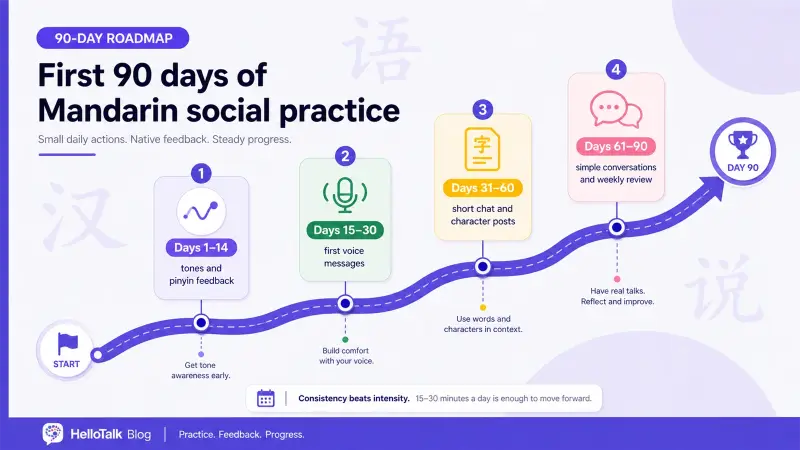
This isn't a rigid curriculum. It's a rough shape of what learning Mandarin looks like when social practice is built in from the beginning, not added later as a "speaking practice" bolt-on.
Days 1–14: Tones first, vocabulary second.
Your first two weeks should be almost entirely about tones and pinyin. Don't rush to vocabulary lists. If your tones are wrong, your vocabulary is wrong: you'll be saying words that mean something completely different, and native speakers will either misunderstand you or politely pretend to understand while getting nothing useful.
Use any structured resource you like, such as a textbook, a YouTube series, or an app, but pair it immediately with HelloTalk. Find a partner in your first week. Your first voice messages don't have to be sentences. They can be syllables. Four tones, demonstrated on one syllable, sent to your partner for feedback. This feels small but it's not: you're building the feedback loop from day one.
Days 15–45: Pinyin + essential vocabulary, first real exchanges.
Once you have a working sense of all four tones, start building vocabulary through themed sets: greetings, numbers, time, family, food, directions. Learn each word in pinyin first, and practice saying it, in voice messages to your partner, before you learn its character. This sequencing matters. Speaking and listening should lead; reading and writing follow.
Your daily routine in this phase: 15 to 20 minutes of structured study (textbook or app), plus at least one voice message exchange with your HelloTalk partner. Even a few sentences. Ask about their day in Mandarin. They correct you. You correct their English. Repeat.
Days 46–75: First real conversations.
By around week seven or eight, if you've been consistent, you'll have enough vocabulary and tone awareness to sustain a simple Mandarin conversation for five to ten minutes. This is the breakthrough moment, not fluency, but genuine communication. You're not just producing memorized phrases; you're constructing sentences in response to what someone actually said.
Start using Voicerooms in this phase. Lurk at first, then participate when you can. The experience of hearing multiple native speakers in the same space, with different regional accents, different speech speeds, and natural interruptions, is something no curated lesson audio provides.
Days 76–90: Characters alongside speaking.
You've probably been picking up some characters passively through your exchanges. Now is when to make character study deliberate. The key is to learn characters that map to words you already know how to say. Don't learn 水 (shuǐ, water) from a flashcard deck before you know what it sounds like: learn it because you've been saying shuǐ for weeks and now you want to recognize it in writing.
Post on Moments in characters. Short sentences, even just "今天天气很好" (jīntiān tiānqì hěn hǎo, the weather is nice today). Get corrected. The character corrections from multiple community members will teach you more about written Mandarin than most workbook exercises.
By 90 days of this kind of consistent, socially-integrated practice, you won't be fluent. No one is fluent at 90 days in Mandarin. But you'll be conversationally functional in a way that people who spent the same 90 days doing apps-only practice typically are not.
How HelloTalk Compares for Mandarin Learning
| HelloTalk | Duolingo | Pimsleur | ChinesePod | italki | |
|---|---|---|---|---|---|
| Tone correction | Native speaker feedback on your actual production | Hear audio, tap answer — no production practice | Audio-first, but one-directional — no feedback on your output | Input only, no speaking practice | Teacher corrects in session |
| Native speaker interaction | Real exchange | None | None | None | Paid tutors |
| Mandarin-specific content | Simplified and Traditional speakers, regional variety | Basic Mandarin course | Mandarin track available | Dialogue lessons by level, strong cultural context | Tutor profiles by dialect and background |
| Daily friction | Low | Very low | Low | Low | High — paid, scheduling required |
| Best role | Daily conversation and tone correction loop | Pinyin and vocab foundation | Early tonal listening habits | Structured dialogue input (pairs well with HelloTalk) | Targeted lessons, HSK prep |
Most serious Mandarin learners end up running a combination: Duolingo or ChinesePod for structured input, HelloTalk for daily spoken practice and native speaker correction. The two aren't competing for the same function. For a full platform comparison, see the best language exchange apps guide.
Frequently Asked Questions
Should I learn Simplified or Traditional Chinese characters?
This depends on your goals. Simplified Chinese (简体字) is used in mainland China, Singapore, and Malaysia, and is what you'll encounter in most Mandarin teaching materials aimed at international learners. Traditional Chinese (繁體字) is used in Hong Kong and other traditional-script regions. If you want to read mainland Chinese media or communicate in the largest Mandarin-speaking markets, start with Simplified. If Hong Kong or Traditional script is your focus, Traditional makes more sense. The spoken language, Mandarin itself, is the same either way. The tones, grammar, and vocabulary are largely identical. HelloTalk connects you with speakers of both, so you can specify in your profile which variety you're focused on.
How do I handle tones during an exchange conversation? It feels embarrassing to be corrected constantly.
Most good language exchange partners are remarkably generous about this. Set expectations explicitly at the start: tell your partner that you specifically want tone corrections, even if it interrupts the conversation. Many learners make the mistake of asking not to be corrected "too much" because they want conversations to flow naturally, but for Mandarin specifically, in the early stages, tone correction is the learning. A good partner will sense your comfort level. If you're using voice messages rather than live voice chat, the dynamic is less awkward because the correction comes after, not during.
Can I start speaking before I've learned to read characters?
Yes, and arguably you should. The speaking-first approach is well-supported in Mandarin learning research and practice. Pinyin gives you a phonetic scaffold to attach to words from the start. Characters can follow once you have a solid spoken foundation, because you'll be learning to write words you already know how to say, which is significantly easier than learning characters with no phonetic connection. Many successful Mandarin learners spend their first two to three months exclusively in pinyin and spoken practice before making characters a focus.
Can exchange practice help with HSK exam preparation?
Yes, though you'll still want some exam-specific prep alongside it. The HSK exams (from HSK 1 through the new HSK 9 framework) test listening, reading, and writing, and for HSK 3 and above, the speaking components are significant. Consistent exchange conversation practice builds the listening comprehension and spoken fluency that the lower and mid-range HSK levels require. For higher HSK levels, you'll want to study the specific vocabulary lists and writing requirements that the exam tests, which exchange practice alone won't systematically cover. But learners who have been practicing conversation regularly typically find the listening and speaking sections far easier than those who have only studied from books.
How long does it take to reach conversational Mandarin?
"Conversational" is a slippery term, but if we mean: able to hold a basic conversation on everyday topics, understand the gist of what a native speaker says to you, and make yourself understood without constant confusion, then the honest answer for a motivated English speaker doing daily practice is roughly 12 to 18 months. With consistent social practice from the beginning, not just app study, learners typically hit basic conversational milestones earlier than the FSI's classroom hour estimates suggest, because native speaker interaction accelerates production skills more efficiently than solo study. Your mileage will vary based on how much weekly time you invest and how consistently you engage with real speakers.
What can I access on HelloTalk for free?
HelloTalk's core exchange features are free: language partner matching, text and voice message exchanges, Moments posts and corrections, participation in Voicerooms, and access to Livestreams. The AI tools, including Grammar Correction, Pronunciation Assessment, Translation (190+ languages), Voice-to-Text, and Image Translation, are available within the app, with certain advanced uses under the premium tier. For a beginner establishing a daily practice routine, the free features are more than sufficient to support consistent, substantive Mandarin learning.
Start Talking — The App Won't Make You Fluent, But the People Will
There's a version of Mandarin learning that looks productive but isn't: a hundred-day streak, thousands of flashcards reviewed, every textbook chapter completed, and still no ability to say nǐ hǎo to a real person without that small, patient pause in response.
The problem isn't effort. The problem is that Mandarin, more than almost any other language on the FSI list, requires real human voices. Tones aren't an abstract concept you master intellectually; they're a physical, auditory skill built through listening and feedback. Grammar patterns don't become intuitive from rules; they become intuitive from saying them wrong a hundred times and being gently corrected by someone who uses them naturally.
The social method works because it addresses what apps and classes structurally cannot: the moment of real communication, with all its ambiguity and correction and small victories. Finding a native Mandarin speaker who wants to learn your language, and building a real exchange practice with them, is the fastest path to actual conversational ability. Not the easiest path. The fastest.
HelloTalk, with over 70 million users and a matching system designed around exactly this exchange dynamic, is where most people will find the best starting point. The platform has been recognized globally, including a 2024 Google Play global homepage feature, because what it enables is genuinely valuable: not another learning gamification system, but actual human connection oriented around language.
If you've been studying Mandarin in isolation, the shift to social learning will feel uncomfortable at first. You'll say things wrong. Your tones will be off. A patient native speaker will correct you. And you'll learn more in that one exchange than in a week of flashcard review.
Start at www.hellotalk.com. Find your first Mandarin exchange partner. Send a voice message. Get corrected. Send another one.
That's how you learn Mandarin.