French Speaking Practice 2026: Daily Routines With Native Speakers That Actually Work
Picture this: you've been studying French for eight months. You've finished two Duolingo courses, worked through a grammar workbook, and you can read a restaurant menu without hesitation. Then you sit down across from an actual French person, maybe it's your partner's colleague from Lyon, maybe it's the woman at the cheese counter in a Paris market, and your mind goes completely blank.
Not a little blank. Totally, painfully blank.
The sentence you want is somewhere in your head. You know the words exist. You've seen them, typed them, probably even said them aloud to yourself in the bathroom mirror. But under the pressure of a real conversation, with someone actually looking at you and waiting, every conjugation you've ever learned dissolves into static.
You manage something. A fractured half-sentence. They smile politely and switch to English.
You smile back and feel that specific, deflating embarrassment of the language learner who studied everything except how to actually speak.
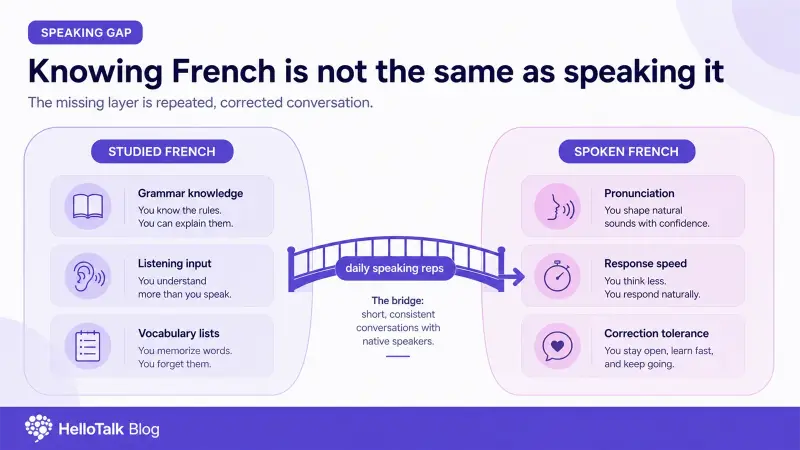
Here's what nobody tells you when you start learning French: reading and listening are passive. Writing is slow. But speaking is performed in real time, under social pressure, with no rewind button. It's a completely different skill, and the only way to build it is by doing it, repeatedly, with real people, until your brain stops treating French like a translation problem and starts treating it like a language you actually live in.
This article is about how to get there. Not through abstract advice, but through a daily practice that's actually sustainable in 2026, one that fits into a regular life, even if you only have fifteen minutes some days.
Why French Speaking Practice Fails for Most Learners
Most people who plateau in French aren't lazy. They're studying the wrong things in the wrong order, or they're studying the right things but never bridging into actual use. A few specific patterns show up again and again.
The grammar-first trap. French grammar is genuinely complex, gendered nouns, subjunctive mood, the difference between imparfait and passé composé, liaisons that change how words sound in connected speech. It's tempting to feel like you need to master all of this before you open your mouth, because speaking "incorrectly" feels embarrassing. But waiting until you're ready is a trap. You will never feel ready. Grammar becomes intuitive through use, not through study. Every native French speaker makes the occasional agreement error. Perfection is not the entry fee for conversation.
Input without output. Podcasts, Netflix shows, YouTube channels in French, these are genuinely useful, and there's real value in immersing yourself in the sound and rhythm of the language. But consuming French is not the same as producing it. Output, actually speaking, forces your brain to retrieve language under pressure. It builds the retrieval pathways that input alone never can. Learners who spend six months listening and reading and then try to have a conversation discover that comprehension and production are stored in different places.
Rehearsed phrases that break down in real conversations. A lot of speaking practice resources teach you scripts. Greetings, ordering at a café, asking for directions. These work fine as long as the other person follows the script. The moment they give you an unexpected answer, or speak faster, or use slang, or take the conversation in a direction you didn't prepare for, the script fails and you freeze. Real fluency isn't about knowing the right lines. It's about being able to improvise, to recover, to ask for clarification without panicking.
No feedback loop. This is the one that quietly kills progress for years. You practice speaking, maybe with an app, maybe by talking to yourself, maybe in a class, but you get no correction, no calibration, no signal that what you're doing is actually landing the way you intend. A French speaker hears your pronunciation and processes it correctly because they're generous; but you never know whether the way you said grenouille was close or genuinely painful. Without honest, specific feedback, you can reinforce errors for months without realizing it.
The anxiety spiral. Speaking a foreign language in front of someone feels vulnerable. You sound childlike. You know what you want to say but can't say it. This triggers a kind of performance anxiety that makes the problem worse, anxiety narrows cognitive bandwidth, and narrowed cognitive bandwidth makes retrieval harder, which increases anxiety. Learners who only practice in high-stakes situations (actual trips to France, formal classes, one-off italki sessions they've been dreading for a week) never get enough low-pressure reps to relax into the language. The stakes need to come down before fluency can come up.
The Shift That Changes Everything
The learners who make real progress share one characteristic: they stopped treating speaking as the final exam at the end of learning, and started treating it as the method of learning itself.
This sounds obvious stated plainly, but it runs against most people's instincts. Speaking feels risky. Speaking feels like you're going to expose how much you don't know. That's exactly why it works. Exposure to the edges of your competence, in low-stakes, high-frequency interactions, is what moves those edges outward.
The word that matters here is frequency. Not length. A thirty-minute formal lesson once a week does less for speaking fluency than ten minutes of relaxed conversation every day. Your brain builds language pathways through repetition under real communicative pressure, not through a single intensive exposure. This is why people who move to France and have to use the language daily, even badly, often make more progress in three months than they made in two years of classes.
The question for most learners is: where do you find that daily exposure when you're not in France and don't have French-speaking colleagues?
This is where the world of language learning apps has genuinely changed. Apps like HelloTalk have built communities of over 70 million learners across 200+ countries, specifically designed around the language exchange model, where you practice French with a native speaker who, in turn, practices English (or your native language) with you. The relationship is reciprocal. Neither person is the teacher; both are learners. That dynamic removes a lot of the performance pressure, because the French speaker across from you is also taking a risk every time they write an English sentence.
What makes this different from just finding a pen pal is the structure around it: native speaker matching by language and interest, tools that let corrections happen in-flow without breaking the conversation, pronunciation feedback, audio rooms where you can listen and drop in without the pressure of being the main speaker. The infrastructure for daily practice exists. The question is how to build a routine around it. For a full breakdown of how language exchange works as a method, session structure, partner evaluation, and how to keep an exchange going long-term, the complete language exchange guide covers the foundations that apply to any language.
Building a Daily Speaking Routine With Native Partners
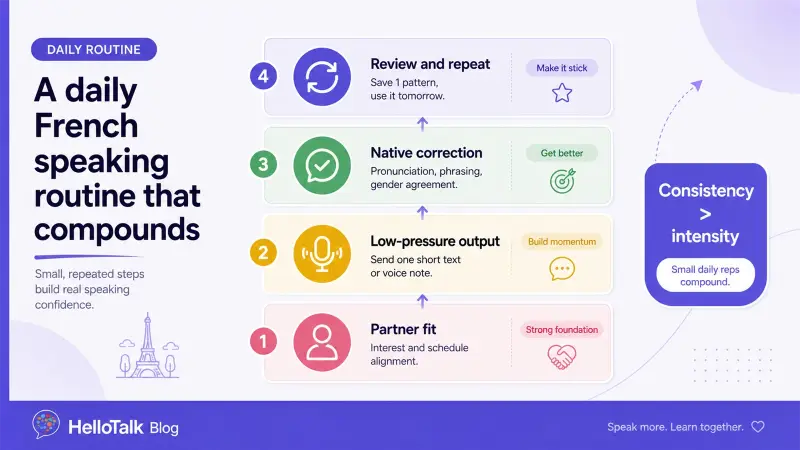
Consistency beats intensity. A ten-minute conversation every morning is worth more than a ninety-minute session every Sunday. Here's how to build a daily French speaking routine that actually holds together.
Start with the matching, not the conversation. The first thing most learners do wrong is trying to start a conversation before they've found the right partners. On HelloTalk, you can filter by native language (French), country (France, Belgium, Senegal, Switzerland, Quebec, French has a remarkably wide geographic footprint), and shared interests. This last part matters more than people think. A conversation about something you genuinely care about, cooking, football, music, cinema, travel, is a hundred times easier to sustain than a conversation about nothing in particular. Your vocabulary around your interests is already partially built. The gaps are smaller.
Take a day or two to find two or three partners you seem to have something in common with. Don't immediately ask for a voice call. Start with text to build familiarity and get a sense of their communication style and patience for helping a learner.
Use Moments as a low-pressure daily habit. HelloTalk's Moments feature is essentially a social feed for language learners, you post short entries (text, photos, audio clips) about your day, your thoughts, something you learned, and native speakers comment, correct, and respond. Think of it as a journal that native speakers can read and react to.
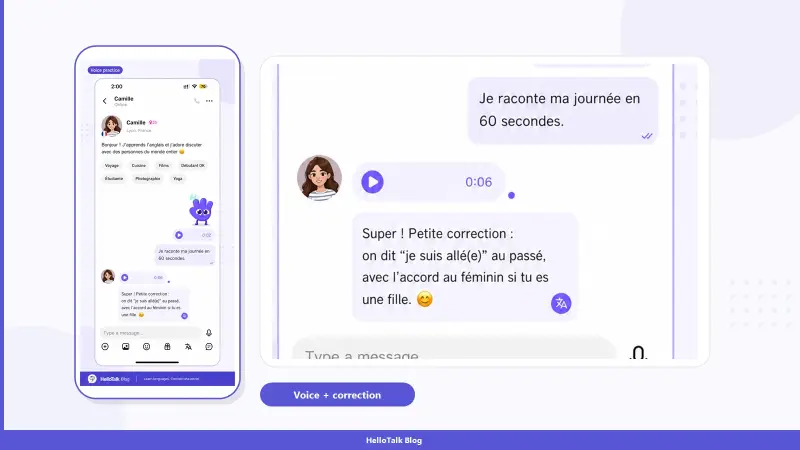
This is genuinely valuable for speaking practice because it builds the habit of daily production without the anxiety of a live conversation. You record a thirty-second voice clip describing what you ate for lunch, in French. A native speaker in Lyon listens, leaves a voice correction on your pronunciation of soufflé, and asks a follow-up question. You respond. This exchange, asynchronous, low-stakes, genuine, is exactly the kind of practice that moves the needle.
Make it a morning ritual. Before coffee, or with coffee, post one Moments entry in French. Audio is better than text for speaking practice. Don't script it. Just talk for thirty seconds about anything.
Drop into Voicerooms for ambient immersion. HelloTalk's 24-hour Voicerooms are themed live audio rooms where speakers gather around shared topics, travel in France, French cinema, cooking, language learning itself. Some are for advanced learners; some are more beginner-friendly. Many run continuously, which means you can join at 7am or 11pm depending on your schedule.
The key insight here is that you don't have to speak to benefit. Listening to authentic French conversation, not scripted podcast French, but people actually talking, with all the stumbles and interruptions and laughter, is enormously useful for your ear. But when you're ready, you can take a turn. The room is already full of people who understand what it's like to be learning a language. The bar for participating is lower than you'd expect.
Commit to joining a Voiceroom at least twice a week. Start as a listener. When you feel the pull to say something, say it.
Build toward voice exchange with your partners. After a week or two of text and Moments exchanges, suggest a voice message exchange with a partner you've connected with. Not a live call yet, voice messages, which you can record, re-record if needed, and send when you're ready. This is a crucial intermediate step between writing and live speaking. You still have to speak spontaneously, but you have the option to redo a message that was truly incomprehensible.
HelloTalk's in-chat translation and grammar correction tools mean your partner can easily understand what you meant even when your French falls apart, and can leave specific corrections without the conversation grinding to a halt. The corrections appear inline, in context. You can tap through them when you're ready, absorb the feedback, and keep going.
Live voice and video exchange comes after this foundation is built. By the time you get there, it won't feel like an exam. It'll feel like a conversation with someone you already know.
When You Only Have 15 Minutes a Day
Life is not always cooperative. Work, family, travel, exhaustion, there are days when fifteen minutes is genuinely all you have. Here's a micro-routine that covers speaking practice without requiring a full session.
Minutes 1-3: Post a Moments entry. Open HelloTalk, tap Moments, record a voice note. Talk for sixty to ninety seconds about anything. Your commute, a thought you had, something you're looking forward to. Don't edit yourself. Post it.
Minutes 3-8: Review corrections from yesterday. Go back to your Moments from the previous day and read through any corrections native speakers left. Don't just acknowledge them, repeat the corrected phrase aloud, two or three times. This active retrieval of corrected material is what makes corrections actually stick rather than sliding off.
Minutes 8-13: Reply to a partner. Send a voice message reply to whoever you've been exchanging with. Keep it focused. Respond to something they said. Ask one question. Don't try to cover everything, brevity is fine.
Minutes 13-15: Skim the Voicerooms. Open the Voicerooms section, see what's active, and listen for two minutes. You're not committing to participate. You're just keeping your ear warm.
That's it. Fifteen minutes of daily French speaking practice that includes production, feedback integration, partner exchange, and ambient listening. On better days, extend the Voicerooms section or turn the voice message exchange into a longer conversation. But even on the worst days, this baseline moves you forward.
The thing about micro-routines is that they stay. A thirty-minute commitment gets skipped on hard days. A fifteen-minute commitment becomes non-negotiable because the friction is so low. Consistency over three months of fifteen-minute daily sessions will outperform a sporadic intensive practice schedule almost every time.
A Sample Weekly French Speaking Schedule
If you want a concrete template to start from, this is what a low-friction weekly practice looks like built around the 15-minute daily structure:
| Day | Format | Task |
|---|---|---|
| Monday | Voice message | Send 3-4 sentences to your partner about your week, no script, just speak |
| Tuesday | Moments post | Write a short paragraph in French, invite corrections from native speakers |
| Wednesday | Voiceroom (listen only) | Drop into a French-themed room for 15 min, build your ear for natural speed |
| Thursday | Voice message reply | Reply to your partner; try to match the register they used with you |
| Friday | Correction review | Re-read the week's corrections; use 2 new phrases you learned in a fresh message |
| Weekend | Flexible | Extend any day's practice, or treat it as rest, the routine doesn't break from two days off |
The table is a starting point, not a prescription. Swap days around to fit your schedule. The structure matters more than which specific task lands on which day.
A routine only works if the resources behind it suit the slot you actually have. That is what a full comparison of French courses, apps, and resources for daily practice is for: it sorts seven picks by the job each does in an ordinary day, and labels the feedback each returns, from automated checking to community corrections, a booked teacher, or an exchange partner.
How HelloTalk Compares
| HelloTalk | Duolingo | Speaky | italki | |
|---|---|---|---|---|
| Native speaker interaction | Real exchange, async or live | Script matching only, no real speakers | Real exchange, basic partner matching | Paid tutors, structured sessions |
| Daily friction | Low, voice messages, Moments, drop-in Voicerooms | Very low, gamified habit loops | Low, easy entry point, though no AI tools | High, scheduling and cost per session |
| Best role | Daily speaking practice home base | Vocabulary foundation before you start speaking | Simple exchange for beginners, though limited depth for serious learners | Targeted lessons to complement daily practice |
One French-specific note: French regional variety is broader than most learners expect. Parisian French, Québécois, and West African French are distinct enough in speed, vocabulary, and some phonology that a partner from Montréal and a partner from Lyon will give you meaningfully different inputs. HelloTalk's filtering lets you specify country of origin, so you can seek out that variety deliberately, or stay focused on one accent while you're building confidence. Duolingo and most course apps give you one standardized accent. The platform comparison table above reflects general exchange dynamics; for the full ranking of seven apps, see the best language exchange apps guide.
Most learners who stick with French long-term use HelloTalk as their daily practice layer and supplement with italki or a tutor for focused feedback. Duolingo can sit alongside HelloTalk depending on your goals, these tools serve different functions rather than competing for the same one.
For a full side-by-side of seven exchange platforms ranked by speaking practice quality, see the best language exchange apps guide. If you're also working on German, the German speaking practice guide covers the same conversation-first approach. For multiple Romance languages, the best Spanish language exchange apps guide is worth reading alongside this one, the exchange dynamics for Spanish and French are more similar than you'd expect, and the Italian learning guide takes a comparable scenario-based approach.
FAQ
How do I find good French conversation partners on HelloTalk?
Filter by native language (French) and then spend time on the profile before reaching out. Look for people who have posted recently, active users make better partners. Look for shared interests in their profile description. Send a first message in French, even if it's imperfect, because it signals that you're serious about practicing. Keep the opener short and specific: mention something from their profile rather than sending a generic greeting. Quality of connection matters more than quantity, two partners you genuinely exchange with regularly are worth more than twenty you messaged once.
What level of French do I need before I can start speaking practice?
Lower than you think. A1/A2 is enough to start text exchanges and Moments posts. You need enough vocabulary to describe simple daily things, your job, your city, something you did today, something you want to do. You don't need to wait for B1. The discomfort of practicing at a lower level is exactly what accelerates you toward a higher one. Voicerooms are good from day one as a listening exercise, and you can start speaking in them when you feel ready, regardless of level.
How do I handle being corrected without feeling embarrassed?
Reframe the correction. A native speaker who takes the time to correct your French is doing you a favor that a polite stranger would never do in person. On HelloTalk, corrections are built into the platform culture, people expect to give and receive them. When a correction comes in, read it, repeat the correct version aloud, and thank them briefly. Don't apologize excessively. Move on. The learners who improve fastest are not the ones who make the fewest mistakes, they're the ones who make mistakes and then absorb corrections fastest.
What's free on HelloTalk vs. what requires payment?
The core language exchange functionality, messaging, voice messages, finding partners, Moments, and Voicerooms, is available for free. HelloTalk's premium subscription (HT VIP) unlocks additional features including advanced translation tools, unlimited translation, and priority matching. For daily speaking practice at an intermediate level, the free version covers everything you need. The premium features become more useful as you go deeper, if you're doing business French or need translation for complex texts, the upgrade pays for itself.
How long before I notice real improvement in my French speaking?
With daily practice, most learners notice a shift in fluency and confidence within six to eight weeks. The first two weeks feel like nothing is happening, you're building infrastructure that isn't visible yet. Around week three or four, retrieval starts to feel faster. Around week six, you catch yourself forming a sentence without consciously translating it first. That moment, when French stops being a translation exercise and starts being a direct thought, is the inflection point. It comes faster when practice is daily rather than sporadic, and faster still when it involves real conversations rather than drills.
What do I do when a language partner stops responding?
It happens. People get busy, travel, lose interest, or simply move on. Don't take it personally and don't wait too long before finding a new partner. A good rule is to keep two or three active exchanges going at once so that when one goes quiet, the routine doesn't break. When someone stops responding, send one follow-up message a week or two later, sometimes life just got in the way and they're happy to reconnect. If there's still no response, let it go and start a new connection. The community on HelloTalk is large enough that finding new partners takes minutes, not days.
Start Where You Are
There's a version of language learning where you spend two years preparing to speak French and never quite get there. And there's a version where you start speaking badly, get corrected, speak a little better, find people who make the practice enjoyable, and look up twelve months later to realize you're having real conversations about real things with people who live in Bordeaux or Montréal or Abidjan.
The second path requires accepting that you're going to sound wrong sometimes. It requires building a daily habit small enough to survive a bad week. And it requires finding actual people to practice with, not scripts, not apps that score your pronunciation against a robot, but humans who will answer your questions differently than you expected and drag you off your prepared script into improvised, imperfect, alive French.
That's what consistent speaking practice actually looks like. And if you want a place to start building it today, HelloTalk puts you in the same room as millions of French speakers who are looking for exactly what you're offering in return.