A must-read for Japanese beginners: No need to study textbooks, practice speaking naturally as quickly as possible
Many beginners assume that once they memorize kana, vocabulary, and grammar, they should be able to speak Japanese. In practice, it rarely works that way. When real conversation starts, they freeze, fall back on awkward textbook phrasing, and realize they have no one to practice with and no one correcting their mistakes.
I know that frustration well. HelloTalk changed the way I approached Japanese because it pushed me into real communication instead of endless memorization. That is where speaking skill actually starts to grow.
Instead of listing features for the sake of it, I want to show how HelloTalk can help a beginner get past the speaking bottleneck and start using simple, natural Japanese without relying on expensive tutors or dry textbook drills.
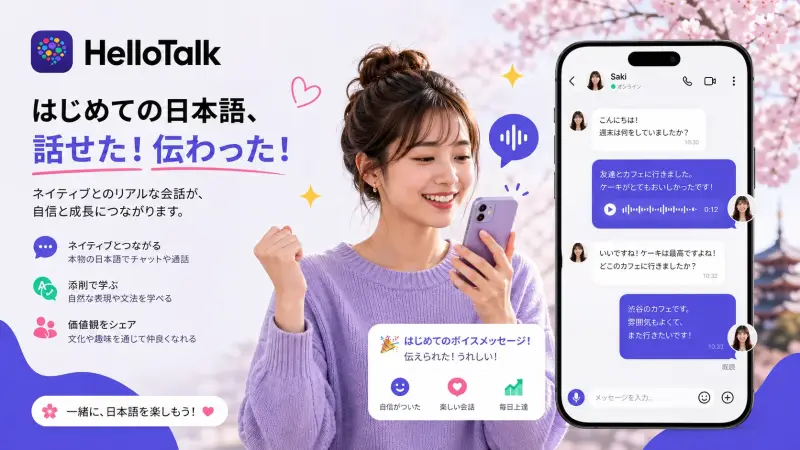
Why do you still can't speak Japanese after studying Japanese for a long time?
In fact, it is difficult for novices to practice speaking, not because they don't work hard enough, but because they are not looking in the right direction. These invisible pain points are the key to hindering you from speaking:
-
Detached from real situations, all you learn is "useless spoken language": The sentence patterns and expressions in the textbook are too stereotyped, and are completely out of touch with the tone, word usage, and habits of Japanese people's daily speech. Even if you memorize everything by heart, you won't be able to use it in real communication, and you will just speak "textbook Japanese".
-
Lack of professional feedback, errors accumulate: I read and practice in front of the textbook by myself. There is no one to correct the pronunciation, grammatical errors, and improper word choice. Over time, I develop wrong habits. The more I practice, the more biased I am. It is difficult to correct later.
-
No one to practice with, falling into "lonely learning": There are very few people learning Japanese around me, and it is even more difficult to find a native Japanese speaker to practice with. Even if you can barely find a practice partner, you may not be able to continue the conversation because of different interests and inconsistent rhythms, and you may not be able to persist.
-
Insufficient motivation, it is difficult to persist for a long time: Memorizing words and answering grammar questions alone is repetitive and draining. There is no obvious progress and no social interaction. I often give up after 3 days. It is difficult to devote long-term energy to practicing speaking.
-
Heavy psychological burden, afraid to speak: Novices are always afraid that they have poor foundation, inaccurate pronunciation, grammatical errors, and being laughed at by others. The more they dare not speak, the less they can speak, falling into a vicious cycle of "dare not speak, then cannot speak, then dare not speak even more".
I have experienced almost all of these pain points, and what impresses me most about HelloTalk is that it can accurately solve every problem, so that novices don't have to be afraid of making mistakes, don't have to worry about finding a partner, and can easily start the road to oral practice.
HelloTalk: An "artifact" for beginners to practice speaking, every function hits the pain point
Different from those learning apps on the market that simply instill grammar points, HelloTalk is more like a global language exchange community. Its core is not "teaching you to learn Japanese", but "helping you practice Japanese" - setting up real communication scenarios, connecting with suitable practice partners, and providing professional feedback so that you can naturally improve during the interaction. All functions meet the needs of novices, and are not stiff or deliberate.
Solve the problem of "no one to practice with": accurately match a language partner who is a good fit, no need to bother to search
Finding a suitable practice partner is the biggest obstacle for novices to practice speaking, but HelloTalk directly saves you all the trouble and easily connects with native Japanese speakers:
-
Intelligent matching, saving time and effort: Open the app, just set "Target language (Japanese) + Native language", and the system will automatically match users who want to learn your language and whose native language is Japanese, without having to blindly filter by yourself.
-
Interest matching to avoid embarrassment: You can further filter based on your own interests (such as animation, food, travel, workplace, exams), age, and online status to find language partners who are in the same rhythm as you and have common topics. You no longer have to worry about "finding a language partner but having nothing to talk about."
-
Two-way exchange, stress-free interaction: The core mode is "mutual benefit" - you teach the other party your language, and the other party teaches you Japanese. There is no need to feel like "troubling others" or psychological burden. Novices can speak boldly, even if it is just a simple greeting, and they can slowly accumulate confidence.
If you want to go deeper on structuring your Japanese exchange sessions — how to split time, what to cover, and how to keep the partnership alive long-term — our Japanese language exchange guide covers all of that in detail. For the universal language exchange framework that underpins all of this, see our complete language exchange guide.
Solve the problem of "no one corrects mistakes": native speakers + AI double error correction to avoid pitfalls in time
The biggest fear when practicing speaking is "no one will care if you make a mistake". HelloTalk uses a dual error correction mode to allow you to get feedback every time you practice and avoid the accumulation of errors:
-
Real-time error correction by native speakers: In the HelloTalk Moments, you can post Japanese text, voice clips, or even a photo with a Japanese description (for example, taking a picture of a bowl of ramen with the text "これはラーメンです"), and within 5 minutes, a Japanese native speaker will accurately correct your errors.
-
Detailed and easy-to-understand error correction: Native speakers will not only point out your grammatical errors and pronunciation problems, but also give authentic replacement expressions and even explain the reasons for the errors, so that you "know what it is and why it is" so that you will never make the same mistake next time.
-
AI intelligent back-up: When chatting with a language partner, send text or voice, and AI will rely on self-developed phonetic notation technology to automatically identify grammar, spelling, and pronunciation problems, give specific scores and correction suggestions, and provide native language demonstrations. Repeated reading can improve pronunciation.
-
Automatic organization of error records: All error correction records will be automatically organized. By spending 10 minutes reviewing every week, you can focus on breaking through weak points, avoid repeated mistakes, and your spoken language will become more standardized.
Solve the "lack of motivation": social interaction + fun, making learning Japanese no longer boring
It's easy to give up when studying alone, but HelloTalk makes practicing speaking a fun thing through social interaction and fun features, making it easy to maintain learning motivation:
-
Socialize in Moments, say goodbye to loneliness: you can see the updates of Japanese learners and native speakers around the world, like, comment, exchange learning experiences, and meet like-minded friends, so you no longer have to explore alone.
-
Picture word recognition, fun word memorization: Just take a photo of something you see, and HelloTalk will immediately analyze the Japanese expression of the object. Memorizing words in real scenes is much more interesting than rote memorization of word lists, and can be used directly in chats.
-
Immersive interaction in Voicerooms: a 24-hour Japanese Voicerooms with a dedicated room for novices. The topics cover daily chat, animation communication, basic sentence structure consolidation, etc. If you are afraid of social pressure, you can listen first and become familiar with the tone before speaking. Chatting with users from all over the world can not only practice speaking but also make friends and increase your motivation for learning.
Solve the problem of "dare not speak": step by step, lower the threshold for speaking
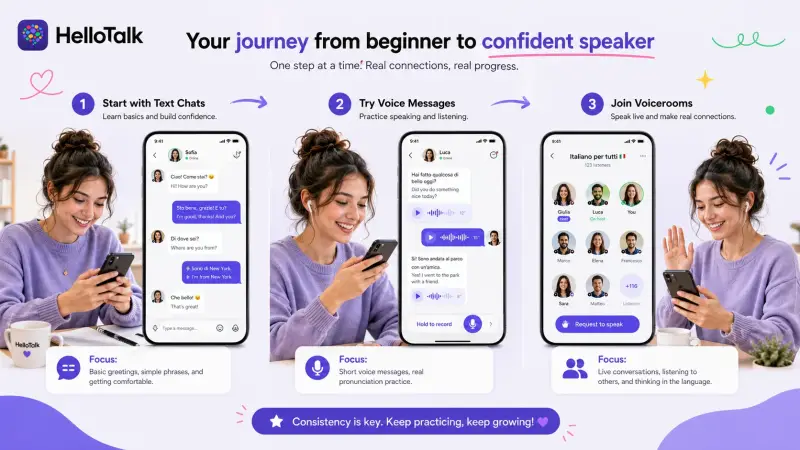
HelloTalk takes full consideration of the timidity of novices and has designed a step-by-step communication model, allowing you to gradually build up your confidence from "dare to speak" to "know how to speak":
-
Diversified communication, choose on demand: Beginners don't need to challenge voice and video at the beginning. They can start with text chat (the least stressful) and slowly transition to voice messages. Once they are familiar with the other party's tone and master basic short sentences, they can then try voice and video calls. Step by step without frustration.
-
AI chat, practice at any time: When there is no language partner online, AI chat is on call 24 hours a day, simulating real daily scenarios (such as asking for directions, ordering food, saying hello, introducing yourself). Even if you say something wrong, no one will laugh at you, and you will slowly build up your confidence in speaking.
-
Livestreams for novices: Sessions for novices are hosted by native Japanese speakers. The content is simple and easy to understand, covering basic pronunciation, daily short sentences, test sprint (N5/N4), workplace Japanese, etc. You can also interact with the host and get guidance. Novices can also boldly ask questions and practice speaking.
Actual test for novices: Use HelloTalk to practice speaking, and you can speak easily in 3 months
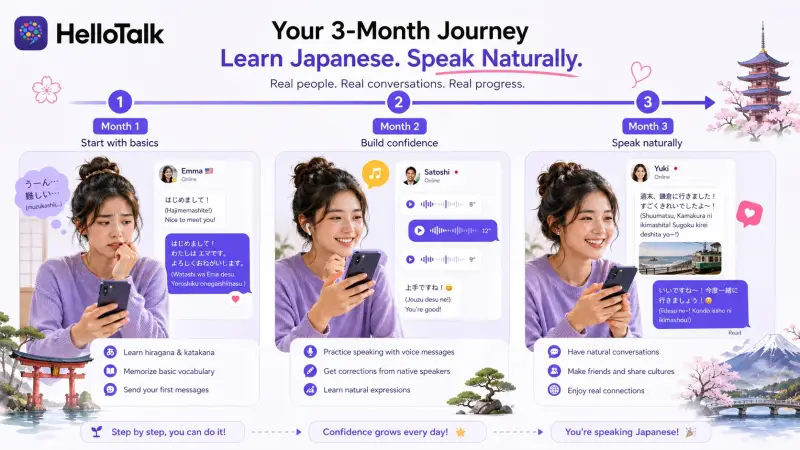
When I first started using HelloTalk, my basic knowledge was so poor that I could only speak the two simplest Japanese sentences "こんにちは" (Hello) and "ありがとう" (Thank you). My pronunciation was not standard, and my grammar was often wrong. I didn't even dare to send voice messages for fear of being laughed at.
Later, I followed the rhythm of HelloTalk and spent 15 to 20 minutes practicing every day: practicing short sentences with AI sparring in the morning, posting in Moments for correction during lunch break, chatting with my language partner for 10 minutes about daily life in the evening, and occasionally listening to Livestreams and visiting Voicerooms on weekends.
In less than 1 month, I was able to communicate in daily life using simple short sentences; after 2 months, my pronunciation became more and more standard, and I could chat with my language partner for 15-20 minutes; after 3 months, I could easily talk about daily trivial matters, animation, and food, and the Japanese I spoke became more and more natural, no longer stiff "textbook Japanese".
Comparing other apps: Why is HelloTalk the first choice for novices?
I have tried many mainstream language learning apps before. In comparison, HelloTalk is far ahead in terms of friendliness and practicality for novices:
-
Comparison with Duolingo: Duolingo focuses on "words + grammar questions", which can only accumulate grammar points and cannot solve the core problem of "difficulty speaking"; while HelloTalk focuses on real interaction, allowing you to use grammar points in communication, and learn "spoken language that can be used directly" instead of simply memorizing.
-
Comparison with Speaky: Speaky can only connect language partners, has a single function, and has no auxiliary tools when encountering problems; while HelloTalk integrates AI translation, double error correction, Moments, Livestreams and other functions to meet all the needs of novices from entry to advanced in one stop, and language partner matching is more accurate.
-
Comparison with Busuu: Busuu only has basic language partner exchange functions, no real-time error correction, AI assistance and other services, and some core functions require payment; while 90% of HelloTalk's core functions are free, with 24-hour mutual assistance and real-time feedback. Novices can get started at zero cost without spending a lot of money to sign up for classes.
What's more worth mentioning is that HelloTalk's strength and reputation are very reliable. It was recommended on the homepage of Google Play in 2024. Its self-developed phonetic notation technology and intelligent error correction system have helped countless novices quickly break through their speaking bottlenecks. This is why I always recommend it.
A must-read FAQ for newbies: Get started with HelloTalk quickly and avoid these misunderstandings
-
How to quickly find a suitable Japanese language partner?: Two simple ways - either post a short self-introduction in Moments (for example, "Japanese newbie, want to find a native speaker to practice, can teach my language, and my hobby is animation"), or use the "Find Language Partner" function, filter by interest and online status, and you can match the right partner in a few minutes.
-
Can you really learn something through language exchange?: Of course! This is the most natural way to learn. In order to learn your language, the other party will patiently listen to you and correct your mistakes. They all start with simple expressions. Novices can keep up and accumulate a lot of practical spoken language without even realizing it.
-
Is HelloTalk really free? Do newbies need to pay?: 90% of the core functions are free, including language partner matching, text/voice chat, Moments, Voicerooms, basic AI tools, Livestreams auditing, etc. Novices can get started at zero cost and can meet their daily practice needs without paying.
-
My foundation is too poor. Will I be laughed at when chatting with native speakers?: Not at all! The core purpose of Japanese native speakers coming to HelloTalk is to learn another language. They will understand your status as a novice, take the initiative to slow down their speaking speed, use simple expressions, and patiently correct your mistakes, so you can feel free to speak.
-
Can it be used offline?: Yes! The real-time translation function supports offline use. Even if there is no Internet, you can chat with the AI, review the phrase book, and check your error records without delaying daily practice.
Finally, I want to say: for novices to practice speaking, "dare to speak" is more important than "pursuing perfection"
Many novices fall into the misunderstanding of "pursuing perfection". They always feel that their grammar is not good enough and their pronunciation is not standard enough, so they dare not speak. But in fact, the core of practicing spoken language is never "to speak perfectly", but "to dare to speak, practice diligently, and correct mistakes in time".
The most powerful thing about HelloTalk (official website: www.hellotalk.com) is that it gives novices an environment where they "dare to speak" - no need to be afraid of making mistakes, there are native speakers and AI to help you correct them; no need to be afraid of loneliness, there are co-channel partners to practice with you; no need to be afraid of boredom, there are social and interesting functions to keep you going.
If you are also a newbie in Japanese and no longer want to be trapped by "can't speak, dare not speak", don't want to memorize words and study boringly, you might as well try HelloTalk. Start by saying the first sentence "こんにちは" with your first Japanese speaking partner and slowly break through yourself. You will find that it is much easier to speak Japanese than you imagined. It is not difficult to practice natural basic Japanese.