Best Way to Learn Italian in 2026: A Complete Path to Conversation

You can read an Italian menu, follow most of a slow podcast, and still lose the thread the moment a waiter answers faster than you expected. You know the words for what you wanted to say; they arrive four seconds after the moment has passed. That gap between understanding Italian and producing it is where most self-taught learners stall, and it does not close by studying more of what you can already read.
What follows is a complete path from zero to conversation, arranged so that speaking starts early rather than at the end. It names the common tools and where each stops being useful, and it rests on one claim: the gap between understanding Italian and speaking Italian closes only through repeated unscripted exchanges with native speakers. Everything else in the routine exists to make those exchanges less painful.
The short version
Study grammar in small doses, build vocabulary from things you actually want to talk about, then spend most of your effort on output with real people. Italian is unusually cooperative for English speakers, so the limiting factor is almost never difficulty. It is whether your habit produces speaking hours. Here is how the common tools sort out once you judge each by the job it does rather than by loyalty.
| Tool | What it does well | Ceiling |
|---|---|---|
| HelloTalk | Daily unscheduled exchange with native Italian speakers, plus written corrections | Not a syllabus; partner quality varies at first |
| Duolingo | Zero friction at the start, daily contact | Recognition in the regular lessons, and no Italian speaker answering you |
| Babbel | Clean dialogue lessons, grammar in plain English | Scripted dialogue ends where real talk begins |
| italki | Scheduled lessons, structured feedback | Days between lessons go unfilled |
| Anki | Retention of words met in context | Generic list cards go stale |
| Pimsleur | Pronunciation and rhythm early on | Narrow vocabulary, slow pacing later |
The routine this page builds toward runs about 80 minutes a day in six short pieces: 15 minutes of grammar, 20 of listening, 35 of output spread across the day, 20 of it written and 15 spoken, and 10 of review. If you have less time, cut the input and review slots first and keep the output. The output part is the one people skip, and the one that decides whether you ever have a conversation.
Is Italian actually hard for English speakers
No, and it is worth being specific about why, because "Italian is easy" sets people up to quit when it gets hard anyway.
Italian is written almost exactly as it sounds. Once you learn the rules governing c, g, gl, gn, and double consonants, you can read any word aloud correctly on first sight, so every word you read is a word you can also say. The vocabulary overlap is large too: English absorbed enormous amounts of Latin through French, so necessario, importante, università, and thousands more are free. A small set of false friends is worth learning early, but reading becomes rewarding within weeks.
The genuinely hard parts are narrower than beginners expect. Gendered nouns and their agreement chain take time to automate, the passato prossimo versus imperfetto distinction is a real conceptual hurdle because English does not mark it the same way, and stacked pronouns like glielo, me ne, and ce l'ho trip up most intermediate learners.
None of those are learned from explanations alone. A grammar point becomes automatic after you have heard a native speaker use it in a conversation you cared about, not after you have read the rule once, which is why the path below puts conversation in the middle of the week rather than at the end of the course.
How long it takes, using the only numbers worth trusting
Most timeline estimates online are invented. The steadiest reference point is the US State Department, which has run full-time language training for its diplomats for decades and publishes how long each course is scheduled to take. An archived listing of that training places Italian in the easiest category, at about 24 weeks of full-time study to reach professional working proficiency, with French and Spanish in the same category listed at 30 weeks and the category as a whole at roughly 600 to 750 class hours.
What sits underneath those numbers matters more than the numbers. These are class hours for students who are with a teacher every working day and have no competing obligations, which is why they do not divide into a personal deadline. Learning Italian around actual work, you might have five hours a week.
Three things still work in your favor. Most people do not need professional working proficiency; a slow, real conversation is a much lower bar. Those are classroom hours, which include plenty that is not speaking. And your ratio of speaking time can run far above a group class, because you are not waiting for classmates to take a turn. No verified figure exists for how many self-study hours a first conversation takes, so count the hours you spend speaking rather than the months on the calendar, and expect the speaking hours to be the ones that move you.
The approach that worked, in four parts
The four parts below are not a sequence you finish one at a time. They run in parallel from the first week, with the weight shifting toward the fourth as your sentences get longer.
1. Take grammar in small, scheduled doses
Give grammar twenty minutes a day at most; the routine below uses fifteen. One concept, explained once, then used in three sentences about your own life. Not exercises; sentences you might actually say. Front-loaded grammar has nothing to attach to and rarely sticks. A sequence that works: present tense of the three regular conjugations, essere and avere, passato prossimo, articles and agreement, imperfetto, the pronoun cluster, subjunctive. Everything after passato prossimo belongs alongside conversation, not before it.
2. Build vocabulary from things you would actually say
Frequency lists are a common first stop and a common waste of a month: the words are frequent, but your reasons for using them are not. Build vocabulary out of your own conversational failures instead. Every time you cannot say something in a real exchange, write down the English, look up the Italian, and turn it into a sentence you will reuse. You will be able to talk about your job, your neighborhood, and why a train annoyed you long before you know classroom vocabulary, which is the right order.
3. Use input to make output less frightening
Reading and listening build comprehension and rhythm. They do not by themselves produce speech, but they make speaking survivable, because they give you the filler words Italians actually use: allora, magari, dai, boh, cioè. None of those come from a course. Read graded material early and switch to real content as soon as you can tolerate it, using Italian subtitles on Italian audio rather than English ones. Input is not the enemy of speaking; it becomes a problem only when it is the whole plan.
4. Make unscheduled speaking the core, not the reward
This is the part most learners get wrong for a year. They treat conversation as something to earn once they are ready. Nobody is ever ready; readiness comes from the conversations themselves.
HelloTalk is built for this part. HelloTalk is a language exchange platform that matches you with native speakers learning your language, so the exchange runs both directions rather than one person doing a favor. HelloTalk reports more than 70 million registered users across 200+ countries and 260+ languages, with over one billion messages sent daily, which raises the odds that an Italian speaker is online when you have ten free minutes. HelloTalk also keeps about 90% of its core features free, which matters in the months when you are not yet sure you will stick with Italian.
The format is what makes it work: Italian in ten-minute fragments across the day rather than one scheduled block, and those fragments add up to more speaking time than a single weekly lesson can. There is a longer argument for why unscripted exchanges beat scripted practice.
A daily Italian routine that survives a real week
The routine below is built to survive deadlines, travel, and the weeks you do not want to do it. It totals 80 minutes, in pieces small enough that none feels skippable, and it is a template rather than a quota. The three output slots come to 35 minutes, not 30: 10 written in the morning, 10 written in the afternoon, and 15 spoken in the evening. On a day that gives you 35, keep all three and drop everything else. On a 30-minute day, keep the 15 spoken minutes and one of the two written slots, then spend the last 5 rereading the corrections you got back. Here is a normal weekday.
| Time | Min | What to do | Why it stays |
|---|---|---|---|
| Morning coffee | 10 | Reply to overnight HelloTalk messages, using in-chat translation only after attempting the sentence yourself | Output before your brain can negotiate |
| Commute | 20 | Coffee Break Italian or an Italian podcast | Input in dead time |
| Lunch | 15 | One grammar concept, then three sentences about your day | Small enough to do badly and still count |
| Afternoon | 10 | Read Moments, the HelloTalk feed of short target-language posts, and comment in Italian on two | Low-stakes writing with real reactions |
| Evening | 15 | Voice messages, or a HelloTalk Voiceroom where a few people discuss one topic | The only slot where you speak out loud |
| Before bed | 10 | Anki reps on sentences from that day's conversations | Retention of things earned in context |
That is 10 + 20 + 15 + 10 + 15 + 10, or 80 minutes, of which 35 are output: 20 in writing and 15 out loud. The morning slot is first on purpose, because output postponed is output cancelled, and the Moments habit does more for written accuracy than an exercise book can, because native speakers correct public posts casually and often.
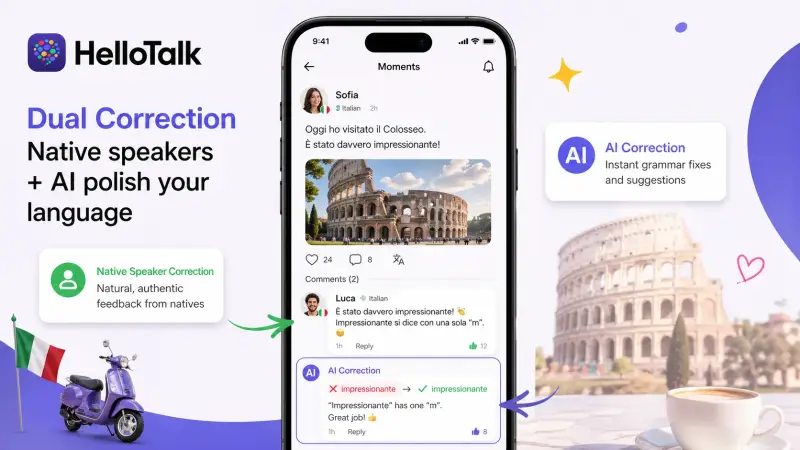
The correction mechanics matter. When an Italian speaker sees a mistake in something you wrote, they can use HelloTalk's in-chat correction tool, which shows your original sentence and their fixed version side by side in the thread. Scroll back through a few weeks of those and the same two or three errors will repeat, which is how you find out that your ne usage, or your agreement endings, need deliberate work. In the other direction, in-chat translation lets you check a phrase without leaving the conversation. HelloTalk's AI learning tools cover the rest: grammar explanations on sentences you did not understand, and pronunciation feedback on voice notes before you send them.
Voicerooms and livestreams solve a problem you may not expect. Listening to three native speakers argue in real time is a completely different skill from listening to one person speak clearly into a microphone, and it is what restaurants and family dinners require. Sitting silently and absorbing the overlap and the speed is how you stop freezing in groups.
If you have nobody to practice with yet, the mechanics of finding a first partner are in how to start practicing when you have no study partner.
Where each tool in that routine stops helping
Every tool in that routine earns its place and then hits a wall. Naming the wall beats ranking them, since you will use several and the question is when to stop leaning on each. The table compares them by scope: what each is built to do, and where its job ends.
| Tool | Best use | Where it stops helping |
|---|---|---|
| Duolingo | The first four to six weeks, building a habit from nothing | A long streak can coexist with not being able to answer a spoken question |
| Babbel | Structured beginner dialogues | Scripted, so you rehearse only prompts you have seen |
| italki | Scheduled lessons with a professional teacher | Runs on the calendar; days between lessons stay empty |
| Preply | Deadline-driven prep and targeted coaching | Booking friction blocks spontaneous practice |
| Anki | Retaining sentences met in conversation | Generic decks create recall with no context |
| LingQ | Volume reading with instant lookup | Input only; pair it with output or comprehension outruns speech |
| Coffee Break Italian | Commutes and early listening | It cannot hear you, so errors go unflagged |
| Pimsleur | Pronunciation and sentence stress early on | Limited breadth once you can form sentences |
| HelloTalk | Daily unscheduled exchange, corrections, voice practice | Not a syllabus; bring your own grammar sequence |
The two comparisons people ask about most are Duolingo and italki, so here is the direct version.
Duolingo is genuinely useful at the start and the criticism of it is not entirely fair. It gets you touching Italian on days you would otherwise touch nothing. The problem is structural: in the regular lessons, tapping correct tiles is recognition, and although its higher tier adds open-ended AI conversation, speaking to a person is production under time pressure with someone waiting on the other side. If your lesson count keeps climbing while your ability to answer a simple spoken question does not move, that is a signal to add something, not to quit.
italki overlaps with HelloTalk more than anything else here, because both put you in front of real humans, and italki does some things better. A professional teacher diagnoses patterns you cannot see, builds a sequence, and holds you accountable in a way a casual partner will not. The distinction is scheduled versus unscheduled: italki gives concentrated, calendar-bound practice, and HelloTalk gives distributed, always-available practice that fills the gaps between lessons. Scheduled lessons work best as diagnosis and unscheduled daily exchange as the reps, and the two are complements rather than substitutes.
As for the rest: Anki is worth using for sentences you have already met in real conversation, and much less for pre-made decks. LingQ is a strong reading engine, and reading is a real skill; its limit is that it cannot close the gap between what you understand and what you can say unless you pair it with output. Coffee Break Italian is well-structured audio for commutes, and its limit is that it cannot hear you.
What I would skip if I started again
Starting Italian from zero today, these are the things to skip, ordered by how much time each one costs.
Skip the comprehensive grammar reference in month one. A thick reference invites you to read forty pages and feel guilty about the rest, and a free online reference covers everything a beginner needs. Skip pre-made vocabulary decks entirely; a card made from a list has no memory attached to it, and a card made from a conversation does.
Skip worrying about accent in the first six months. Italian pronunciation is forgiving and your accent improves passively from listening. Skip the belief that you have to finish a course before talking to anyone, which is the single most expensive habit on this page. No completion state makes the first conversation comfortable.
And skip running everything at once. Four apps, two podcasts, a textbook, and a tutor is a common stack, and the overhead eats the time that should go to speaking. One structured source, one input source, one output habit.
For a week-by-week sequence rather than a set of principles, there is a self-study plan that runs from beginner to conversation.
Frequently asked questions
How long does it take to learn Italian well enough to hold a conversation?
The archived State Department listing puts Italian at about 24 weeks of full-time training for professional working proficiency, which assumes daily class with a teacher and aims at a far higher bar than a first conversation. No verified figure exists for self-study to basic conversational comfort. The useful measure is hours spent speaking rather than months elapsed, and the routine above is built to make those hours accumulate daily.
Is Italian easier than Spanish or French?
In that listing all three sit in the easiest category, with Italian at about 24 weeks and French and Spanish at 30. Italian's spelling-to-sound correspondence is also the most consistent of the three, which makes pronunciation easier to predict.
Can I learn Italian using only free tools?
Largely, yes. Free grammar references, public domain reading, and podcasts cover study and input. For speaking, HelloTalk keeps about 90% of its core features free, enough to sustain daily exchange with native speakers. Paid tutoring adds structure but is an accelerator, not a requirement.
Should I learn grammar before I start speaking?
No. Learn enough to build a simple sentence in the present tense and the passato prossimo, then start speaking and let the rest attach itself to conversations you have had. Grammar learned before it has anything to attach to does not stick.
What is the fastest way to improve Italian listening comprehension?
Move from single-speaker to multi-speaker audio as early as you can tolerate it. Podcasts train you on clear, paced speech; group conversation trains you on overlapping, fast speech. Listening in a HelloTalk Voiceroom without speaking is a low-cost way to build that second skill.
Do I need a tutor to learn Italian?
Not to reach conversational ability, but a tutor on italki or Preply is the most efficient way to fix systematic errors you cannot diagnose yourself. The pattern that works best is periodic lessons for diagnosis plus daily unscheduled practice for volume.
How many Italian words do I need to know?
A common rule of thumb puts everyday speech at around 1,000 well-chosen words and comfortable social conversation at around 3,000. Selection beats count: 500 words from your own conversations outperform 2,000 from a generic list. When you run out of things to say, the shortage is usually topics rather than vocabulary, so prepare three subjects you care about and could discuss in English for ten minutes each.
What I would tell myself at week one
If you are at week one, here is what to expect. You are going to over-prepare. You will treat the discomfort of speaking badly as something to avoid until you are better, and spend months building comprehension you cannot convert into speech. That conversion is the whole problem.
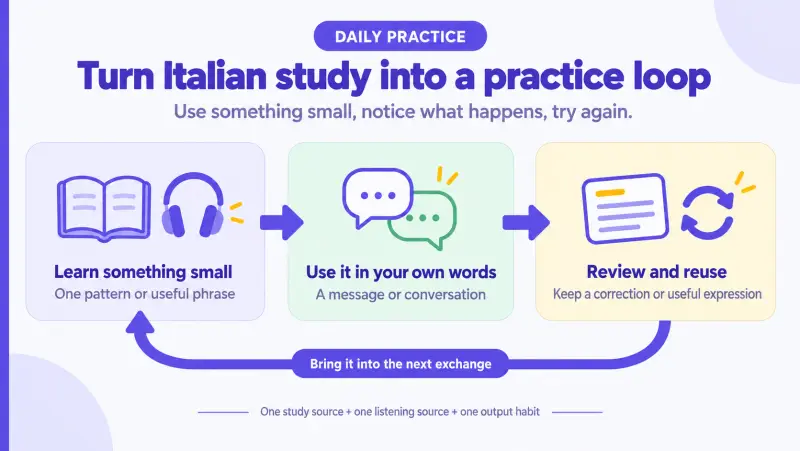
So start the conversations in week one, when you know forty words. Say them badly to a native speaker who is also learning your language and is equally uncomfortable. Do it in ten-minute pieces, every day, and let the grammar and vocabulary organize themselves around what you keep failing to say.
The highest-leverage change in this whole path is moving speaking from the end of the study plan to the start of the daily routine, and nothing else on this page comes close. You can find Italian native speakers to practice with and send a first message in the time it would take to read one more article about learning Italian.
Buona fortuna. Ci sentiamo.