
No Study Partner Nearby? How to Pick an Italian Method That Works Solo First

Who Tells You You Are Wrong?
There is no Italian conversation group in your town, none of your friends speak it, and the nearest class meets at a time you cannot make. So every Italian sentence you produce this month is going to be judged by you.
That is the actual constraint, and it is not a motivation problem. Alex can study every evening for four months and still arrive at his first conversation with phrasing no Italian would use, because nothing ever pushed back.
The chain is short. You guess a phrase, nothing contradicts it, you repeat it, and feeling correct is indistinguishable from being correct when you are the only witness. A mistake nobody corrects does not stay a mistake for long, it becomes a habit that later feels like your natural way of speaking Italian. Four months alone can leave you more fluent and more wrong at once.
So the question that picks your method is not which app teaches best. It is: who tells you you are wrong, and how fast?
What Has to Cover That Gap
The best way to learn Italian without a study partner is to pick a method that supplies correction some other way. Not more content, not a better explanation of the subjunctive. Correction, meaning something outside your own head that reacts to a sentence you made up yourself.
There are only a few honest sources: automated feedback, public posting read by native speakers, and paid tutor time.
HelloTalk is worth naming early because it stacks three of them behind one screen. HelloTalk's chat window carries in-chat translation, phonetic transcription, read-aloud playback, and correction on the message you just typed, so checking a phrase never means leaving the conversation. That is chat-based learning in practice: feedback lands on your sentence, not on a lesson someone else planned.
None of these need a fixed partner, which matters because beginners stall for months waiting to find one. Correction and companionship are separate needs, and the methods that supply correction without requiring a scheduled partner are the ones that survive a month when nobody replies.
Laying those jobs side by side makes the substitutions concrete. Read by row: one job, what breaks alone, what stands in, what the stand-in misses.
| Job a partner does | What is missing solo | What can stand in | What the stand-in misses |
|---|---|---|---|
| Catching grammar errors | Nothing contradicts a sentence you invented | HelloTalk's AI grammar correction, with the reason attached | Wording that is correct but no Italian would choose |
| Judging phrasing | You cannot hear that a phrase sounds translated | HelloTalk's Moments posts, read by many native speakers | Whether it suits the person in front of you |
| Checking pronunciation | Your ear flattens double consonants | HelloTalk's AI pronunciation scoring on read-aloud attempts | Rhythm under the pressure of a live reply |
| Teaching grammar in order | No syllabus, no sense of what comes next | A course app such as Busuu, or a tutor | HelloTalk is not a graded course and will not sequence grammar |
The general route from zero to conversation, assuming you have people to talk to, is laid out in the zero-to-real-conversations path for Italian. This article stays in the narrower case: the first stretch alone.
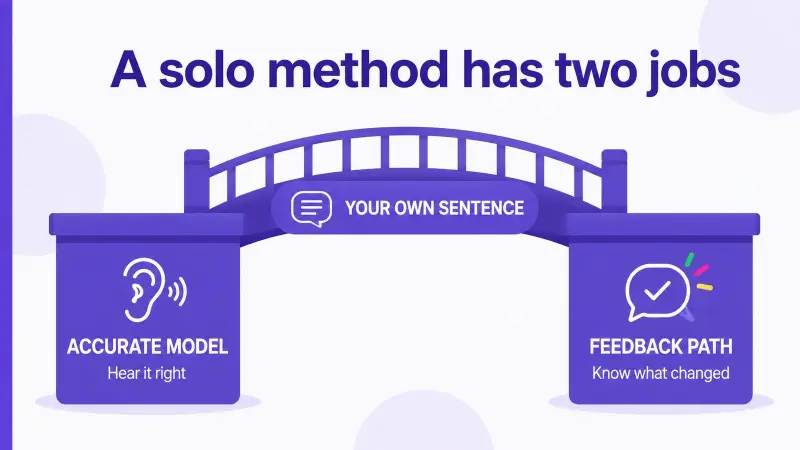
Two Jobs a Solo Method Must Do
Once correction is the missing piece, judging a method gets simpler. Ask it two questions.
First: does it catch errors in sentences I invented? Multiple-choice drills cannot, by design. Duolingo and Busuu build a base of forms; neither reviews your original paragraph about your weekend.
Second: does it make me produce sound? Double consonants carry meaning in Italian, and stress changes which word a listener hears. Italian pronunciation errors from double consonants and misplaced stress are almost impossible to notice in your own voice without either a recording or an external score.
A method that does both jobs works alone. A method that does neither is content, not practice.
The Order That Works Alone
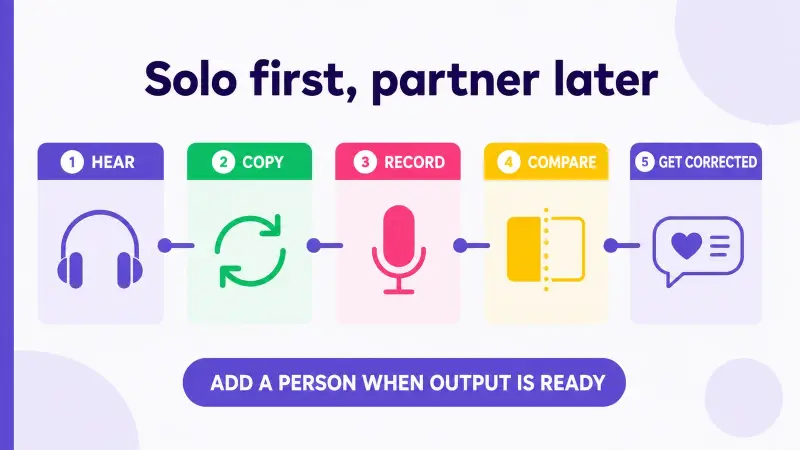
Sequence does real work, because the wrong order lets errors set before anything catches them. Run these five steps in order, twenty to thirty minutes a day.
- Write four or five sentences about your actual day. Real content, not textbook sentences. Writing is where you discover which words you are missing.
- Run them through automated grammar checking first. This clears mechanical mistakes, wrong article, wrong auxiliary, wrong agreement, so human attention later goes to phrasing rather than to plumbing.
- Post the cleaned version publicly and ask one narrow question. One HelloTalk Moments post often returns three or four suggestions. Ask something specific, like whether ho fatto or facevo fits.
- Read the sentences out loud and get a score. Do this after corrections arrive, so your mouth practices the fixed version rather than drilling the error.
- Listen for ten minutes and steal one phrase. HelloTalk's Voicerooms run around the clock and you can sit in one as a listener. Take a phrase you heard into tomorrow's step 1.
Steps 2 through 4 are all correction, from three directions, none needing a partner. A day-by-day version sits in this daily Italian plan for 2026.
Adding a Partner Later
Solo is not permanent. It is the phase where you build enough Italian to make a conversation worth having.
The marker is when you can write those five sentences without looking things up, and corrections come back about word choice rather than grammar. That usually takes 6-10 weeks. A live exchange then gives you what the solo loop cannot: someone reacting in real time.
Arriving with a stock of already-corrected sentences also changes how a first conversation feels. HelloTalk reports 70M+ registered users across 200+ countries and 260+ languages, which is why posting at an odd hour still tends to find someone awake. How the chat tools carry a beginner through early exchanges is covered in mastering authentic Italian through everyday chat.
Keep the solo loop running after the partner appears. It fills the days between conversations.
Frequently Asked Questions
Can I reach conversational Italian without a study partner? Yes, as long as something corrects the sentences you invent. Automated grammar and pronunciation feedback plus public posting reaches a functional conversational level, usually a few weeks slower than speaking regularly with a person.
Is Italian easier than other languages to self-study? Spelling helps, since Italian is written close to how it sounds, so reading aloud is more reliable than in English. Verb conjugation and gender agreement still need outside correction, because those errors sound fine to a learner's ear.
How long should I stay solo before looking for a partner? Until you can produce a few sentences about your day without pausing, often 6-10 weeks of daily practice. Before that, conversations tend to be long silences.
Do AI corrections replace native speakers? For mechanical errors, largely yes, and instantly. Native speakers still catch what is technically correct but nobody says, which is why the two work better stacked than chosen between.
What if nobody answers my public post? Make it shorter and ask about one thing. A four-line text with one explicit question about a single word gets answered far more often than a long paragraph ending with "corrections welcome."
Does this cost money? Not to run this routine. HelloTalk keeps 90% of core features free, covering chat, posts, corrections, and voice. HelloTalk's VIP tiers are sold as regional monthly, yearly, or lifetime options (see in-app quote).
Can I practice speaking Italian alone? Partly. Reading aloud with a pronunciation score trains articulation, and joining a Voiceroom as a listener trains your ear. What solo work cannot train is responding under time pressure.
What Solo Study Never Covers
Be clear about the ceiling. No amount of solo practice teaches you to handle being interrupted, to catch a fast reply you half heard, or to keep talking while you hunt for a word. Those come only from someone talking back.
What it does is make sure that when the talking starts, your Italian is not carrying four months of quietly rehearsed errors. Write something true, let a correction land on it, say the fixed version out loud, come back tomorrow. When you are ready to add the person, start at HelloTalk.