Best Way to Learn Italian in 2026: A Daily Plan From Beginner to Conversation

Italian is one of the friendliest languages an English speaker can pick up, and that creates a specific problem: progress is quick enough at the start that people mistake early comfort for a plan.
Reading Italian is easy. Pronouncing Italian is easy. Understanding two Italians talking to each other at normal speed is not, and neither is producing correct verb forms while someone waits. The best way to learn Italian is to use its easy pronunciation to start speaking in week two, then spend your real effort on verbs and listening speed, which is where the actual difficulty lives.
Here is the daily plan, with the reasoning behind each block.
Why Italian is forgiving, and where it is not
The Italian alphabet has 21 letters: five vowels and 16 consonants, with j, k, w, x and y appearing only in words borrowed from other languages. Spelling maps onto sound with very few surprises, stress usually falls on the second-to-last syllable, and the letter h is silent but changes the consonant before it in combinations like ch and gh.
Because Italian is close to phonemic, a beginner can read an unfamiliar word aloud correctly on first sight most of the time, which removes the delay between studying a word and being able to say it. That is why Italian rewards early speaking more than French or English do.
The Foreign Service Institute places Italian in its most accessible tier for English speakers, at roughly 600 to 750 class hours to professional working proficiency, alongside Spanish and French. On the Cambridge guided-hours scale, A2 arrives at roughly 180 to 200 hours and B1 at 350 to 400.
The difficulty is concentrated in three places:
- Verbs. Multiple conjugation patterns, plenty of irregulars, and a past tense system that splits between two forms with different uses.
- Listening speed. Italian is spoken quickly, with vowels running together across word boundaries.
- Gender and agreement. Nouns, articles and adjectives all agree, and the endings shift in ways that need to become automatic rather than calculated.
The daily plan
Those three difficulties do not disappear through one lesson or one long weekend. Verbs need repeated retrieval, listening speed needs daily exposure, and agreement needs frequent correction, so the plan below gives each problem a recurring block instead of leaving it to chance.
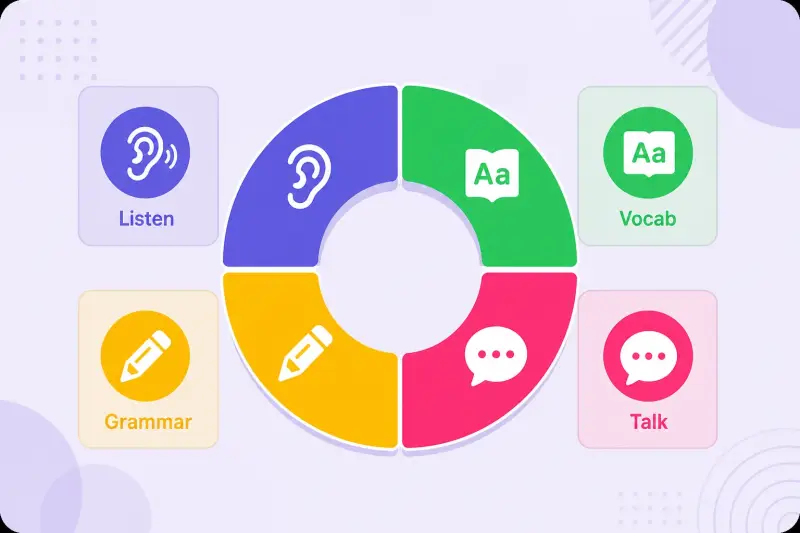
| Block | Time | What you do | Why it is there |
|---|---|---|---|
| 1 | 15 min | Spaced review, nouns stored with their article | Protects everything already learned |
| 2 | 25 min | Structured course, next lesson | Removes the decision about what to study |
| 3 | 20 min | Italian audio, listening only | Listening speed needs its own slot |
| 4 | 30 min | Conversation with a native speaker, or 15 min of writing plus correction on non-call days | Only activity that trains retrieval under pressure |
| 5 | 10 min | Write down three corrections from the day, add to review | Turns feedback into retention |
Total: about 100 minutes, or roughly 12 hours a week. At that pace, A2 arrives in around four months and B1 in around seven or eight.
Blocks 1 and 5 are the ones to protect on a bad day. A 2022 meta-analysis pooling 98 effect sizes from 48 experiments with 3,411 learners found that spacing review across days retained material better than the same total time in a single block, which is why fifteen minutes daily beats a long Sunday session.
The order to learn Italian in
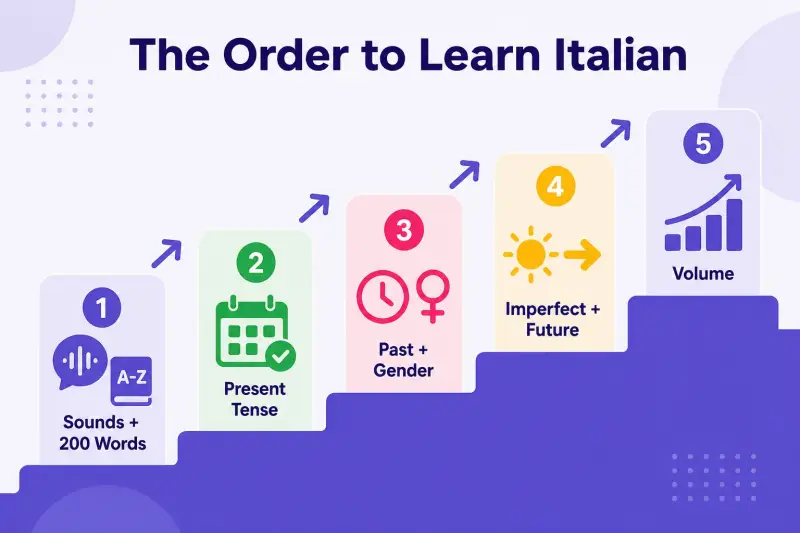
Weeks 1-3: sounds and 200 words. The alphabet and the consonant combinations that trip people up, particularly gn, gl, sc, ch and gh. Present tense of essere, avere, andare, fare, volere and potere. Read everything aloud. Start text conversations with native speakers in week two.
Weeks 4-8: present tense properly, plus first voice calls. All three regular conjugation patterns, the common irregulars, questions and negation. First voice conversation in week four. Two a week from then on.
Weeks 9-16: the past, and gender agreement. Passato prossimo, including the choice between essere and avere as the helper verb, which is the point where Italian starts feeling like real work. Adjective agreement. Direct object pronouns.
Months 5-8: imperfect, future, and listening at full speed. The imperfetto and how it divides work with the passato prossimo, which has no clean English equivalent and therefore needs exposure rather than a rule. Switch your audio from graded material to real Italian content chosen for interest.
Month 9 onward: volume. Grammar becomes reference. Conversation and input carry the load.
Do not learn the passato prossimo and the imperfetto in the same fortnight. Their difference is a matter of aspect rather than time, and it becomes intuitive through hearing them in context rather than through comparing rules.
Free and low-cost tools that fit each block
For the course block, both free and paid options work; what matters is that it is sequenced and that you finish it. Language Transfer offers a free introductory Italian course with no account required, built around reasoning through the grammar rather than memorising lists, which suits the first few weeks well.
For review, any free spaced-repetition tool will do, provided you store every noun with its article: never "casa", always "la casa". Fixing gender later costs several times more than learning it correctly the first time.
For listening, start with slow, clearly enunciated material and move to real Italian video and podcasts around month four. Below roughly 500 words, Italian media is entertainment rather than study, because a word typically needs 8 to 10 comprehensible encounters to stick and early input supplies very few of those.
Where the conversation block comes from
The fourth block is the one with a scheduling problem, and it is where the HelloTalk platform supports the plan.
Chat-based learning. Text chat with Italian native speakers is the right format for weeks two and three, giving you production practice without live time pressure. Translation, phonetic transcription and read-aloud sit inside the message thread, so an unfamiliar reply is decodable in place, and read-aloud lets you hear natural Italian rhythm on a sentence you have just read. Real-time grammar correction flags your errors while the exchange is live, which for Italian learners usually means gender agreement and the essere-versus-avere choice in the past tense.
Moments. Post three Italian sentences publicly and several native speakers will correct the same text. This is the most reliable practice in the plan because it depends on nobody's calendar. The plurality of corrections also teaches you which forms are rules and which are regional or stylistic, and Italian has a lot of regional variation. Reading the feed gives you casual written Italian, which looks very different from coursebook Italian.
Voicerooms and Livestreams. Italian voice rooms run around the clock, and joining as a silent listener is normal. For the listening-speed problem specifically, hearing several Italians talk over each other is the training your ear needs and graded audio postpones. Livestream mini-lessons add a host and a topic when open conversation is more than you want that evening.
AI learning tools. AI pronunciation scoring names the specific sound you are missing, which for Italian learners is usually gn, gl, the rolled r, or double consonants that change meaning when shortened. AI grammar correction explains the rule behind each fix, so corrections generalise. Image translation handles Italian signs, menus and labels.
HelloTalk's scale is what makes two to four weekly conversations schedulable rather than lucky: 70M+ registered users across 200+ countries studying 260+ languages, with over 1 billion messages daily. 90% of HelloTalk's core features are free, and HelloTalk was named Google Play's Best Social App in 2017 with a global Google Play homepage feature in 2024.
Checkpoints, so you can tell whether it is working
Daily effort is difficult to judge from inside the routine, so the checkpoints below convert the plan into observable speaking and listening outcomes.
| Point | Test | Pass looks like |
|---|---|---|
| Week 3 | Record a 45-second self-introduction | Correct vowels, no long pauses |
| Week 8 | Five-minute conversation about your weekend | Under five switches into English |
| Week 16 | Talk about something you did last month | Passato prossimo mostly correct, helper verb usually right |
| Month 6 | Summarise a three-minute Italian clip out loud | Main points captured, some details missed |
| Month 8 | 20-minute conversation on three unprepared topics | Sustained, with errors, without collapse |
Keep the week-3 recording. Comparing month six against it is the most reliable motivation available, because progress in Italian is invisible day to day and obvious across months.
Common mistakes with Italian
- Mistaking easy pronunciation for easy grammar. The verbs are where the hours go.
- Learning nouns without their article. The most expensive shortcut available in Italian.
- Studying passato prossimo and imperfetto together. Learn one, use it for a month, then meet the other.
- Silent study. Italian's phonetic regularity is a gift; reading aloud from day one collects it.
- Italian media too early. Below 500 words it is enjoyable and not yet study.
- Ignoring double consonants. They change meaning, and English speakers routinely shorten them.
- Postponing conversation. Italian is one of the languages where you can speak intelligibly within two weeks. Use that.
For the general framework behind this plan, see the best ways to learn a language and what the numbers say and how to choose a method for your specific goal. If you are weighing exposure against a syllabus, immersion versus structured learning covers the sequence, and the tool families are compared in Duolingo, Pimsleur and language exchange.
FAQ
What is the best way to learn Italian for beginners? A sequenced course for structure, daily spaced review with nouns stored alongside their articles, a daily listening slot, and conversation with native speakers starting in week two. Italian's regular pronunciation makes early speaking practical, so there is no reason to delay it.
How long does it take to learn Italian? On the Cambridge scale, roughly 180 to 200 guided hours to A2 and 350 to 400 to B1. At about 100 minutes daily, that is around four months to A2 and seven to eight months to conversational B1.
Is Italian easy to learn for English speakers? Comparatively, yes. It sits in the most accessible difficulty tier at roughly 600 to 750 class hours to professional proficiency, and its spelling maps closely onto its sounds. The verb system and listening speed are the real work.
What is the hardest part of Italian? The verbs, especially the division of labour between the passato prossimo and the imperfetto, which has no clean English equivalent. Gender and adjective agreement come second.
Can I learn Italian for free? Yes. Free introductory courses, free spaced-review tools, free listening material and language exchange with native speakers cover the whole path to conversation. Hours are the constraint, not money.
When should I start speaking Italian? Text conversations in week two, first voice call in week four. Italian pronunciation is regular enough that you will be understood earlier than in most languages, which makes early speaking unusually productive.
Do I need to learn regional differences? Not at the start. Standard Italian is understood everywhere and is what courses teach. Regional vocabulary and accents become interesting once you are having real conversations, and native-speaker partners will introduce them naturally.
Set the five daily blocks, protect the review and the corrections, and get an Italian native speaker into week two. You can start that part free on HelloTalk.