
Best Ways to Learn a Language in 2026: How to Combine Methods That Work
There is no single best way to learn a language in 2026, because the main methods train different subskills. Each method family covers one job and leaves another one open.
Structured courses build grammar in a sensible order, and spaced review keeps vocabulary retrievable. Comprehensible input trains listening and reading, while active output turns recognition into production. Corrective feedback keeps errors from settling in, and real conversation ties everything to live use with actual people.
The practical question is not which method wins but which combination matches your goal and your current stage. A traveler preparing for a trip needs a different mix than a student preparing for an exam, and a beginner needs different proportions than someone stuck at a plateau. This guide compares what each method family trains, names its main limitation, and shows how to pair methods so that their weaknesses cancel out. It also shows where a small amount of real conversation fits, even with a limited vocabulary.
Why one method is never enough
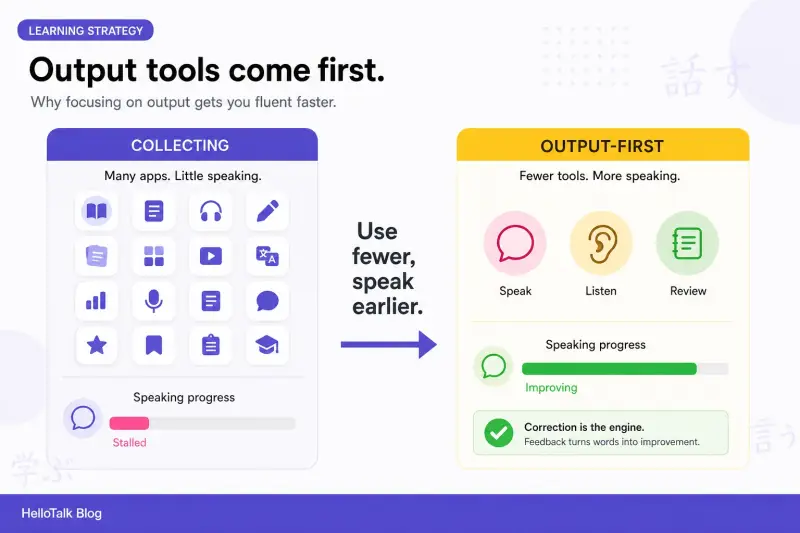
One method is never enough because recognizing language and producing it are different skills. Passive knowledge does not turn into speaking on its own: recognizing a word when you read it and producing it in real time are separate abilities that need separate practice. A learner can finish a vocabulary book and still freeze when a native speaker asks a simple question at normal speed.
The reverse is also true. A learner who only chats picks up fragments without systematic coverage, and gaps in core grammar keep resurfacing. The mechanics of this split are covered in the comparison of input versus output in language learning, and the short version is that each side feeds the other. A strong routine deliberately covers both, plus a channel that catches errors.
The six method families, compared
Before choosing anything, it helps to see all six method families side by side. The table below lists what each one trains, its main limitation, the stage or goal it serves, and what to pair it with. Read it by row when evaluating a method you already use, and by the last column when deciding what to add next.
| Method | What it trains | Main limitation | Best stage or goal | What to pair it with |
|---|---|---|---|---|
| Structured course | Grammar sequence, base vocabulary | Cannot react to sentences you produce | Beginner foundations, exam preparation | Output practice plus a feedback source |
| Spaced review | Long-term vocabulary retention | Words often stay recognition-only | Every stage, in small doses | Using reviewed words in real output |
| Comprehensible input | Listening, reading, natural phrasing | No pressure to produce anything | After basics, and during plateaus | Output practice on the same topics |
| Active output | Producing language under mild pressure | Errors repeat if nobody corrects them | Once core structures are in place | Corrective feedback and review |
| Corrective feedback | Accuracy and error awareness | Only works when you produce regularly | Whenever output is part of the week | Output practice plus spaced review |
| Real conversation | Live retrieval, natural usage, culture | Coverage is unplanned and unsystematic | As early as a controlled scope allows | A course that supplies structure |
The table is a pairing guide, not a ranking. Each limitation in the third column is answered by something in the last column, which is the core argument of this article: a routine built from two or three complementary rows covers more of the skill than any single row used heavily.
What AI practice adds, and where people take over
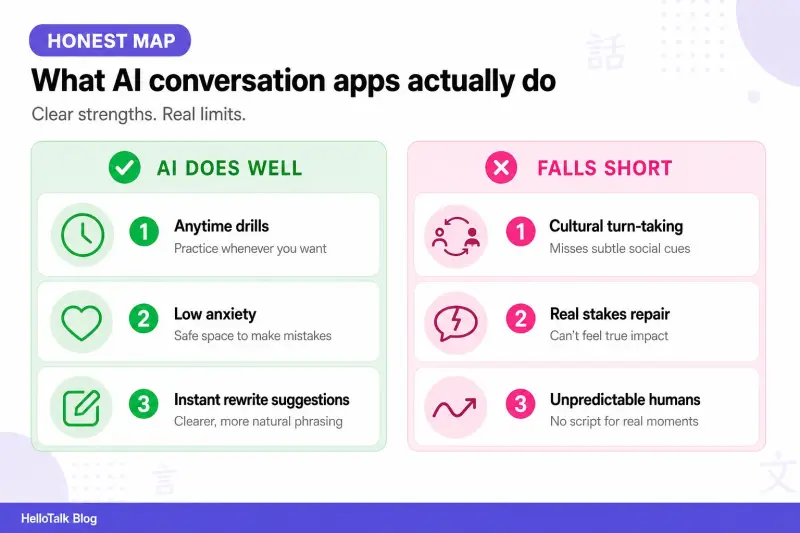
AI conversation practice has a clear job in a combined routine: it is available on demand and suited to rehearsing predictable exchanges before they matter. Rehearsing a self-introduction or a restaurant order with an AI partner keeps early attempts low-stakes. AI checks can also flag spelling and grammar slips close to the moment you make them.
What AI practice cannot fully supply is the behavior of a real person. Human replies are unpredictable, carry cultural detail and humor, and include the specific feedback that a sentence is grammatically correct but not how people say it. Neither side replaces the other, and a combined routine can use AI tools as rehearsal and real people as the destination.
HelloTalk's AI learning tools include two dedicated AI apps available through the same account, AI Grammar and SpeakUp AI, plus a separate AI-powered visual translation feature. AI Grammar gives real-time grammar feedback with explanations on written attempts, SpeakUp AI returns pronunciation scores and corrections, and visual translation reads real-world text such as signs and menus. These tools cover checkable mechanics and reference needs, while real conversation remains the source of unpredictable human replies.
Real conversation can start earlier than you think
A learner does not need a large base before real conversation, as long as each exchange is scoped to things they can half-say. Keeping an exchange to one familiar topic, and keeping it short, holds the attempt inside what a beginner can manage. The full case for how to start with a controlled real conversation before you know much, including how to keep that scope in place, is its own article.
HelloTalk's Moments feed fits attempts at that scale, since one posted sentence is visible to native speakers who can correct or reword it on their own time. HelloTalk's built-in aids for translation, pronunciation, and corrections sit inside the conversation, so a small exchange and any fixes it collects stay in one thread.
How to combine methods by goal and stage
The right combination follows from your goal, so start there rather than with the tools. An exam candidate leans on a structured course and spaced review, adds input in the exam's topic areas, and uses output practice with feedback to sharpen accuracy. A traveler weights the mix toward high-frequency phrases, listening input, and short rehearsed conversations. A learner whose goal is real relationships in the language moves conversation to the center early and lets structure fill gaps as they appear.
A fuller mapping of goals to mixes is laid out in how to choose a language learning method by goal. Stage matters as much as goal here. A method earns a place in your routine only if it trains a subskill your current stage actually requires.
For complete beginners, structure and review are the natural starting layers. The question of what a language learner should study first is worth settling before collecting resources.
Difficulty shifts the proportions too. Treat the distance between your language and the target as one planning variable among several, and let your own comprehension and production signals decide how much input and review to schedule before leaning harder on output.
Combining methods is the first step; running the combination as a plan you monitor and adjust is the second. That planning loop, including how to diagnose the bottleneck actually slowing you down, is covered separately in language learning strategies for 2026, so this article stays on the methods themselves.
For the input slot of a mix, HelloTalk's Voicerooms and Livestreams offer group audio you can join as a listener. Sitting in a room puts real speed and real phrasing in your ears with nothing depending on your reply.
Where HelloTalk fits a combined routine
HelloTalk's role in a combined routine is the two rows prepared materials cannot cover: real conversation and the feedback attached to it, in the places described section by section above. The HelloTalk platform connects 70M+ registered users across 260+ languages, and HelloTalk offers free core features. Registered users are a pool of potential partners, not a promise that a specific person is online or will reply, which is one more reason to treat HelloTalk as a component in a combined routine rather than the whole plan.
FAQ
What is the single fastest way to learn a language?
There is no single fastest method. A combination of one structure source, one output habit, and one feedback channel covers complementary subskills, since each addresses a limitation of the others.
How many methods should I combine at the same time?
Choose a small set that covers three different jobs: a source of structure, a regular form of output, and a feedback channel. What matters is covering different subskills, and the table above is the checklist for which jobs your current mix leaves open.
Do apps replace classes or tutors?
No, they cover different rows of the comparison. Apps deliver structure, review, and rehearsal on your schedule, while classes and tutors add planned correction and accountability. Which one you need depends on the limitation currently slowing you down, not on which format is newer.
When should real conversation enter the mix?
Earlier than a lessons-first plan schedules it, as long as each exchange is small and scoped to things you can half-say. A short exchange on one familiar topic stays manageable at an early stage, and any replies it receives are tied to your own sentences in a way prepared material is not.
How do I know my combination is working?
Look for behavior signals rather than feelings: fewer dictionary lookups for the same topics, longer stretches before you switch to your native language, and corrections that stop repeating. If a signal stays flat past the period you set for the test, swap the method that targets that subskill rather than restarting everything.
Do harder languages need a different combination?
The families stay the same but the proportions shift. Language distance is one planning variable among several, so adjust the share of input, review, and output based on the comprehension and production signals your own practice shows rather than on a fixed formula.
The best way to learn a language in 2026 is a small set of methods chosen so that each one covers another's weakness, with real people in the loop from early on. HelloTalk supplies the conversation and feedback rows of that combination.