
How to Talk in Spanish: Start, Sustain, and Repair Real Conversations
Talking in Spanish gets manageable when you stop treating a conversation as one big test and start treating it as a sequence of small stages, each with its own goal and its own moves. The stages are: prepare one small goal, open with something easy to answer, sustain the exchange with follow-up questions, confirm what you understood, repair when your Spanish runs out, close politely, and review what the conversation exposed. Every stage can be practiced separately, which is what makes the whole flow learnable.
This matters because production is its own skill. Guides on how to learn a language fast keep arriving at the same point: speaking requires different practice from comprehension study, and silent preparation is not a substitute for staged, real attempts. A real conversation becomes manageable when each stage has one goal, one move, and one known next step. The table below maps the full flow, and each section then walks one stage.
The conversation flow, stage by stage
Before drilling any phrases, it helps to see the whole flow in one view. In this article, a conversation stage means a moment in a real exchange where you have one job to do, and the table gives each stage its learner goal, one useful Spanish move, and a next move you control. Read it top to bottom as the shape of a single conversation.
| Conversation stage | Learner goal | Useful Spanish move | Learner-controlled next move |
|---|---|---|---|
| Prepare | Choose one small topic you can half-say | Draft one line, such as "Me gusta cocinar comida china" | Open the exchange while the line is fresh |
| Open | Invite an easy reply | "¡Hola! Soy Ana, estoy aprendiendo español. ¿De dónde eres?" | If a reply comes, answer briefly and add one detail |
| Sustain | Keep turns going with follow-ups | "¿Y qué te gusta hacer allí?" | Pick one word from any reply and ask about it |
| Confirm | Check your understanding out loud | "¿Quieres decir que trabajas los sábados?" | Continue with whatever the check clarifies |
| Repair | Keep the exchange alive when stuck | "Perdón, ¿puedes repetir más despacio?" | Save the recovered word and keep going |
| Close | End warmly without strain | "Gracias por la charla, ¡hablamos pronto!" | Note anything worth saving |
| Review | Turn the exchange into study material | Copy the corrected or new phrases somewhere | Reuse one saved phrase in the next conversation |
Use the table as a rehearsal script: practicing one row at a time is less demanding than rehearsing whole conversations, and the moves transfer across partners and topics. The middle rows carry the live exchange, so the sections ahead spend the longest time there.
Prepare: one small goal before you open the chat
Preparation for a real conversation means choosing scope, not memorizing scripts. One topic you can already half-say, one drafted opening line, and a way to end politely cover the preparation. Good first topics are your city, food, one hobby, or the other person's country, because each generates easy follow-ups.
Small scope also protects you at the stages where things go wrong: a conversation about one familiar topic produces breakdowns you can repair, while an ambitious topic produces breakdowns that end the exchange. Scope is the one variable fully in a beginner's hands.
HelloTalk's AI learning tools fit the stages you control, preparation and review, rather than the live middle: two AI apps under the same account, plus a separate AI-powered visual translation feature. The AI Grammar app can check a drafted line with feedback and explanations, the SpeakUp AI app can score the pronunciation of a spoken opener, and the visual translation feature reads real-world Spanish such as menus and signs. None of them predicts or replaces what a partner will actually say.
Open and sustain: questions carry the conversation
A good opener is short, honest about your level, and ends in an easy question, and "Soy principiante, ¿de dónde eres?" does all three in seven words. If first exchanges still feel intimidating, the first Spanish conversation guide walks that initial step in detail, including what to write when nobody has replied yet.
Sustaining is the art of the follow-up question: pick one word from the reply and ask about it. Partners who share your interests make this easier, because the follow-ups suggest themselves when both sides care about the topic. HelloTalk's partner search helps here, letting you look for native Spanish speakers by native language, city, and more.
A stock of ready-made connectors and reactions helps carry the middle turns. The collection of Spanish conversation phrases supplies exactly that shelf of everyday lines.

Confirm and repair: what to do when Spanish runs out
Confirming understanding is an underused move in learner conversations. Restating what you think you heard, in your own simple Spanish, surfaces misunderstandings while they are still small, and it doubles as production practice: "¿El sábado, entonces?" is both a check and a sentence you built under real pressure.
Listening at real speed is the muscle behind the confirm stage. HelloTalk's Voicerooms and Livestreams give you Spanish group audio to sit in as a listener, with nothing depending on your reply.
Repair is its own skill with its own scripts, because breakdowns arrive under pressure, exactly when improvising is hardest. Repair moves are requests with a defined target: a repetition, a slower version, a confirmation, or a missing word.
Two representative moves cover a lot of ground: "¿Cómo se dice...?" hands your missing word to the partner as a direct request, and "Perdón, ¿puedes repetir más despacio?" asks for a slower pass at what you missed. The full script book, six stuck scenarios with exact lines and next moves, lives in how to repair a Spanish conversation when you get stuck, and a few of those lines drilled in advance are ready at the exact moment you need them.
HelloTalk's built-in aids back the same moments in text: in-chat translation and pronunciation support help decode a reply you cannot parse, and the built-in corrections keep your broken sentence and its fix together. The stuck moment and its repair stay in one thread.
Close and review: one conversation feeds the next
Closing well costs one line: a warm "Gracias por la charla, ¡hablamos pronto!" ends the exchange on your terms. End early and warmly rather than stretching an exchange past your energy, especially while the habit is new.
Review is where talking becomes progress. Save any corrections, new words, and better phrasings the exchange surfaced, and bring at least one of them into your practice. HelloTalk's Moments feed gives this step a venue with the pressure turned down, since a posted phrase can collect corrections or rewordings from native speakers who happen to see it.
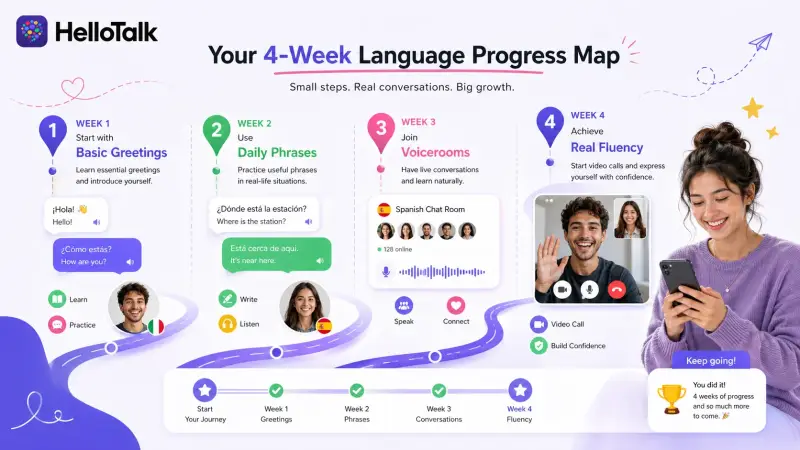
Frequency you can sustain matters more than any single session's length, and the realistic timelines for learning Spanish for daily conversation are shaped by how regularly produced Spanish meets real listeners. A practice arrangement like the one below shows one example of phasing these stages over time; treat it as a sample rhythm to adapt, not a schedule that promises a result.
HelloTalk as the practice venue
Everything in this flow assumes somewhere to run it, and that is HelloTalk's job here, in the roles covered section by section above. HelloTalk offers free core features, and no feature promises that a particular partner is online or will reply, which is why the flow is built from moves you control.
FAQ
How much Spanish do I need before my first conversation?
Less than it feels like: choose one very small, controlled topic scope you can already half-say, and keep the first exchange inside it. If replies arrive, they become study material tied to your own sentences, so a larger vocabulary is not a prerequisite for starting.
What should I say when I do not understand a reply?
Say so in simple Spanish and ask for a slower repetition: "Perdón, ¿puedes repetir más despacio?" is a neutral, standard request. Asking for repetition is a normal conversational move, not an imposition, and a slower repetition, when it comes, is targeted listening practice.
Is text or voice better for practicing conversation?
Text is an easier starting format for many learners because it removes time pressure and leaves a written record of every correction. Voice adds pronunciation and real-time listening once text exchanges stop feeling stressful, and the two can run in parallel with different partners.
How do I keep a conversation from dying after two messages?
End your turns with a small question drawn from the other person's last reply where you can. Follow-up questions signal interest and hand the partner an easy next turn, and partners chosen through shared interests give every exchange a natural supply of topics.
Should I switch to English when I get stuck?
Try one Spanish repair line first, because the stuck moment is exactly what repair practice is for. English stays available as a last resort when communication matters more than practice, but reaching for it at once skips the part of the exchange that repair practice exists for.
How often should I practice talking in Spanish?
Choose a frequency you can actually sustain, and judge it by one condition: each conversation should leave you with real language material to review. Sustainable frequency matters more than any single session's length, since each conversation feeds material into the next.
Talking in Spanish is a flow you can rehearse one stage at a time: prepare small, open easy, sustain with questions, confirm, repair, close warm, review. HelloTalk gives you partners and tools to run that flow for real.