
Language Learning Strategies in 2026: How to Build a Plan That Works
A language learning strategy that works is not a longer list of tips; it is a loop you run. The loop has six steps: define one outcome, diagnose the bottleneck currently blocking it, choose one primary strategy aimed at that bottleneck, pair the strategy with a feedback source, measure a behavior or performance signal, and review the signal to keep, adjust, or replace the strategy.
The loop matters because adding methods does not fix a plan whose methods are aimed at the wrong problem. A learner who cannot follow spoken speed gains little from more grammar drills, and a learner whose errors never get corrected gains little from more input. A strategy pays off when it targets the bottleneck you actually have, and your own recent practice is where that bottleneck shows itself, not a generic method ranking. This article walks the loop, provides a bottleneck-to-strategy table, and shows where feedback and real conversations plug in.
The strategy selection loop
The loop is the plan, so here is each step in one pass. Define an outcome means naming something observable, such as holding a ten-minute conversation about your work, rather than "get fluent." Diagnose the bottleneck means finding the subskill that fails first when you attempt the outcome now: missing words, unparsed listening, sentence construction, or fear of starting at all.
Choose one primary strategy means picking a single practice aimed at that bottleneck and running it until a review point you set in advance. Pair it with feedback means deciding who or what will catch your errors, because unnoticed errors tend to settle into habits. Measure a signal means choosing one observable number or behavior, and review means comparing that signal at the review point and deciding what changes. Then the loop runs again.
Match the strategy to the bottleneck
Diagnosis is the easiest step to skip, so the table below does the matching work. Each row is one observed bottleneck, a strategy worth testing against it, the action to test it implies, the progress signal to watch, and the condition that says adjust. Find the row that matches what fails first in your own attempts, and test that row before any other.
| Observed bottleneck | Strategy to test | Action to test | Progress signal | When to adjust |
|---|---|---|---|---|
| Words vanish when you need them | Retrieval practice over rereading | Recall sessions from prompts, not lists, at a pace you set | Fewer mid-sentence word searches | No movement by the review point you set |
| Studied words fade within days | Spaced review | Small review doses with increasing intervals | Old cards coming back without a struggle | Reviews pile up or feel like pure recognition |
| Real speech is too fast to parse | Comprehensible input at the right level | Listening sessions you can largely follow | Following learner audio without a transcript | Material feels either too easy or opaque |
| You understand but cannot produce | Active production in small doses | Small written or spoken attempts on a schedule you set | Producing basic sentences without drafting first | Attempts stall at the same structures |
| The same errors keep repeating | Feedback on your own output | Corrected exchanges or reviewed attempts | Corrections stop recurring on the same points | The same fix keeps returning |
| Practice never touches real use | Conversation diagnostics | Small real exchanges at a pace you set | Gaps found in conversation entering your study queue | Exchanges feel random and produce nothing to study |
The table is a starting menu, not a verdict: run one row until the review point you set, watch its signal, and let the review step decide what happens next. The last row deserves a closer look, because conversations are not only practice; they double as a diagnostic instrument.
The strategies behind the rows
Each strategy in the table has a plain rationale, stated as what you do rather than as a promise. Retrieval practice asks you to pull language out of memory instead of re-reading it, and spaced review times each pass so older material comes back just as it starts to fade. Comprehensible input keeps listening at a level you can parse, and active production practices turning recognition into your own sentences.
For the input row, HelloTalk's Voicerooms and Livestreams are one concrete source: group audio at real speed that you can join as a listener first. The listening stays at conversation pace while nothing depends on your reply.
None of these is a ranking, and this article deliberately does not crown a best method. A full comparison of the method families themselves, what each trains and what to pair it with, lives in the guide to the best ways to learn a language in 2026; this article assumes those categories and focuses on choosing among them for your bottleneck.
Two neighboring questions have their own answers elsewhere. For learners at the very start, before any bottleneck has appeared, the cold-start question of what a language learner should study first is covered separately, and a broader tour of proven techniques is collected in language learning strategies that actually work.
Feedback: the step that makes every strategy safer
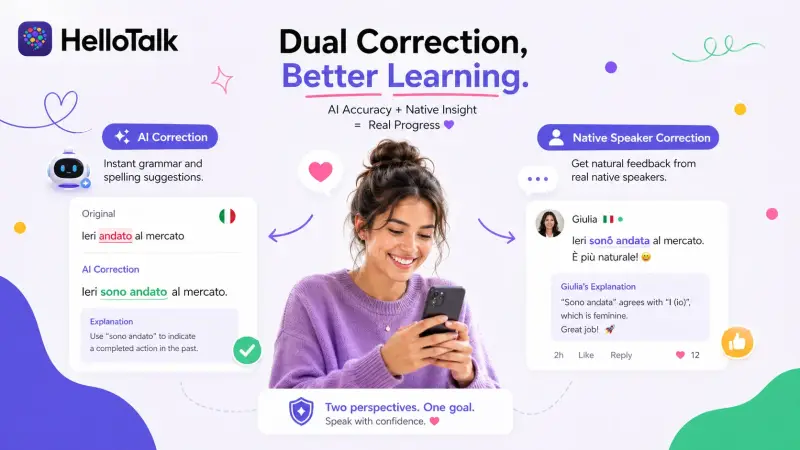
Pairing every strategy with feedback is the loop's insurance policy. Errors that nobody catches tend to get rehearsed into habits as they repeat, which is why a production strategy without a correction source can quietly trade accuracy for fluency. Feedback can come from a corrected exchange, an AI check on a written attempt, or a partner marking up your sentence, and the requirement is only that it lands close to the attempt.
Inside HelloTalk, corrections are one of the chat's built-in aids, alongside translation and pronunciation support. A corrected sentence and its fix stay together in the thread where the exchange happened, which keeps the feedback close to the attempt.
Two of HelloTalk's AI apps, available under the same account, can serve as feedback sources you run without a partner: SpeakUp AI returns pronunciation scores and corrections, and AI Grammar provides feedback with explanations on written attempts. HelloTalk's separate AI-powered visual translation feature is a reference aid for real-world text, not a source of output feedback. What real exchanges still supply is the context judgment no automated tool gives: whether a correct sentence is also the natural one.
Feedback also powers the review step, because corrections are data about where you stand. A correction that recurs is a bottleneck announcing itself, and a correction that stops recurring is a progress signal you can read directly.
Let real conversations feed the plan
Real conversations deserve a named place in the loop because the diagnostic data they carry is tied to your own sentences, not to an average learner. A real exchange can expose a concrete gap tied to the exact sentence you produced, which is the kind of bottleneck candidate the diagnose step runs on. A short capture habit keeps that material from evaporating.
The full method for how to turn conversation gaps into a study queue covers the capture, sorting, and follow-through, so this plan only needs its output: a personally prioritized list feeding the diagnose step. Conversations can enter the loop early, and the case for learning through conversation before you know much shows how small a useful exchange can be.
HelloTalk's Moments feed keeps the entry cost of those exchanges low: post an attempt publicly, and native speakers who see it can respond or correct it on their own time. Whatever comes back is candidate material for the queue.
HelloTalk in the loop
HelloTalk's place in this plan is the pair of inputs the loop cannot generate on its own: real exchanges and feedback close to the attempt, in the roles described section by section above. HelloTalk connects 70M+ registered users across 260+ languages, and HelloTalk offers free core features. The pool describes reach, not a promise that a specific partner is online or will reply, which is one more reason the loop measures your own signals rather than anyone else's activity.

Review and adjust without restarting
The review step is what separates a plan from a pile of habits, and it works as a small fixed ritual. At each review point you set, compare the signal you chose against where it started, in one honest sentence. If the signal moved, keep the strategy and consider raising the difficulty; if it did not, change one variable, the level, the dose, or the feedback source, before abandoning the strategy entirely.
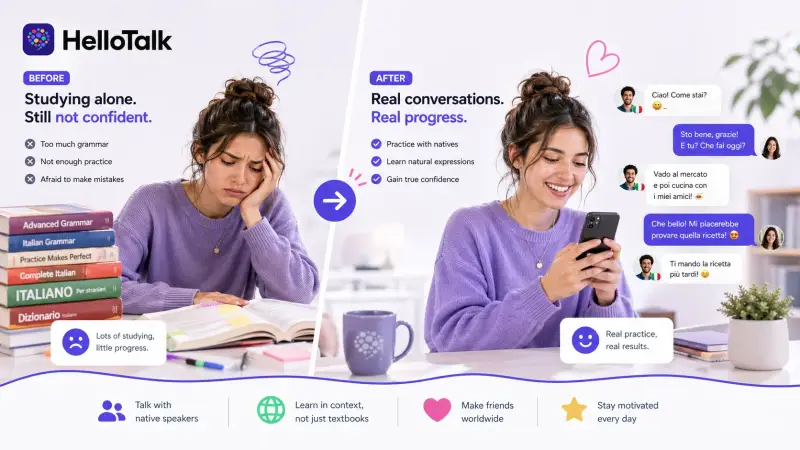
Adjusting one variable at a time keeps a plan readable, while replacing the whole routine at once hides what was working. Motivation follows the same logic: plans lean on visible signals and real human contact rather than willpower, which is one more reason to keep at least one row of the table pointed at real people.
FAQ
What is the difference between a method and a strategy?
A method is a type of practice, such as spaced review or comprehensible input, while a strategy is a method deliberately aimed at a diagnosed bottleneck, paired with feedback, and measured for a fixed period. The same method can be a good strategy for one learner and a poor one for another, depending on the bottleneck.
How do I find my bottleneck if everything feels weak?
Attempt your target outcome once, badly, and watch what fails first: a missing word, an unparsed reply, a sentence you could not build, or the courage to start. The first failure point is your working diagnosis, and a small real exchange can make it concrete.
How long should I test one strategy before judging it?
Set a review point in advance and hold to it; the right distance depends on the strategy and your schedule. Deciding it in advance lets the review step compare the signal against a known baseline instead of a feeling.
Can I run several strategies at once?
Keep one primary strategy per bottleneck, plus the background habits you already sustain, such as a small review habit. Testing several new strategies simultaneously makes the review step unreadable, because you cannot tell which change moved the signal.
Do I need talent to make a plan work?
Learners differ in pace, and no plan controls anyone's personal speed. What a plan does control is which signal you record, when you review it, and which single variable you change at a time, so honest plans promise direction and adjustment rather than identical timelines.
What role should AI tools play in a strategy?
AI checks return feedback on demand for written and spoken attempts, which makes them a natural pairing for production strategies. Real people add what AI does not: unpredictable replies, cultural phrasing, and the judgment that a correct sentence sounds unnatural, so a mature plan uses both.
A plan that works is a loop you can name: outcome, bottleneck, one strategy, feedback, signal, review. Point at least one part of that loop at real people, and HelloTalk is where the loop can meet real exchanges and feedback.